Hedgerows
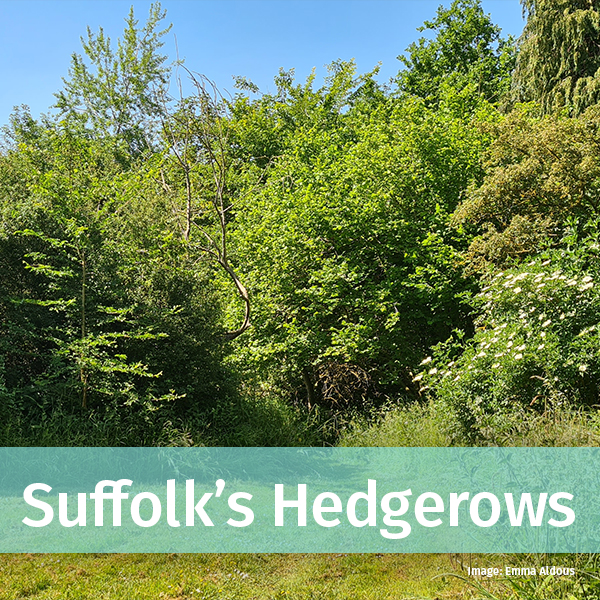
Hedgerows are the defining feature of the Suffolk farmed landscape. Managed boundaries of shrubs and trees, maintained by centuries of cutting, laying and grazing, they function simultaneously as stockproof barriers, wildlife corridors, nesting habitat, foraging ground and connectivity infrastructure for species ranging from bats to Hazel Dormouse to Turtle Dove. Suffolk’s most ecologically important hedgerows – ancient boundaries with a diverse mix of native shrub species, mature hedgerow trees, continuous dense bases and associated ditches and grass margins – support communities of birds, invertebrates, fungi and lichens that cannot be recreated by planting alone.
Defining features
- A boundary of trees or shrubs over 20 metres long and less than five metres wide, with gaps of no more than 20 metres between individual woody plants.
- Banks, walls, ditches and herbaceous vegetation within two metres of the centre of the hedgerow are considered part of the habitat.
- Climbers such as Honeysuckle and Bramble are an important component, but woody plants must be present to form a distinct woody boundary feature.
- The age and species diversity of a hedgerow are indicators of its ecological quality: ancient hedgerows with many native shrub species, mature standard trees, a continuous dense base, and an associated ditch and grass margin are the most valuable.
Importance for wildlife
Hedgerows perform a function in the landscape that no other habitat type fully replicates: they connect isolated habitat fragments, enabling species to move through an otherwise inhospitable agricultural matrix in ways that would be impossible across open arable fields. For bats, they provide linear foraging routes and commuting corridors between roosts and feeding areas; for Hazel Dormouse, a network of connected hedgerows is essential for dispersal and gene flow between populations; for farmland birds, they provide nesting cover, a winter food supply of berries and seeds, and shelter from predators and weather. A single well-structured hedgerow with a tall, wide canopy, a dense base, mature trees, and an adjacent grass margin can support breeding territories for a dozen or more bird species simultaneously.
The structural diversity of a hedgerow – its height, width, species composition, age and management history – determines which species it supports. Some birds favour low, dense hedgerows with wide grass margins for ground-nesting; others, including Lesser Spotted Woodpecker and Spotted Flycatcher, depend on mature hedgerow trees with cavities and old bark. Mature and dying hedgerow trees support invertebrates, fungi and lichens, and deadwood at the hedgerow base provides habitat for Stag Beetle larvae. The hedgerow base and adjacent margin are used by reptiles, amphibians and small mammals for foraging, basking and shelter. A landscape with a variety of hedgerow types at different stages of management is far richer in total species diversity than one managed to a uniform standard throughout.
Important associated species
Species marked * are Suffolk Priority species. Species marked ** are Priority – Research Only: common and widespread, but rapidly declining.
- Beetles
- Birds
Bullfinch, Corn Bunting, Song Thrush, Dunnock, Starling, House Sparrow, Cuckoo, Lesser Redpoll, Lesser Spotted Woodpecker, Spotted Flycatcher, Marsh Tit, Willow Tit, Tree Sparrow, Grey Partridge, Turtle Dove *, Linnet, Yellowhammer, Reed Bunting
- Butterflies
White-letter Hairstreak (elm trees)
- Ferns and Flowering Plants
- Fungi and Slime Moulds
- Lichens
Bacidia incompta (mainly on elm, sometimes ash, holly, beech, sycamore and hornbeam), Orange-fruited Elm Lichen (on mature elm and sycamore), Caloplaca virescens
- Mammals
Brown Hare, Hazel Dormouse, Harvest Mouse, Hedgehog, Water Shrew *, Barbastelle, Daubenton’s Bat *, Brandt’s Bat *, Common Pipistrelle *, Soprano Pipistrelle, Natterer’s Bat *
- Moths
Sloe Carpet, Horehound Longhorn, Barberry Carpet, Grey Dagger**, Brown-spot Pinion**, Centre-barred Sallow**, Figure of Eight**, Dusky Thorn**, August Thorn**, Dot Moth**, Pale Eggar**, Dusky Lemon Sallow** (elms)
- Other Invertebrates
- Reptiles and Amphibians
Common Lizard, Grass Snake, Slow-worm, Great Crested Newt, Common Toad
Factors affecting this habitat in Suffolk
- Removal of hedgerows for agricultural expansion or building development, which permanently reduces the extent of this habitat and fragments the landscape network that wildlife depends on for movement.
- Inappropriate cutting regimes – too frequent, too severe or at the wrong time of year – leading to a decline in structural diversity, loss of berry and blossom production, the development of gaps and a reduction in the range of species the hedgerow can support.
- Lack of management, allowing hedgerow trees to grow unchecked until the hedge gaps beneath them, or the hedgerow to become rank and structurally uniform.
- Failure to replace trees lost to disease, age or storm damage, progressively reducing the mature tree component and the associated communities of invertebrates, fungi and lichens it supports.
- Agricultural activity too close to hedgerows, including ploughing up to the hedgerow base that damages tree roots, and inappropriate ditch management that lowers surrounding water tables.
- Application of herbicides, pesticides and fertilisers close to hedgerow margins, leading to nutrient enrichment and a decline in plant diversity in the associated grass margin and hedgerow base.
Habitat management advice
- Maintain a variety of hedgerow types across the farm or estate, including hedgerows at different heights, widths and stages of management, to support the greatest breadth of species. Tall, wide hedgerows support different species from short, tight ones; both are valuable.
- Maintain continuous, dense bases with adjacent uncut grass margins. A dense base prevents predator access to nesting birds; the grass margin provides foraging habitat for small mammals, reptiles and invertebrates and a buffer against agricultural inputs.
- Cut hedges on a two to three-year rotation rather than annually. Annual cutting prevents flowering, fruiting and the development of structural complexity. Where resources allow, cut some hedges on a two-year rotation and others on a three-year rotation to maximise berry and blossom production across the landscape over time.
- Cut between October and February only, outside the bird nesting season. Where possible, aim to cut some hedgerows in January or February – leaving the berry crop available through autumn and early winter – and others in October, to avoid destroying moth and butterfly eggs laid on hedge shrubs in late summer.
- Retain deadwood at the hedgerow base – stumps, roots and fallen timber – for Stag Beetle larvae and other saproxylic invertebrates. Do not remove old or dying hedgerow trees unless there is a clear safety reason.
- Replace lost trees by planting locally sourced native species appropriate to the hedgerow’s character – Field Maple, Pedunculate Oak, Ash and Black Poplar where appropriate – to maintain continuity of the mature tree component.
- Restore lost hedgerows by replanting locally sourced native shrubs, preferably on the lines of former hedges identified from historical maps. New hedgerows should include hedgerow trees from planting to provide structural diversity more quickly.
- Use agri-environment scheme options – currently through Countryside Stewardship and the Sustainable Farming Incentive – to fund hedgerow management and restoration. Note that the felling of hedgerow trees may require prior approval from the Forestry Commission.
Ancient and species-rich hedgerows
The oldest hedgerows in Suffolk are among the most ecologically significant linear habitats in the county. Hooper's Rule – which estimates hedgerow age in centuries by counting the number of native woody species in a 30-metre length – typically gives ages of several hundred years for the most diverse Suffolk hedgerows, and some boundary features on the boulder clay plateau may follow parish or estate boundaries that predate the Norman Conquest. However, modern hedgerow planting practice has, over the past three or four decades, tended towards using a mix of native species from the outset, meaning that a recently established hedge can accumulate a species count that Hooper's Rule would otherwise associate with considerable age. The rule is best used alongside other dating techniques, such as old maps, local history, study of field patterns, and other flora present in the hedge, rather than in isolation. The method can be off by a couple of centuries even under favourable conditions. Ancient, species-rich hedgerows are protected under the Hedgerow Regulations 1997, administered by the Local Planning Authority, and their removal requires prior notification. Species-rich hedgerows containing five or more native woody species within 30 metres, or those associated with ancient woodland, veteran trees or archaeological features, are likely to qualify for protection. The Hedgerow Regulations guidance explains how to determine whether a hedgerow qualifies.
Vision for Suffolk
The following priorities reflect the strategic goals for hedgerows in Suffolk, drawing on both the Biodiversity Action Plan framework and the Local Nature Recovery Strategy.
- Improve knowledge of the extent and condition of hedgerows across the county, including unrecorded ancient and species-rich examples.
- Maintain the existing extent of hedgerows to ensure no net loss, and strengthen the protection of species-rich and ancient hedgerows through the planning system.
- Re-create hedgerows where opportunities arise, prioritising connections between existing hedgerow networks and the restoration of former boundaries identified from historical maps.
- Encourage the restoration and improvement of degraded hedgerows, particularly through the reinstatement of appropriate cutting rotations and the retention or replacement of hedgerow trees.
Further information
- Buglife – Advice on managing ancient and species-rich hedgerows
- Buglife – Notable invertebrates associated with ancient and species-rich hedgerows (PDF)
- Farm Wildlife – Farmwildlife.info
- Hedgelink – Management of hedgerows
- Hedgerow Regulations 1997 – Countryside hedgerows: regulation and management
- JNCC – Habitat description: Hedgerows (PDF)
- MAGIC – Interactive mapping including designations
- Sanford, M. and Fisk, R. (2010) A Flora of Suffolk. D.K. and M.N. Sanford
- Suffolk Wildlife Trust – Habitats Explorer: Hedgerow
- Making Space for Nature – Lawton Review, Defra, 2010 (PDF, historical reference)
- The Natural Choice: Securing the Value of Nature – Natural Environment White Paper, 2011 (PDF, historical reference)
Suffolk’s Farmed Landscape and Wider Countryside Habitats
Key
A conservation priority in Suffolk’s Historic Biodiversity Action Plan.
A key habitat for recovery under Suffolk’s Local Nature Recovery Strategy.




Hedgerows are primarily a part of the Farmed Landscapes and Wider Countryside habitat group, but also feature in these habitat groups: Woodland, River and Riverside, Scrub and Mosaic, Non-Woodland Trees and Urban, Built and Garden.
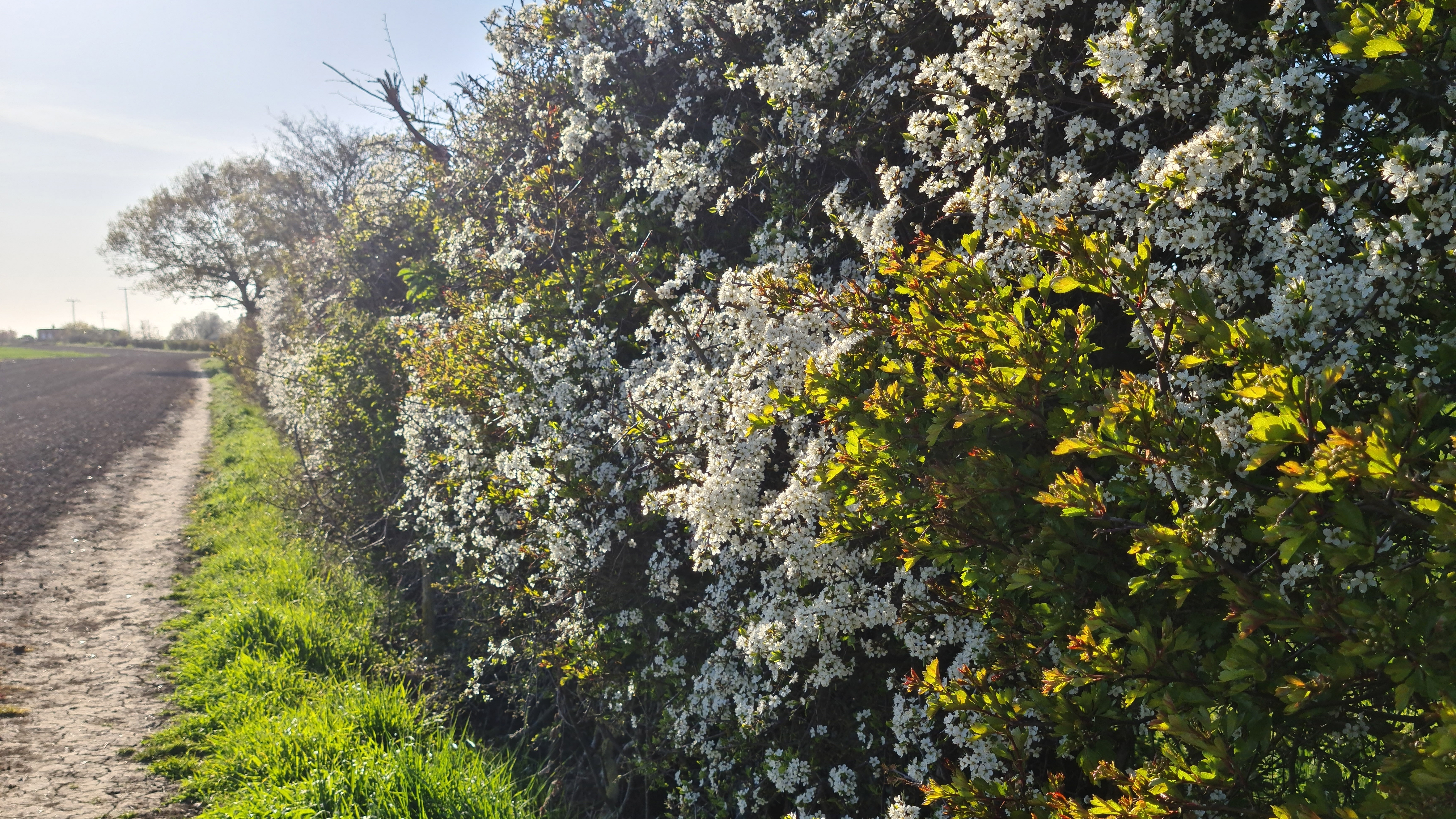
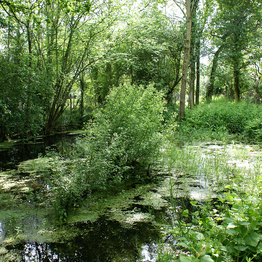
Image: Springtime hedge and ditch © Emma Aldous
 Archived Habitat Factsheet (PDF, 2020) Superseded – provided for reference only.
 Archived Suffolk BAP action plan (PDF, 2004) Superseded – provided for reference only.