
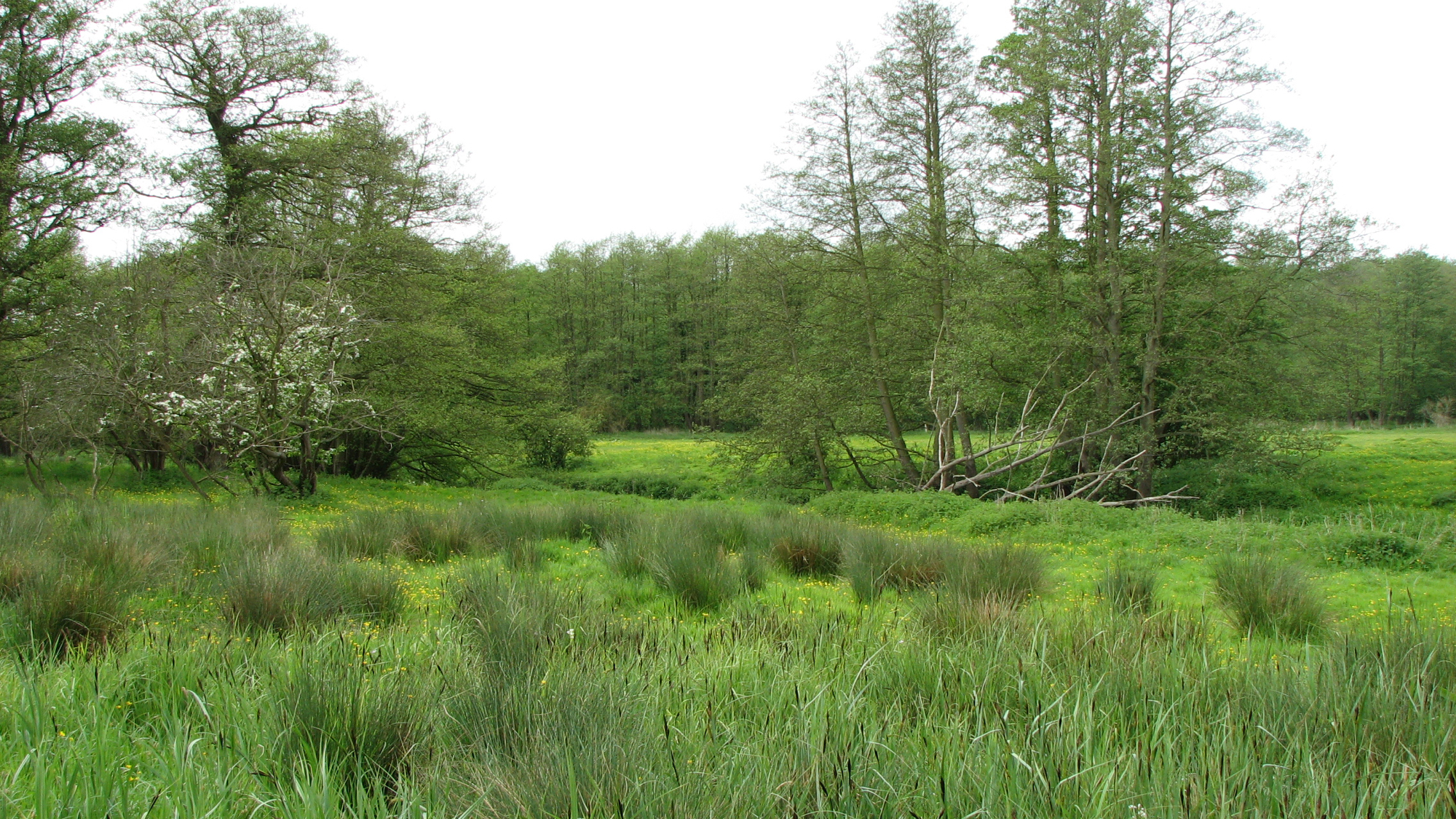
Wet Woodland
Wet woodland develops on poorly drained or seasonally waterlogged soils – in river valleys, flood plains, bog margins, lakesides and peaty hollows – where fluctuating water tables prevent the establishment of drier woodland types. Dominated by alder, willows and downy birch, with ash and oak on slightly drier ground at the margins, these are inherently dynamic habitats shaped by periodic flooding and the slow accumulation of organic material. Suffolk’s wet woodlands are concentrated in the river valleys of the Waveney and Little Ouse and across the Suffolk Broads, where they form some of the most structurally complex and species-rich woodland communities in the county.
Defining features
- Occurs on poorly drained or seasonally waterlogged soils, typically in river valleys, floodplains, lakesides, flushes, and peaty hollows.
- Alder, grey willow and downy birch are the predominant tree species; ash, oak, pine and beech may be present on slightly drier ground at the margins.
- Ground flora characterised by moisture-tolerant species including Common Reed, Greater Tussock Sedge, Purple Moor-grass, Marsh Marigold and Opposite-leaved Golden Saxifrage.
- Periodic flooding is a normal part of the ecological cycle to which the habitat and its associated communities are adapted.
- Contains a range of National Vegetation Classification (NVC) stand types; see technical note below.
Importance for wildlife
Wet woodland supports a distinctive, often highly specialised community of species largely absent from drier woodland types. The waterlogged conditions promote the development of sphagnum and other mosses, and the frequent presence of standing and fallen deadwood in or adjacent to water creates micro-habitats of exceptional value for invertebrates, fungi and bryophytes. The structural complexity typical of undisturbed wet woodland – multiple canopy layers, open water features, dense understorey and a rich ground flora – provides a range of conditions that few other habitats can match.
Wet woodland is particularly important for bats, which roost in cavities and forage along the woodland edge and over open water. Daubenton’s Bat is closely associated with rivers and pools within or adjacent to wet woodland, while Natterer’s Bat forages extensively through the understorey. Otter and Water Shrew are strongly associated with the waterways running through or alongside wet woodland blocks. Specialist birds, including Willow Tit, Marsh Tit and Lesser Spotted Woodpecker, rely on the standing deadwood and dense scrubby growth that characterise well-structured examples of the habitat.
Important associated species
Species marked * are Suffolk Priority species. Species marked ** are Priority – Research Only: common and widespread, but rapidly declining.
- Beetles
Alder Flea Weevil, Sallow Guest Weevil
- Birds
Cuckoo, Lesser Spotted Woodpecker, Marsh Tit, Willow Tit, Siskin, Lesser Redpoll
- Ferns and Flowering Plants
Native Black Poplar *, Common Marsh-bedstraw, Common Reed, Purple Moor-grass, Greater Tussock Sedge, Opposite-leaved Golden Saxifrage, Marsh Marigold
- Flies
- Mammals
Water Shrew *, Brown Long-eared Bat, Daubenton’s Bat *, Common Pipistrelle *, Nathusius’ Pipistrelle *, Soprano Pipistrelle, Natterer’s Bat *, Noctule, Serotine, Otter
- Moths
Concolorous, Minor Shoulder-knot, Small Square-spot **, Oblique Carpet **, Powdered Quaker **
Factors affecting this habitat in Suffolk
- Loss of woodland through restoration to other conservation land uses, such as fen or reedbed, which – while valuable in their own right – reduces the overall extent of wet woodland.
- Poor or absent management, leading to changes in canopy structure, uncontrolled scrub invasion, a lack of regeneration and a decline in structural and species diversity.
- Unusual or extreme flooding events that degrade water quality and alter the composition of plant and animal communities. Periodic flooding is a normal part of the habitat’s ecological cycle; it is sustained or polluted flooding that causes harm.
- Colonisation by invasive non-native species, particularly Himalayan Balsam, can suppress native ground flora and alter habitat structure.
- Removal of moss-covered trees, deadwood, hollow trunks and old or diseased trees, which destroys micro-habitats of high value for specialist invertebrates, fungi and cavity-nesting species.
- Water pollution and nutrient enrichment from agricultural run-off damage water quality and shift plant community composition towards rank, nutrient-demanding species.
- Water abstraction and drainage works that lower the water table, reducing or eliminating the wet conditions on which the habitat depends.
Habitat management advice
- Maintain the natural character of the woodland wherever possible; avoid sudden or drastic modifications to structure, hydrology or species composition.
- Leave wet features – streams, pools, ditches and flushes – undisturbed wherever practicable. These are disproportionately valuable for specialist invertebrates, amphibians and foraging bats.
- Retain deadwood in all its forms: standing dead trees, fallen trunks, rot holes and moss-covered timber in and around water. Do not remove old, hollow or diseased trees unless there is a clear safety requirement.
- Manage woodlands in accordance with the UK Forestry Standard, which provides guidance appropriate to semi-natural woodland types.
- Control invasive non-native species – particularly Himalayan Balsam – through targeted management, prioritising watercourse margins where spread is most rapid.
- Note that felling of wet woodland trees may require approval from the Forestry Commission.
Technical note: National Vegetation Classification
The National Vegetation Classification (NVC) is a common standard developed for nature conservation, providing a comprehensive, systematically named classification of Britain’s plant communities. The following NVC stand types are found in Suffolk’s wet woodlands:
- W1 – Grey willow – common marsh-bedstraw woodland (Salix cinerea – Galium palustre)
- W2 – Grey willow – downy birch – common reed woodland (Salix cinerea – Betula pubescens – Phragmites australis)
- W4c – Downy birch – purple moor-grass woodland, Sphagnum sub-community (Betula pubescens – Molinia caerulea)
- W5 – Alder – greater tussock sedge woodland (Alnus glutinosa – Carex paniculata)
- W6 – Alder – common nettle woodland (Alnus glutinosa – Urtica dioica)
These stands occur as successional habitats on flood plains, fens and mires, along rivers and streams, beside flushes and in peaty hollows. Wet woodlands on the boulder clay of Suffolk tend to be classified as ash – field maple – dog's mercury woodland (Fraxinus excelsior – Acer campestre – Mercurialis perennis, W8) and are not covered by this factsheet.
Vision for Suffolk
The following priorities reflect the strategic goals for wet woodland in Suffolk, drawing on both the Biodiversity Action Plan framework and the Local Nature Recovery Strategy.
- Improve knowledge of the extent and condition of wet woodland across the county.
- Maintain the existing extent of wet woodland to ensure no net loss.
- Re-create wet woodland where opportunities arise, particularly in association with river valley restoration and fen edge habitats.
- Encourage the restoration and improvement of degraded wet woodland, including sites where hydrology has been compromised or invasive species have become established.
Further information
- Buglife – Advice on managing BAP habitats
- Forest Research – The management of semi-natural woodlands
- JNCC – Habitat description: Wet Woodland (PDF)
- JNCC – The National Vegetation Classification (NVC)
- MAGIC – Interactive mapping including designations
- Peterken, G.F. (1981) Woodland Conservation and Management. London: Chapman and Hall
- Rackham, O. (1980) Ancient Woodland. London: Arnold
- Suffolk Wildlife Trust – Habitats Explorer
- Woodland Trust – Wet Woodland
- Making Space for Nature – Lawton Review, Defra, 2010 (PDF, historical reference)
- The Natural Choice: Securing the Value of Nature – Natural Environment White Paper, 2011 (PDF, historical reference)
Suffolk’s Woodland Habitats
Key
A conservation priority in Suffolk’s Historic Biodiversity Action Plan.
A key habitat for recovery under Suffolk’s Local Nature Recovery Strategy.



Wet woodland is primarily a part of the Woodland habitat group, but also features in these habitat groups: Farmed Landscapes and Wider Countryside, Fen, Reedbed and Wetland and River and Riverside.
Image: Alder Carr at Syleham Road
 Archived BAP action plan, 2007 (PDF) Superseded – provided for historical reference only.
 Suffolk BAP action plan for Wet Woodland (PDF, 2007)