
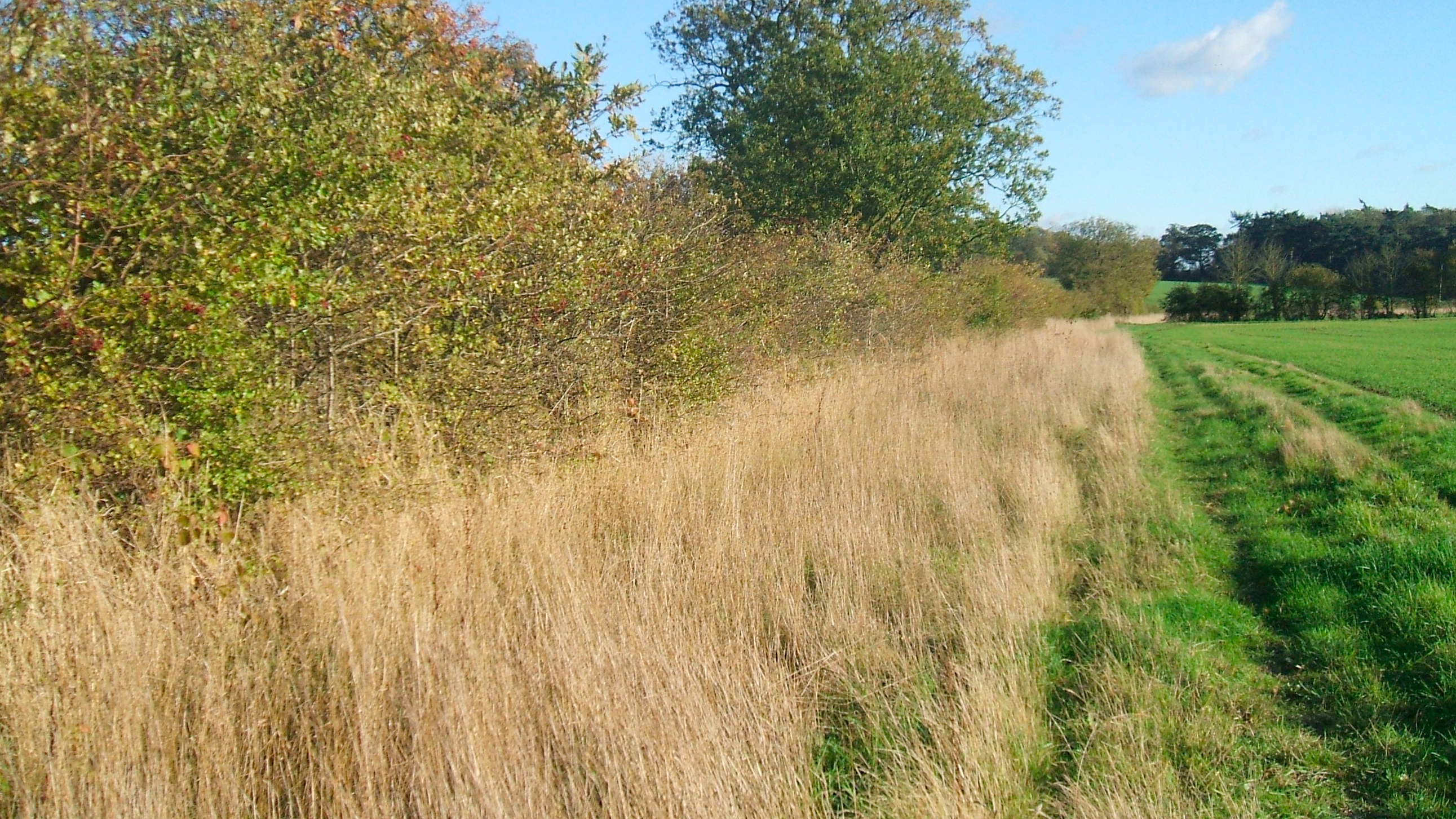
Arable Field Margins
Arable field margins – the herbaceous strips managed between a crop and the field boundary – are the primary interface between intensive farmland and the wider countryside, and one of the most cost-effective habitats for farmland wildlife in the landscape. Up to 75% of the biodiversity within an arable field is concentrated in the margins, regardless of the farming system in the cropped area. In a county where arable cultivation dominates the land use, well-managed field margins provide the nesting sites, food supply, overwintering habitat and connectivity that farmland birds, invertebrates and small mammals depend on throughout the year. Suffolk has nationally important populations of several declining farmland species – including Corn Bunting, Turtle Dove, Grey Partridge, Stone Curlew and Lapwing – whose recovery is directly linked to the quality of management in field margins across the county.
Defining features
- Herbaceous strips between an arable crop and the field boundary, managed specifically to provide benefits for wildlife. The strip may be cropped on a conservation headland regime, left uncropped and cultivated, managed as temporary grassland or as more permanent tussocky grassland.
- Margins link farmland habitats together across the landscape and buffer sensitive habitats – including hedgerows, watercourses and ancient grassland remnants – against the effects of crop management operations.
- Help to reduce diffuse pollution by intercepting run-off from the cropped area before it reaches field boundaries, ditches and watercourses.
- Vary considerably in ecological value depending on their width, management, floristic composition, position in the landscape and the nature of the adjacent boundary feature.
Importance for wildlife
Field margins provide a suite of ecological functions that the cropped area cannot deliver: nesting cover for ground-nesting birds including Skylark, Lapwing and Grey Partridge; hunting habitat for Barn Owl and other raptors; overwintering refugia for the invertebrates and spiders that move out of the crop after harvest; foraging and seed sources for buntings, finches and sparrows through the autumn and winter; and pollen and nectar for bees and hoverflies during the spring and summer. The value of any individual margin depends on these functions being combined across a farm or landscape; a single beetle bank or wildflower strip, however well managed, is far less effective than a network of complementary margin types designed to sustain populations of target species through the whole year.
Rare arable plants are among the most important beneficiaries of field margin management in Suffolk. The county retains a nationally significant concentration of rare and declining arable archaeophytes – plants that arrived with Neolithic and Bronze Age farming and have persisted in disturbed, cultivated ground ever since. Species including Corn Buttercup, Shepherd’s Needle, Spreading Hedge-parsley, Cornflower and, in the Brecks, Grape Hyacinth, Fingered Speedwell and Basil Thyme are among the most threatened plants in Britain and depend on lightly cultivated, low-input field margins for their survival. Many cannot establish in undisturbed grassland and require the periodic disturbance that cultivated margins provide.
Important associated species
Species marked * are Suffolk Priority species.
- Ants, Bees and Wasps
Brown-banded Carder Bee, Large Garden Bumblebee, Red-shanked Carder Bee
- Beetles
Necklace Ground Beetle, Brush-thighed Seed-eater, Stag Beetle
- Birds
House Sparrow, Stone Curlew *, Woodlark *, Corn Bunting *, Tree Sparrow, Grey Partridge *, Yellow Wagtail *, Turtle Dove *, Linnet, Skylark *, Yellowhammer, Bullfinch, Reed Bunting, Barn Owl *
- Ferns and Flowering Plants
Basil Thyme, Red Hemp-nettle, Grape Hyacinth, Fingered Speedwell, Annual Knawel, Corn Buttercup, Cornflower, Fine-leaved Sandwort, Shepherd’s Needle (boulder clay areas), Small-flowered Catchfly, Spreading Hedge-parsley, Red-tipped Cudweed, Broad-leaved Cudweed
- Liverworts and Mosses
- Mammals
Harvest Mouse, Hedgehog, Brown Hare, Common Pipistrelle *, Soprano Pipistrelle
- Moths
Grey Carpet (Brecks), Pale Shining Brown, Four-spotted Moth
- Reptiles and Amphibians
Factors affecting this habitat in Suffolk
- Intensive arable production involving high inputs of herbicides and insecticides, which reduce both the diversity of flowering plants in and adjacent to margins and the invertebrate populations that farmland birds depend on for chick food during the breeding season.
- The shift to autumn-sown winter cropping, which has reduced the availability of spring-sown fields and winter stubbles that previously provided a critical seed food supply for seed-eating birds through the winter months. Corn Bunting, Yellowhammer and Tree Sparrow all declined sharply as winter stubbles became scarce from the 1970s onwards.
- The reduction of grass leys in the rotation with arable crops, which removed a diverse sward component from the farmed landscape and reduced the structural complexity available to ground-nesting birds and invertebrates.
- Loss of margin width and quality to ploughing, cultivation right to the hedge base and the application of fertilisers and herbicides into the margin strip.
Habitat management advice
Maintaining a mosaic of complementary margin types provides the greatest benefit for the widest range of species. The main options are described below.
Uncropped cultivated margins: Lightly cultivated in spring or autumn to provide habitat for rare arable plants and foraging sites for seed-eating birds. Apply no fertilisers or manures. Use herbicides only as spot treatment or weed-wiper for pernicious weeds; do not broadcast-spray. Particularly important for Breckland arable archaeophytes, including Grape Hyacinth, Fingered Speedwell and Basil Thyme.
Conservation headlands: Provide a food supply and habitat for birds, arable plants and insects within the growing crop at the field edge. Apply no fertiliser or manure before drilling. Apply no insecticides between 15 March and harvest; restrict herbicide use to those that will not eliminate broad-leaved arable plants. Consider leaving the headland unharvested to maintain a seed resource into winter.
Permanent grass margins: Provide varied habitat on arable or grassland farms. Coarse, tussocky grass is an important overwintering habitat for insects and small mammals; finer grass and flowering plants provide nectar, pollen, seed and more open foraging habitat. Field corner management – creating undisturbed, rough grassy areas at corners – provides additional nesting cover for Grey Partridge and other ground-nesters.
Beetle banks: Sown strips of native tussocky grasses created within the cropped area, typically as a raised bank through the centre of a large field. Mow on a two-year rotation and do not spray. Beetle banks provide overwintering shelter for ground beetles and spiders that prey on aphids and other arable pests, and can significantly reduce the need for insecticide applications in adjacent crops.
In-field arable options: A range of additional in-field options can complement the margin network. These include wild bird seed mixture plots, nectar flower mixture plots, Skylark plots (small undrilled patches within cereal crops for nesting), overwintered stubble, low-input cereal and reduced-herbicide cereal. These options are deliverable through Countryside Stewardship and the Sustainable Farming Incentive; contact Natural England or Suffolk FWAG for scheme-specific advice.
Rare arable plants in Suffolk: Suffolk holds a nationally significant concentration of rare arable plants – species that colonised Britain with Neolithic agriculture and have persisted in cultivated ground ever since. Many are now critically endangered nationally, surviving only in the low-input field margins, Breckland cultivation plots and boulder clay arable edges where management has allowed them to persist. Records of rare arable plants – including Corn Buttercup, Shepherd’s Needle, Spreading Hedge-parsley and the Breckland specialities – are among the most valuable farmland species records SBIS holds. If you encounter these species in field margins or at arable edges, please submit your records; targeted management advice can be provided to landowners and farmers for sites where rare arable plants are confirmed.
Vision for Suffolk
The following priorities reflect the strategic goals for arable field margins in Suffolk, drawing on both the Biodiversity Action Plan framework and the Local Nature Recovery Strategy.
- Improve knowledge of the extent and quality of arable field margins across the county, including the distribution of rare arable plants in low-input margins.
- Maintain the existing extent of managed arable field margins to ensure no net loss.
- Increase the area of well-managed field margins, beetle banks and conservation headlands across the Suffolk arable landscape, with particular focus on areas supporting declining farmland birds and rare arable plants.
- Encourage the restoration and improvement of degraded field margins through agri-environment scheme uptake and targeted advice.
Further information
- Buglife – Advice on managing cereal field margins
- Buglife – Notable invertebrates associated with cereal field margins (PDF)
- JNCC – Habitat description: Arable Field Margins (PDF)
- MAGIC – Interactive mapping including designations
- Suffolk FWAG – Farm Wildlife Advisory Group Suffolk
- Suffolk Wildlife Trust – Habitats Explorer: Farmland, Farm Wildlife Advice
- Making Space for Nature – Lawton Review, Defra, 2010 (PDF, historical reference)
- The Natural Choice: Securing the Value of Nature – Natural Environment White Paper, 2011 (PDF, historical reference)
Suffolk’s Farmed Landscape and Wider Countryside Habitats
Key
A conservation priority in Suffolk’s Historic Biodiversity Action Plan.
A key habitat for recovery under Suffolk’s Local Nature Recovery Strategy.




Image: Field margin © Diane Ling
 Archived Habitat Factsheet (PDF, 2020) Superseded – provided for reference only.
 Archived Suffolk BAP action plan (PDF, 2003) Superseded – provided for reference only.