
Wood Pasture and Parkland
Wood pasture and parkland is one of England's most ecologically complex and irreplaceable habitats. Open-grown veteran trees, grazed grassland and the slow accumulation of decaying wood create conditions that support remarkable assemblages of saproxylic invertebrates, specialist fungi, epiphytic lichens, hole-nesting birds and bats. It is the long continuity of management – across centuries rather than decades – that gives these sites their significance. Suffolk has nationally important examples at Staverton Park near Woodbridge, Helmingham Hall and Ickworth, where ancient pollarded oaks carry lichen and invertebrate communities that have developed over hundreds of years and cannot be replicated by planting.
Defining features
- Open grassland or heathland ground vegetation with widely spaced ancient and veteran trees.
- Grazing animals are present; their dung contributes to invertebrate and fungal diversity, and grazing maintains the semi-open structure of the habitat.
- A range of micro-habitats, including hollow trees, rot holes, decaying wood, aging bark, sap runs and fallen but regenerating trees.
- Very long-lived individual trees and a continuity of management that may span several centuries.
Importance for wildlife
Wood pasture and parkland supports an exceptionally wide range of wildlife. The veteran trees are the keystone feature: a single ancient oak in good condition can support over 2,000 invertebrate species, and the specialist communities that depend on progressive wood decay, bark habitats and tree cavities cannot establish themselves except over very long timescales. Saproxylic beetles – species whose larvae develop within decaying wood – are among the most demanding inhabitants, with different species requiring particular forms of decay such as red rot, sap runs and water-filled holes.
Hole-nesting birds benefit from the cavities that develop in old trees, with Woodpeckers, Spotted Flycatcher, tit species and Tree Sparrow all making use of this habitat. Bats roost and breed in crevices and hollows and forage extensively across the open ground and woodland edge; parkland and wood pasture support a greater diversity of bat species than almost any other lowland habitat type. The dung of grazing animals provides a further specialist niche, supporting communities of dung beetles, flies and fungi that have declined steeply with the widespread use of veterinary drugs in livestock.
Important associated species
Species marked * are Suffolk Priority species. Species marked ** are Priority – Research Only: common and widespread, but rapidly declining.
- Beetles
- Birds
Dunnock, Tree Sparrow, Starling, Cuckoo, Hawfinch, Bullfinch, Marsh Tit, Spotted Flycatcher, Turtle Dove, Linnet, Barn Owl *
- Flies
- Fungi and Slime Moulds
Bearded Tooth, Coral Tooth, Orange Chanterelle, Oak Polypore
- Lichens
Anaptychia ciliaris subsp. ciliaris, Bacidia incompta (mainly on elm), Orange-fruited Elm Lichen, Pyrenula nitida
- Mammals
Barbastelle *, Brandt's Bat *, Brown Long-eared Bat, Daubenton's Bat *, Leisler's Bat *, Lesser Horseshoe Bat, Nathusius' Pipistrelle *, Natterer's Bat *, Whiskered Bat *, Common Pipistrelle *, Soprano Pipistrelle, Noctule, Serotine
- Moths
Goat Moth, Knot Grass **, Brown-spot Pinion **, Large Nutmeg **, Dusky Brocade **, Oak Lutestring **, September Thorn **, August Thorn **, Dusky Lemon Sallow **
Factors affecting this habitat in Suffolk
- Inappropriate management leading to the loss of structural and age diversity – in particular, over-tidiness, the removal of deadwood, and intensive grazing that damages tree root zones and suppresses flowering plants.
- The use of veterinary drugs in livestock has caused a significant decline in the invertebrates associated with dung.
- Agricultural practices include ploughing too close to trees, drainage, the application of fertilisers and fungicides to the grassland component, and the destruction of heathland ground vegetation.
- Tree diseases, notably Acute Oak Decline, Ash Dieback and Phytophthora infections, which threaten the veteran tree resource.
- Reduction in nectar-producing shrubs such as Hawthorn, which provide food for emerging insects.
- Fragmentation of habitat and isolation from similar sites limit the movement of specialist species between locations.
- Intensification of neighbouring agriculture, increasing pressure on habitat margins.
Habitat management advice
- Create age diversity through enrichment planting using locally sourced trees appropriate to the site.
- Avoid over-tidying: retain standing and fallen deadwood, sap runs, rot holes, red-rot tree hollows, scrub patches, and leaf-litter cover. These features provide breeding and foraging habitat for specialist beetles, flies and fungi.
- Maintain a suitable but not intensive grazing regime – sufficient to control invasive scrub and sustain a dung supply for invertebrates, but light enough to allow flowering plants and shrubs to persist.
- Retain open, sunny, sheltered areas with nectar-producing plants and shrubs to support invertebrates.
- Manage any waterways or ponds on the site to ensure deadwood is retained within and around them.
- Monitor trees for signs of Acute Oak Decline and report suspected cases, including records of the beetle Agrilus biguttatus, to the relevant authorities.
- Note that felling of wood pasture or parkland trees may require approval from the Forestry Commission.
Site spotlight: Staverton Park and the Thicks, Wantisden
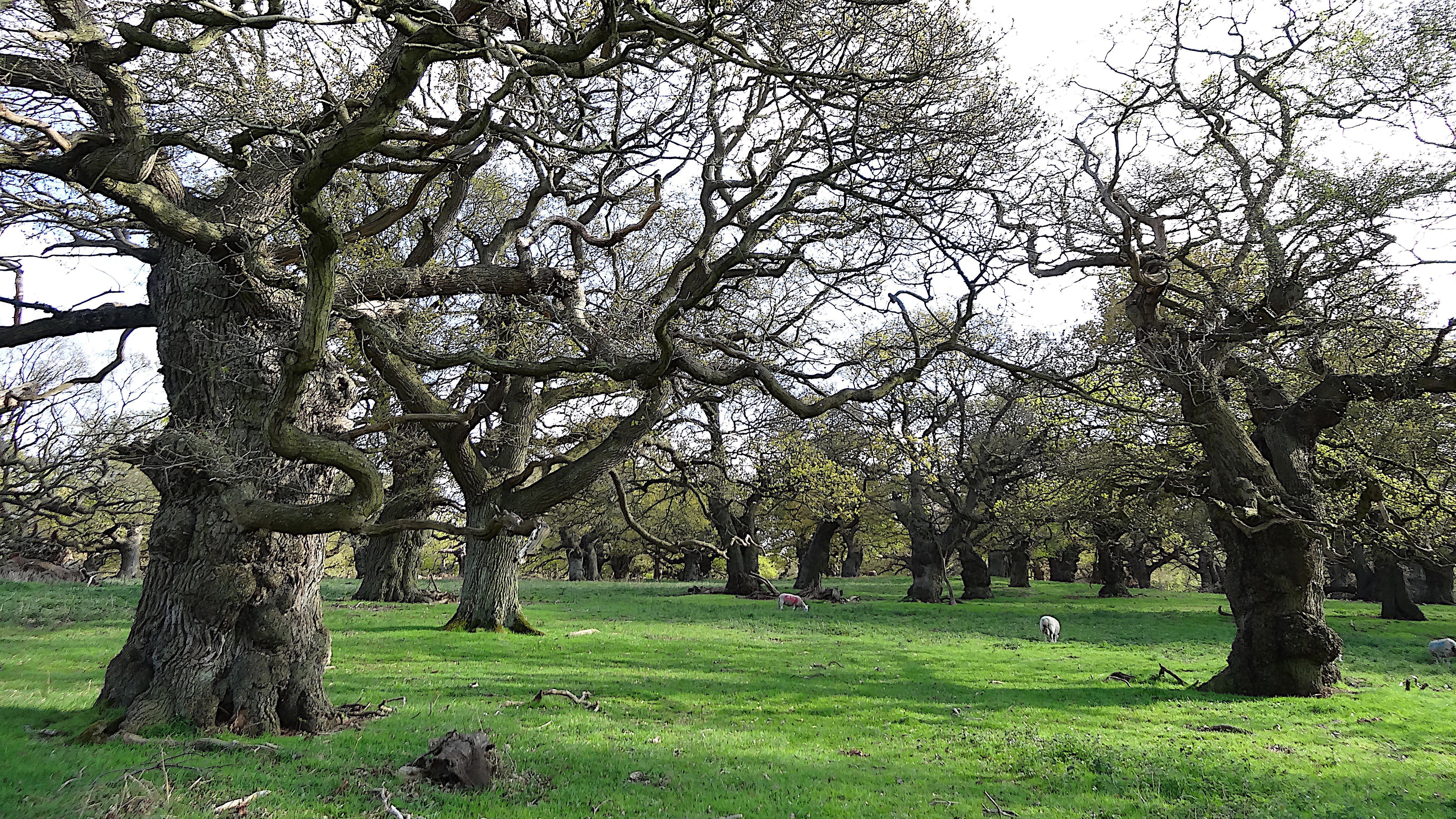
Staverton Park, near Woodbridge, is one of the oldest and most ecologically significant wood pasture sites in England. Once a medieval deer park, it is now dominated by a remarkable grove of ancient pollarded oaks, some dating back to the medieval period, alongside dense holly understorey in the area known as the Thicks. The veteran oaks carry exceptionally rich assemblages of saproxylic invertebrates and epiphytic lichens, including rare and Atlantic species recorded at very few other sites in England. Notable lichens include Haematomma elatinum, Lecidea cinnabarina, Thelotrema lepadinum, Graphis elegans and Stenocybe septata.
Vision for Suffolk
The following priorities reflect the strategic goals for wood pasture and parkland in Suffolk, drawing on both the Biodiversity Action Plan framework and the Local Nature Recovery Strategy.
- Improve knowledge of the extent and condition of wood pasture and parkland across the county.
- Maintain the existing extent of wood pasture and parkland to ensure no net loss.
- Re-create wood pasture and parkland where opportunities arise, particularly in association with existing veteran tree populations.
- Encourage the restoration and improvement of degraded sites, prioritising those with the greatest potential for veteran tree development.
Further information
- Buglife – Advice on managing lowland wood pastures and parklands
- Buglife – Notable invertebrates associated with lowland wood pasture (PDF)
- JNCC – Habitat description: Wood Pasture and Parkland (PDF)
- MAGIC – Interactive mapping including designations
- Suffolk Wildlife Trust – Habitats Explorer
- Making Space for Nature – Lawton Review, Defra, 2010 (PDF, historical reference)
- The Natural Choice: Securing the Value of Nature – Natural Environment White Paper, 2011 (PDF, historical reference)
Suffolk’s Non-Woodland Tree Habitats
Key
A conservation priority in Suffolk’s Historic Biodiversity Action Plan.
A key habitat for recovery under Suffolk’s Local Nature Recovery Strategy.


Wood pasture and parkland are primarily a part of the Non-Woodland Trees habitat group, but also feature in these habitat groups: Farmed Landscapes and Wider Countryside, Grass and Heath and Meadow and Pasture.
Image: Staverton Thicks © Gary Batell
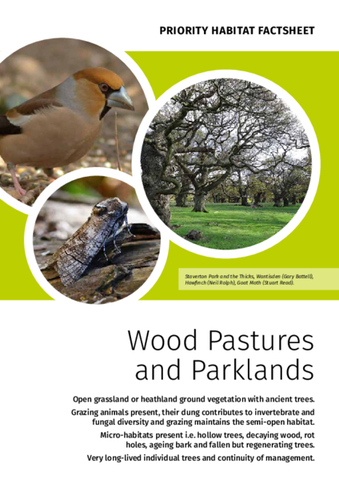 Archived Habitat Factsheet (PDF, 2020) Superseded – provided for reference only.
 Archived Suffolk BAP action plan (PDF, 2007) Superseded – provided for reference only.