
Coastal and Floodplain Grazing Marshes
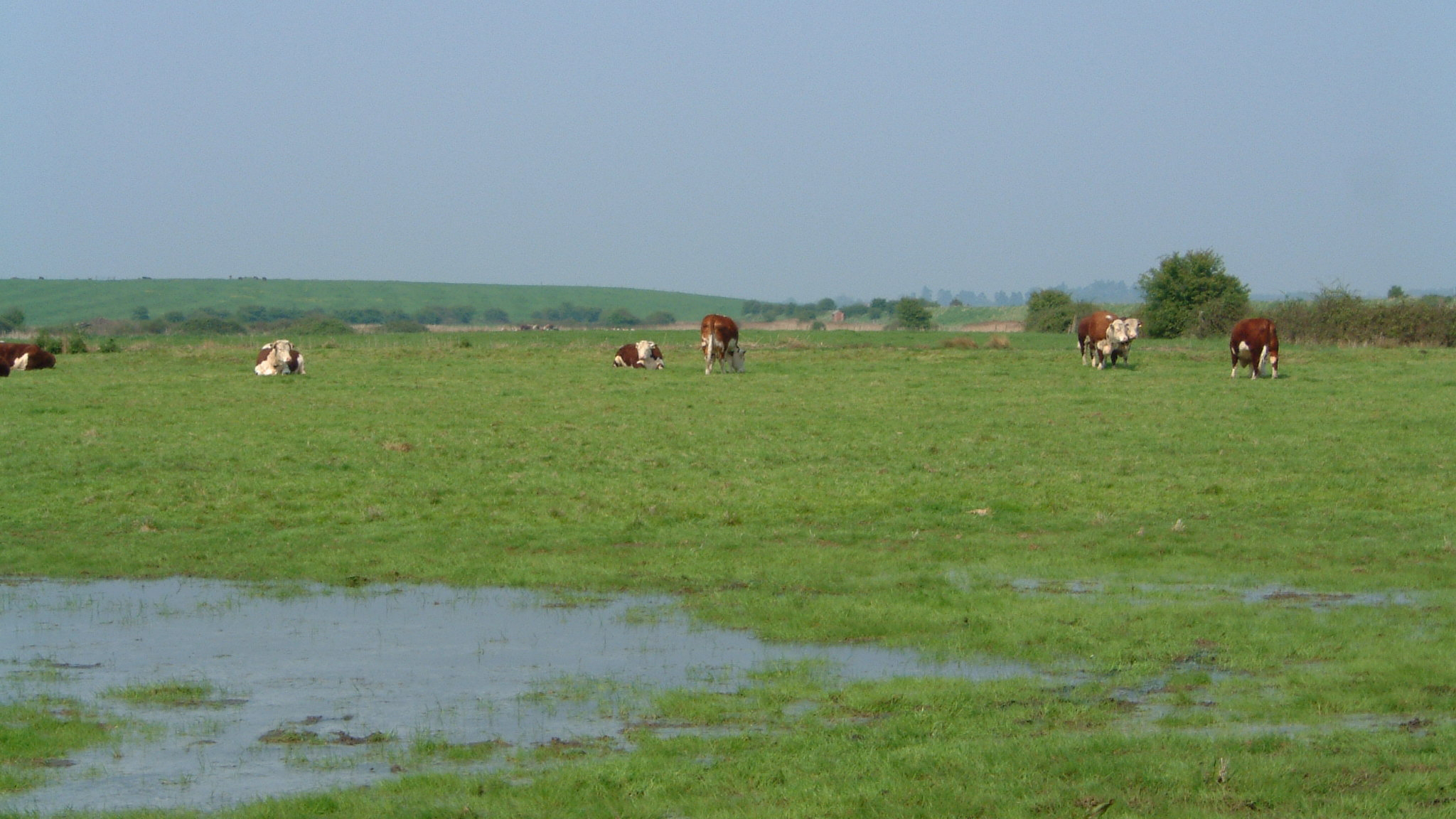
Coastal and floodplain grazing marshes are the most characteristic of all the county’s habitats. Low-lying wet pastures and meadows, bounded by sea walls or river levées and threaded through with a network of ditches, dykes and brackish channels, they form the dominant landscape of the Suffolk coast from Lowestoft to Landguard. Suffolk’s grazing marshes support breeding and wintering populations of waders and wildfowl of international significance, a rich community of aquatic invertebrates in the ditch systems – including several of Britain’s rarest freshwater molluscs – and specialist plants found at very few other sites inland. The habitat is defined by the interaction of water level management, light cattle grazing and the seasonal inundation that creates the shallow, invertebrate-rich conditions on which so much of its wildlife depends.
Defining features
- Wet pastures or meadows on the coast or in river valley floodplains, lying at or below sea level and typically enclosed by sea walls or flood embankments.
- Periodically inundated or bounded by ditches and dykes maintained at high water levels, often with water-filled hollows, scrapes and ponds supporting emergent swamp communities.
- Almost all are grazed, primarily by cattle; some are cut for hay or silage. Grazing management shapes the sward structure that makes the habitat suitable for breeding waders.
- In coastal areas, the ditch system is frequently brackish, providing a transitional habitat between fully freshwater and estuarine conditions that supports a specialist community of plants, invertebrates and molluscs found nowhere else.
- The mosaic of open grassland, shallow surface water, scrapes, ditches and marginal vegetation provides the structural complexity that underpins the habitat’s exceptional biodiversity.
Importance for wildlife
Grazing marshes are critical habitat for breeding waders in Suffolk. Lapwing, Redshank and Snipe all breed on the county’s marshes, and their breeding success depends on the availability of shallow, invertebrate-rich surface water – whether naturally flooded or managed as scrapes – within the sward during the spring and early summer. Yellow Wagtail breeds on coastal grazing marsh and is a Suffolk Priority species whose populations have declined steeply. In winter, the same marshes support large concentrations of wildfowl and waders from Arctic and sub-Arctic breeding grounds, with internationally significant numbers of Wigeon, Teal, Pintail, Golden Plover, Lapwing and Black-tailed Godwit recorded annually across the Suffolk coast.
The ditch systems are ecologically as important as the sward itself. Suffolk’s brackish and freshwater grazing marsh ditches support a suite of rare aquatic molluscs, including the Little Whirlpool Ramshorn Snail, Shining Ram’s-horn Snail and Desmoulin’s Whorl Snail, as well as nationally scarce aquatic plants, including Flat Sedge, Divided Sedge and Borrer’s Saltmarsh-grass. Tassel Stonewort, an indicator of clean, base-rich water, is associated with the highest-quality ditch systems. The Fen Raft Spider – one of Britain’s rarest invertebrates – occurs at grazing marsh sites in the Waveney valley. Water Vole depends on the network of well-vegetated, stable-banked ditches that characterise traditionally managed grazing marsh.
Important associated species
Species marked * are Suffolk Priority species.
- Ants, Bees and Wasps
- Beetles
- Birds
Black-tailed Godwit, Grasshopper Warbler, Yellow Wagtail *, Skylark *, Curlew, Lapwing *, Barn Owl *
- Butterflies
- Dragonflies and Damselflies
- Ferns and Flowering Plants
Tassel Stonewort, Flat Sedge, Slender Hare’s-ear, Divided Sedge, Sea Barley, Tubular Water-dropwort, Borrer’s Saltmarsh-grass, Greater Water-parsnip, Marsh Stitchwort, Native Black Poplar *
- Mammals
- Molluscs
Little Whirlpool Ramshorn Snail, Depressed River Mussel, Shining Ram’s-horn Snail, Large-mouthed Valve Snail, Desmoulin’s Whorl Snail, Narrow-mouth Whorl Snail, Swollen Spire Snail
- Spiders
Factors affecting this habitat in Suffolk
- Sea level rise and increasing storm surge frequency, which alter salinity levels in coastal ditches and can inundate low-lying marsh with seawater. While some brackish transition communities – such as those at Minsmere South Levels – are themselves valuable, uncontrolled saline incursion can eliminate the freshwater and slightly brackish communities associated with the most species-rich ditch systems.
- Drought and excessive groundwater abstraction, which lower water tables and reduce the seasonal flooding and saturated soil conditions on which breeding waders and specialist invertebrates depend.
- Agricultural intensification, including over-grazing that damages sward structure and ditch banks, under-grazing that allows rank vegetation to develop, and spray drift from surrounding arable land that degrades water quality in the ditch system.
- Inappropriate ditch management: excessive dredging that removes aquatic vegetation and the invertebrate communities within it, or maintaining artificially low water levels, both significantly reduce the ecological value of the ditch network.
- Invasive non-native aquatic plants, including Floating Water Pennywort (Hydrocotyle ranunculoides), Parrot’s Feather (Myriophyllum aquaticum) and New Zealand Pigmyweed (Crassula helmsii), which can choke ditches and outcompete native aquatic flora with considerable speed.
- American Mink, which prey on Water Vole and ground-nesting birds, and whose populations on Suffolk’s marshes require active management to control.
Habitat management advice
- Maintain water levels as high as possible throughout the year, using control structures to retain water in the ditch network and create shallow surface flooding across the sward. Peak water levels should coincide with the wader breeding season (March–July), when shallow, invertebrate-rich surface water is the primary determinant of breeding success for Lapwing, Redshank and Snipe.
- Create and maintain shallow scrapes and wet flashes within the sward to provide the open, shallow feeding conditions that wader chicks depend on. Scrapes should be sited away from field boundaries to reduce predation risk.
- Manage grazing with light cattle over the autumn, winter and spring months. Cattle produce a more varied sward structure than horses or sheep, and their moderate poaching of ditch banks creates the bare, muddy margins that invertebrates and marginal plants require. Avoid over-grazing; remove cattle from the most sensitive areas during the breeding season to prevent nest trampling.
- Manage the ditch network using a rotational plan, clearing no more than a quarter of the total ditch length in any single year and never clearing both sides of a ditch simultaneously. Retain a varied ditch profile – slopes below 35° provide optimum invertebrate habitat – and maintain some ditches in a relatively choked state, as several specialist species depend on dense aquatic vegetation.
- Maintain water quality by preventing nutrient input from fertilisers and livestock feed and ensuring no pesticide residues enter the ditch system. Create buffer strips between arable land and ditch margins.
- Maintain stable salinity in brackish ditches and water bodies. Do not flush brackish ditches with fresh water to dilute salinity; the specialist brackish community is as ecologically valuable as the freshwater one and is adapted to its specific conditions.
- Control invasive aquatic plants through targeted removal as soon as populations are detected; early intervention is far more effective than attempting to manage established infestations.
- Maintain an open landscape with only occasional hedges, trees and bushes; an unbroken skyline with clear sight lines is an important factor in the suitability of a marsh for breeding waders, which are vulnerable to predators perching on tall structures.
- Manage Water Vole habitat by maintaining well-vegetated ditch banks and controlling American Mink through trapping programmes, coordinated where possible across connected ditch networks.
- Protect bird roosts and nesting areas from disturbance by walkers and dogs, particularly during the autumn and winter roosting season and the spring breeding season.
Site spotlight: North Warren and Aldringham Walks
North Warren, managed by the RSPB near Aldeburgh, encompasses a mosaic of coastal grazing marsh, reedbed, heathland and scrub that is one of the most ecologically diverse sites on the Suffolk coast. Its grazing marshes and managed scrapes support breeding Lapwing, Redshank, Avocet and Marsh Harrier, and the site is a significant wintering ground for wildfowl including Wigeon, Teal and Pintail. The combination of high water level management, active scrape creation and light cattle grazing has made North Warren one of the most productive wader breeding sites in Suffolk and a demonstration of what well-managed coastal grazing marsh can achieve when water control infrastructure, grazing management and predator control are integrated across the whole site.
Vision for Suffolk
The following priorities reflect the strategic goals for coastal and floodplain grazing marshes in Suffolk, drawing on both the Biodiversity Action Plan framework and the Local Nature Recovery Strategy.
- Improve knowledge of the extent and condition of coastal and floodplain grazing marsh across the county.
- Maintain the existing extent of coastal and floodplain grazing marsh to ensure no net loss.
- Create new grazing marsh and expand existing sites where opportunities arise, including through the conversion of improved grassland and the creation of new water control infrastructure.
- Encourage the restoration and improvement of degraded grazing marsh, prioritising the reinstatement of high water levels and appropriate grazing regimes on sites where these have been lost.
Further information
- Buglife – Advice on managing coastal and floodplain grazing marsh
- Buglife – Notable invertebrates associated with coastal and floodplain grazing marsh (PDF)
- JNCC – Habitat description: Coastal and Floodplain Grazing Marsh (PDF)
- MAGIC – Interactive mapping including designations
- Suffolk Wildlife Trust – Habitats Explorer: Coastal and floodplain grazing marsh
- Making Space for Nature – Lawton Review, Defra, 2010 (PDF, historical reference)
- The Natural Choice: Securing the Value of Nature – Natural Environment White Paper, 2011 (PDF, historical reference)
Suffolk’s Coastal and Marine Habitats
Key
A conservation priority in Suffolk’s Historic Biodiversity Action Plan.
A key habitat for recovery under Suffolk’s Local Nature Recovery Strategy.





Coastal and floodplain grazing marshes are primarily a part of the Coastal and Marine habitat group, but also feature in these habitat groups: Reedbed and Wetland, Saltmarsh and Lagoon and Still Water.
Image: Cattle grazing at Butley Marshes © Emma Aldous
 Archived Habitat Factsheet (PDF, 2020) Superseded – provided for reference only.
 Archived Suffolk BAP action plan (PDF, 2003) Superseded – provided for reference only.