
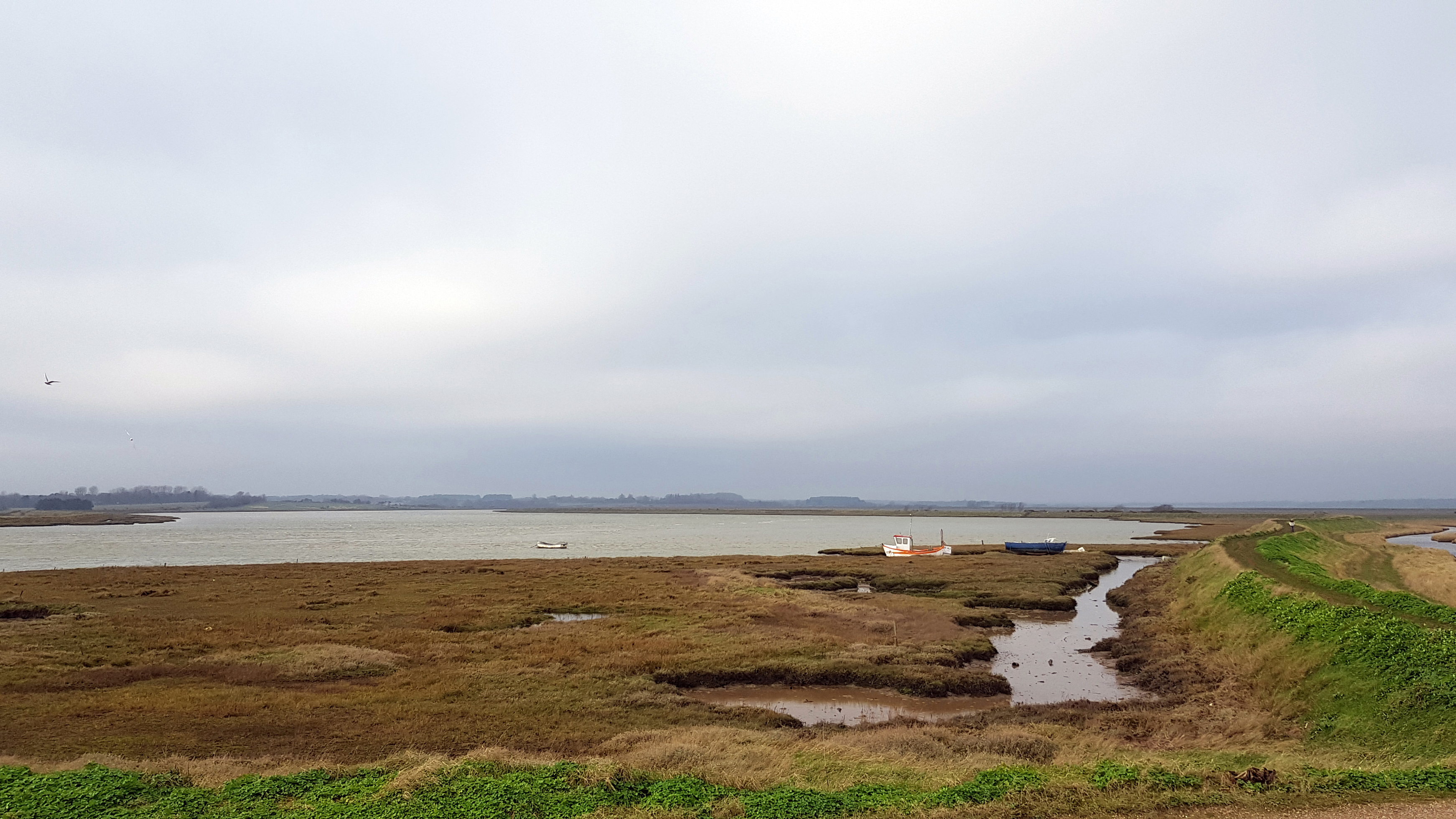
Saltmarsh and Mudflats
Suffolk’s estuaries and tidal inlets hold some of the most ecologically important coastal habitats in England. Saltmarshes – stands of salt-tolerant plants colonising the upper intertidal zone between the mean high water of neap and spring tides – and the invertebrate-rich mudflats that front them together form a system of extraordinary biological productivity. The Stour, Orwell, Deben, Alde-Ore and Blyth estuaries hold internationally significant concentrations of wintering and passage waders and wildfowl, supported by the vast invertebrate populations living within the estuary sediments. Suffolk also holds 25 distinct saltmarsh plant communities and is one of the strongholds for the rare Small Cord-grass (Spartina maritima) and the scarce Sea-aster Colletes Bee, which depends entirely on Sea Aster pollen to provision its nests.
Defining features
- Saltmarshes are intertidal habitats colonised by plants adapted to high salinities and periodic submersion in seawater. They extend from the mean high water of neap tides to the mean high water of spring tides, with distinct vegetation zones determined by the frequency and duration of tidal inundation.
- Lower saltmarsh is characterised by pioneer species tolerant of frequent, prolonged submersion – including Common Glasswort, Annual Sea-blite and Eel Grass – while the upper marsh is dominated by more diverse communities of Sea Purslane, Sea Aster, Sea Lavender and Thrift.
- Mudflats are sedimentary intertidal habitats typically occupying the zone between the low water mark and the lower saltmarsh, characterised by fine mineral sediments with high organic content and supporting dense communities of invertebrates.
- Creeks, runnels, pools and bare mud within the saltmarsh mosaic provide a range of microhabitats that contribute significantly to the overall biodiversity of the system.
- Saltmarshes play an important coastal defence role: they dissipate wave energy, trap sediment and reduce the risk of erosion and tidal flooding to the land behind them.
Importance for wildlife
Intertidal mudflats are among the most productive marine habitats by biomass: the bivalves, worms, shrimps and other invertebrates living within and on the sediment surface provide the food resource that sustains internationally important populations of wading birds and wildfowl through the autumn and winter. Species including Dunlin, Knot, Grey Plover, Oystercatcher, Curlew, Black-tailed Godwit and Redshank depend on estuary mudflats as feeding habitat, and the quantities of invertebrate prey they require are possible only because mudflat productivity is so high. Dark-bellied Brent Geese feed on Eel Grass beds and the algal films that develop on mudflat surfaces. The Native Oyster, now scarce in most of its former British range, persists in the Deben and Orwell estuaries.
Saltmarshes complement the mudflats ecologically, providing roosting habitat for waders and wildfowl as the tide covers the feeding grounds, breeding habitat for Redshank and, on the upper marsh, foraging habitat for seed-eating birds including Linnet, Twite, Skylark and Reed Bunting. The plant diversity of Suffolk’s saltmarshes is exceptional: the county’s 25 distinct saltmarsh communities reflect the varied salinity, drainage and substrate conditions across its estuaries, and several nationally scarce species are present, including Borrer’s Saltmarsh-grass, Slender Hare’s-ear and the declining Small Cord-grass. The Sea-aster Colletes Bee, a solitary bee entirely dependent on Sea Aster pollen, nests in bare earth banks at saltmarsh edges and is one of the most charismatic invertebrate specialists associated with this habitat.
Important associated species
Species marked * are Suffolk Priority species.
- Ants, Bees and Wasps
- Beetles
Saltmarsh Short-spur
- Birds
Black-tailed Godwit, Herring Gull, Lapwing, Curlew, Linnet, Skylark, Twite (wintering), Reed Bunting, Redshank, Oystercatcher, Wigeon, Teal, Dark-bellied Brent Goose
- Bugs
- Ferns and Flowering Plants
Slender Hare’s-ear , Sea Barley, Borrer’s Saltmarsh-grass, Small Cord-grass, Dwarf Eelgrass, Dittander, Shrubby Seablite, Common Glasswort, Sea Aster, Sea Purslane
- Marine Life
- Molluscs
- Spiders
Factors affecting this habitat in Suffolk
- Coastal squeeze: sea defences prevent the landward migration of saltmarsh as sea levels rise, compressing the intertidal zone between a static defence line and a rising sea. This is the primary long-term threat to Suffolk’s saltmarshes and mudflats, particularly on the open coast and in estuaries with hard defences on one or both banks.
- Land reclamation and barrage schemes, which permanently convert intertidal habitat to other land uses and destroy the associated invertebrate and plant communities.
- Reduced sediment supply, where coastal defence structures, port development and dredging of shipping channels alter sediment cycles and may prevent mudflats from accreting in pace with sea level rise.
- Pollution, including eutrophication from agricultural run-off and sewage, which can promote the growth of algal mats that smother mudflat invertebrate communities and degrade water quality.
- Invasion by Common Cord-grass (Spartina anglica), a hybrid of introduced and native cord-grass species, which spreads rapidly across mudflats and can convert open feeding habitat to dense saltmarsh unsuitable for many waders.
- Bait digging and fishing activity on mudflats, which disturbs the sediment surface and can alter the structure of invertebrate communities at locally significant scales.
- Human and dog disturbance, which affects the feeding and roosting behaviour of waders and wildfowl, particularly during the critical winter period when birds need to maintain energy reserves.
Habitat management advice
- Allow natural processes to operate wherever possible. An undisturbed saltmarsh managed by tidal processes alone will maintain the vegetation zonation and structural diversity that the habitat’s invertebrate and plant communities require. Intervention should be considered only where the site is at risk from specific threats that natural processes cannot address.
- Maintain unimpeded tidal patterns. The natural vegetation zones of saltmarsh are determined by tidal inundation frequency; any alteration to tidal flow – including the infilling or canalisation of creeks and runnels – will change vegetation structure and degrade the habitat. Creeks and runnels also provide structural diversity and microhabitats for invertebrates and should not be modified.
- Retain the full range of successional stages, from pioneer saltmarsh and bare mud through to upper marsh communities and the transition zone with terrestrial habitats. Prevent excessive scrub encroachment in the upper marsh transition zone.
- Consider managed retreat where appropriate: allowing deliberate tidal ingress onto low-lying land behind existing sea defences can create new saltmarsh habitat and compensate for losses elsewhere. Managed realignment also provides natural coastal defence benefits and is consistent with current government policy for estuarine management in Suffolk.
- Continue light traditional grazing on previously grazed saltmarsh sites. Cessation of grazing typically leads to dense grass growth that suppresses the diversity of saltmarsh plants and shades out the pools and bare mud areas used by invertebrates. Do not introduce grazing to unmanaged sites without assessing its likely effects.
- Retain biodegradable tidal debris – seaweed, driftwood and other organic strandline material – on the upper marsh and strandline. This provides important habitat for invertebrates and should not be removed in the interests of tidiness.
- Ensure that coastal defence works do not disrupt the movement of sediment along the coast. Extensive hard defences upstream of mudflat systems can starve them of sediment needed to maintain elevation, particularly under conditions of sea-level rise.
- Manage recreational access to reduce disturbance to roosting and feeding birds, particularly during the winter period between October and March. Consider creating defined access routes and dog-control zones around key roost and feeding sites.
Managed realignment on the Suffolk coast
Several managed realignment schemes have been undertaken on the Suffolk coast in recent decades, creating new intertidal habitat by deliberately breaching or removing sea walls to allow tidal ingress. The Trimley Marshes realignment on the Orwell estuary and the Abbotts Hall Farm scheme are among the most significant, creating hundreds of hectares of new saltmarsh and intertidal habitat and demonstrating that realignment can deliver both nature recovery and coastal resilience. As sea levels continue to rise and the costs of maintaining hard defences increase, managed realignment is expected to play a growing role in Suffolk’s coastal strategy, providing opportunities to replace the saltmarsh and mudflat lost to coastal squeeze elsewhere in the county.
Vision for Suffolk
The following priorities reflect the strategic goals for coastal saltmarsh and intertidal mudflats in Suffolk, drawing on both the Biodiversity Action Plan framework and the Local Nature Recovery Strategy.
- Improve knowledge of the extent and condition of coastal saltmarsh and intertidal mudflats across the county, including changes in the extent and community composition of saltmarsh over time.
- Maintain the existing extent of coastal saltmarsh and intertidal mudflats to ensure no net loss, resisting land reclamation and development proposals that would reduce the intertidal resource.
- Create new saltmarsh and intertidal habitat through managed realignment and coastal restoration, particularly to compensate for losses attributable to coastal squeeze.
- Encourage the restoration and improvement of degraded saltmarsh and mudflat, including the control of invasive cord-grass and the reinstatement of natural tidal flow where it has been impeded.
Further information
- Buglife – Advice on managing BAP habitats: saltmarsh, mudflats
- Buglife – Notable invertebrates associated with coastal saltmarsh (PDF)
- JNCC – Habitat descriptions: Coastal saltmarsh, Intertidal mudflats (both PDF)
- MAGIC – Interactive mapping including designations
- Suffolk Wildlife Trust – Habitats Explorer: Saltmarsh and mudflats
- Making Space for Nature – Lawton Review, Defra, 2010 (PDF, historical reference)
- The Natural Choice: Securing the Value of Nature – Natural Environment White Paper, 2011 (PDF, historical reference)
Suffolk’s Saltmarsh and Saline Lagoon Habitats
Key
A conservation priority in Suffolk’s Historic Biodiversity Action Plan.
A key habitat for recovery under Suffolk’s Local Nature Recovery Strategy.



Saltmarsh and Mudflats are primarily a part of the Saltmarsh and Lagoon habitat group, but also feature in these habitat groups: Coastal and Marine.
Image: Butley River from Boyton © Emma Aldous
 Archived Habitat Factsheet (PDF, 2020) Superseded – provided for reference only.

 Archived Suffolk BAP action plan (PDF, 2003) Superseded – provided for reference only.