
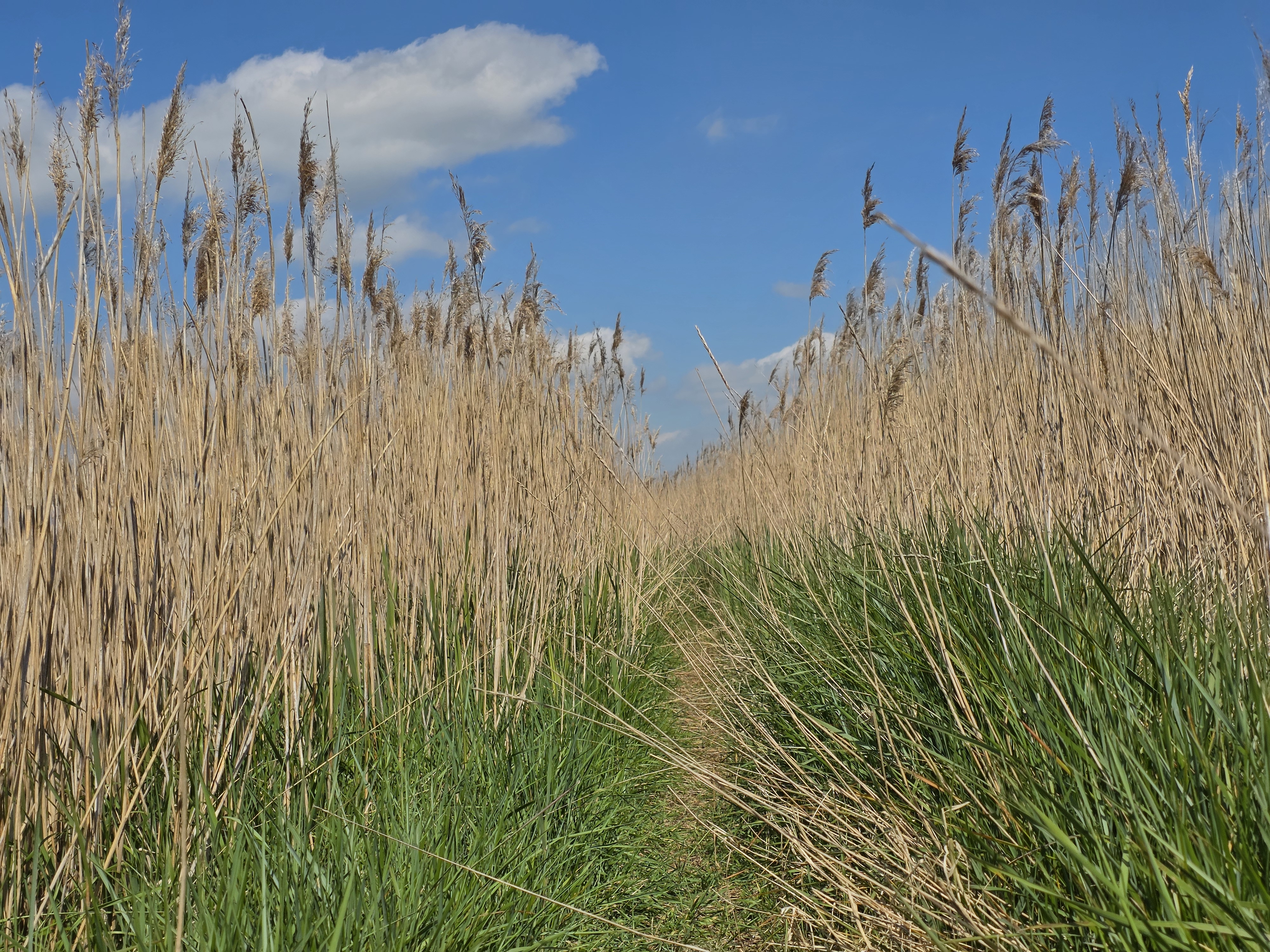
Reedbeds
Reedbeds are one of Britain’s rarest and most wildlife-rich habitats, and Suffolk holds a disproportionate share of the national resource. The three largest reedbeds in the UK – at Minsmere, Walberswick and Benacre – are all on the Suffolk coast, and together with smaller sites in the county’s river valleys, they support over 56 species of conservation concern. A reedbed at its most ecologically diverse is not simply a stand of common reed: it is a dynamic mosaic of open water, ditches, fen, wet grassland and wet woodland, shaped by water level management and successional history, and providing conditions found in very few other lowland habitats.
Defining features
- A fen community dominated by common reed (Phragmites australis), occurring in permanently or seasonally waterlogged conditions, mostly in fresh water but also in brackish or tidal situations.
- Typically includes a mosaic of reedbed, fen, eutrophic open water, ditches and wet woodland, and may incorporate small areas of wet grassland and carr.
- Most of the UK’s reedbeds are in East Anglia, with Suffolk holding three of the largest individual sites in the country.
- Ecological character is shaped by water-level management, cutting regime, successional stage and proximity to other wetland habitats.
Importance for wildlife
Reedbeds provide breeding habitat for some of Britain’s rarest birds and are of outstanding importance as wintering and migratory habitat for others. The Bittern – one of the UK’s most threatened breeding birds – depends on large, well-structured reedbeds with sufficient open water, and Suffolk’s coastal sites are among the most important in the country for this species. The Savi’s Warbler, a scarce summer visitor, breeds in very few UK locations outside Suffolk. The reedbed mosaic also supports Otters, Water Voles, Water Shrews and Harvest Mice, and its varied structural features – shallow areas, well-vegetated ditches, open water and gently graded bank profiles – create conditions suitable for a wide range of amphibians and reptiles.
The invertebrate interest of Suffolk’s reedbeds is exceptional: 54 notable invertebrate species have been recorded in association with this habitat across the county, spanning flies, beetles, true bugs, spiders, caddis flies and other groups, many of which are rare or nationally scarce. The structural diversity of well-managed reedbeds – and particularly the availability of standing deadwater, dense litter, flowering marginal vegetation and transitional habitats at the reedbed edge – is what sustains this richness. Reedbed moths, including Fenn’s Wainscot and Concolorous are indicators of high-quality habitat.
Important associated species
Species marked * are Suffolk Priority species. Species marked ** are Priority – Research Only: common and widespread, but rapidly declining.
- Birds
Starling, Grasshopper Warbler, Savi’s Warbler, Cuckoo, Reed Bunting, Bittern, Marsh Harrier, Cetti’s Warbler, Reed Warbler, Sedge Warbler, Crane, Bearded Tit
- Flies
Broads Long-legged Fly, Black Fungus Gnat
- Mammals
- Molluscs
Depressed River Mussel, Desmoulin’s Whorl Snail, Swollen Spire Snail, Narrow-mouth Whorl Snail
- Moths
White-mantled Wainscot, Fenn’s Wainscot, Concolorous, Large Wainscot **
- Reptiles and Amphibians
Common Frog, Smooth Newt, Great Crested Newt, Common Toad, Grass Snake
Notable Invertebrates
Species and Designation
- Snails and slugs (Mollusca)
- Vertigo moulinsiana, BAP Priority RDB3
- Oxyloma sarsi, RDB1
- Mercuria confusa, probably in Suffolk. Recorded under the older name ‘Pseudamnicola confusa’ at Barsham Marshes 2006, several sites in the 1980s and Carlton Marshes 1992, RDB2
- Spiders and allies (Arachnida: Araneae and Pseudoscorpiones)
- Clubiona juvenis, Redgrave & Lopham 2009-10, RDB2
- Donacochara speciosa, Na
- Entelecara omissa, Na
- Gongylidiellum murcidum, Redgrave & Lopham 1984, Nb
- Hypomma fulvum, Na
- Marpissa radiata, Na
- Tetragnatha striata, Nb
- Woodlice (Isopoda)
Trichoniscoides albidus, Nb
- True Bugs (Hemiptera)
Heteroptera
- Microvelia pygmaea, Nb
- Gerris lateralis, Local
Leafhoppers, planthoppers, froghoppers, treehoppers & cicadas (Auchenorrhyncha)
- Chloriona dorsata (feeds exclusively on Phragmites), Nb
- Oliarus leporinus (feeds exclusively on Phragmites), Nb
- Paralimnus phragmitis (feeds exclusively on Phragmites), Nb
- Flies (Diptera)
Snail-killing flies, picture-wing flies, grass flies and allies (Acalyptrata)
- Lipara similis (Chloropidae), Redgrave & Lopham 2000, RDB2
- Elachiptera austriaca (Chloropidae), N
- Eribolus slesvicensis (Chloropidae), N
- Lipara rufitarsis (Chloropidae), N
- Anagnota bicolor (Anthomyzidae), N
Craneflies (Tipulidae)
- Tipula marginella, RDB3
- Dicranomyia complicata, RDB2
- Erioptera bivittata, RDB2
- Dicranomyia danica, RDB3
- Thaumastoptera calceata, N
- Molophilus pleuralis
- Beetles (Coleoptera)
Ground beetles
- Demetrias imperialis, Nb
- Odacantha melanura, Nb
Leaf beetles (Chrysomelidae)
- Donacia aquatica, BAP Priority Rare
Rove beetles and allies (Staphylinidae/Scydmaenidae/Silphidae)
- Stenus butrintensis, Redgrave & Lopham 2009-10, N
- Rugilus fragilis, Hopton Fen 2004, N
- Dacrila fallax (characteristic of reedbeds, but also found elsewhere), N
- Aloconota languida, Thelnetham 2004 (characteristic of reedbeds, but also found elsewhere), N
- Stenus binotatus, Local
- Stenus solutus, Local
- Paederus riparius, Local
- Erichsonius cinerascens, Local
- Tachyporus pallidus, Local
- Myllaena infuscata, Local
- Myllaena intermedia, Local
- Myllaena minuta, Local
- Hygronoma dimidiata, Local
- Alianta incana, Local
- Pachnida nigella, Local
- Ocyusa picina, Local
- Caddis flies (Trichoptera)
- Phacopteryx brevipennis 1 undated record from Redgrave & Lopham, N
- Agrypnia pagetana, Local
- Limnephilus binotatus, Local & Regionally Notable
- Trichostegia minor, Regionally Notable
- Ants, bees and wasps (Hymenoptera: Aculeata)
- Odynerus simillimus, RDB1
- Passaloecus clypealis, RDB2, RDB3, Rare
- Hylaeus pectoralis, Rare
- Macropis europaea, RDB3, Na, Scarce
Definitions of Designations
- RDB3 – Red Data Book category 3
RARE: Species which occur in small populations and, although not currently either Endangered or Vulnerable, are at risk. Rare species exist in 15 or fewer 10km squares, or are more widespread than this but dependent on small areas of especially vulnerable habitat.
- RDB2 - Red Data Book Category 2
VULNERABLE: A taxon is Vulnerable when it is not Critically Endangered or Endangered but is facing a high risk of extinction in the wild in the medium-term future. Rare species exist in 15 or fewer 10km squares, or are more widespread than this but dependent on small areas of especially vulnerable habitat.
- Nb – Nationally Scarce Category B
Species which do not fall within Red Data Book categories but which are nonetheless uncommon in Great Britain and thought to occur in between 31 and 100 10km squares of the National Grid, or for less well recorded groups, between eight and twenty vice-counties.
- Na – Nationally Scarce Category A
Species which do not fall within Red Data Book categories but which are nonetheless uncommon in Great Britain and thought to occur in 30 or fewer (typically between 16 and 30) 10km squares of the National Grid, or for less well recorded groups, in seven or fewer vice-counties.
- RDBK
Species appear in the Red Data Book, but the status is unknown, although they are thought to be rare.
- Local
Found in restricted habitats.
- Notable A
Taxa which do not fall within RDB categories but which are nonetheless uncommon in Great Britain and thought to occur in 30 or fewer 10km squares of the National Grid or, for less well-recorded groups, within seven or fewer vice-counties. The same as ‘Nationally Scarce’.
- Notable B
Taxa which do not fall within RDB categories but which are nonetheless uncommon in Great Britain and thought to occur in between 31 and 100 10km squares of the National Grid or, for less-well recorded groups, between eight and twenty vice-counties. Superseded by Nationally Scarce, and therefore no longer in use.
- N – Nationally Scarce
Species which do not fall within Red Data Book categories but are nonetheless uncommon in Great Britain. This status category is used when information is not sufficient to allocate a species to either Na or Nb. These species are thought to occur across 16 to 100 10km squares of the National Grid.
- BAP Priority Species
Listed under Sec 41 of the Natural Environment and Rural Communities Act 2006 as priorities for conservation action.
Factors affecting this habitat in Suffolk
- Coastal erosion and saline incursion have already caused substantial reductions in the size and quality of coastal reedbeds. The shingle banks that protect these sites are being eroded and overtopped, and further losses are expected as the frequency of seawater inundation increases with sea level rise.
- Conversion to intensive agriculture, water abstraction and land drainage, which reduce or eliminate the waterlogged conditions on which the reedbed depends.
- Inappropriate management leading to dehydration, scrub encroachment and loss of open water. Unmanaged reedbeds rapidly succeed to woodland, losing the open structure on which many specialist species depend.
- Inappropriate water level management – both too high and too low – which can threaten key species through drowning or desiccation, or prevent the management operations needed to maintain habitat structure.
Habitat management advice
- Maintain water levels at a sufficiently high level to prevent litter drying out, but avoid sudden large rises, which can be damaging to many invertebrates. Aim for stable, predictable levels with gradual seasonal variation rather than abrupt fluctuations.
- Maintain all stages of succession across the site, from young reed in shallow water to old reed with dense litter and areas of carr on virtually dry ground, to maximise overall species diversity.
- Retain existing stands of Phragmites, tussocky grasses, sallow carr and sedges to ensure structural and habitat diversity across the reedbed.
- Retain scrub in small patches to increase habitat diversity. Where unwanted scrub is removed, pull out bushes rather than cutting, and allow the resulting hollows to hold water.
- Consider light grazing to maintain floral and invertebrate diversity. Moderate trampling and poaching create valuable patches of bare ground and maintain high-quality berms at ditch margins.
- Encourage flower-rich areas at reedbed margins to provide pollen and nectar for adult insects, including specialist reedbed moths and flies.
- Create gently sloping profiles at the fen edge to accommodate seasonal water-level variations without stranding or drowning marginal communities.
- For non-commercial cutting, operate on a four-year or longer rotation to allow invertebrates sufficient time to complete their life cycles before the habitat is disturbed.
- On commercially managed reedbeds, limit intensive cutting to part of the site at any one time, leaving other areas as longer-term invertebrate habitat. Where burning is used, restrict it to small areas to avoid large-scale simultaneous loss of structure.
Site spotlight: Minsmere
Minsmere, managed by the RSPB on the Suffolk coast between Dunwich and Sizewell, is one of the most celebrated wildlife reserves in England and holds the largest reedbed in the country. Its reedbed, pools, grazing marsh, heathland and coast form a mosaic of exceptional ecological diversity, and it has been central to some of the most significant conservation achievements of the twentieth century – including the recolonisation of England by Avocet and the recovery of the Bittern as a breeding species. Minsmere has supported breeding Bitterns continuously for decades and remains a stronghold for Marsh Harrier, Bearded Tit and a suite of specialist reedbed invertebrates found at few other sites in Britain.
Vision for Suffolk
The following priorities reflect the strategic goals for reedbeds in Suffolk, drawing on both the Biodiversity Action Plan framework and the Local Nature Recovery Strategy.
- Improve knowledge of the extent and condition of reedbeds across the county.
- Maintain the existing extent of reedbeds to ensure no net loss, recognising the acute threat posed by coastal erosion and sea level rise to the largest sites.
- Re-create reedbeds where opportunities arise, particularly in association with wetland restoration, floodplain management and coastal realignment schemes.
- Encourage the restoration and improvement of degraded reedbeds, prioritising sites where water level management can be restored and scrub encroachment reversed.
Further information
- Buglife – Advice on managing BAP habitats
- JNCC – Habitat description: Reedbeds (PDF)
- MAGIC – Interactive mapping including designations
- Natural England – Access to Evidence No. 13: Reedbeds
- Natural England – NCA Profile 82: Suffolk Coast and Heaths, April 2015
- RSPB – Reedbed management for wildlife
- Hawke, C.J. and Jose, P.V. (1996) Reedbed Management for Commercial and Wildlife Interests. RSPB Management Guides
- Suffolk Wildlife Trust – Habitats Explorer: Rivers and wetlands
- Making Space for Nature – Lawton Review, Defra, 2010 (PDF, historical reference)
- The Natural Choice: Securing the Value of Nature – Natural Environment White Paper, 2011 (PDF, historical reference)
Suffolk’s Reedbed and Wetland Habitats
Key
A conservation priority in Suffolk’s Historic Biodiversity Action Plan.
A key habitat for recovery under Suffolk’s Local Nature Recovery Strategy.




Reedbeds are primarily a part of the Reedbed and Wetland habitat group, but also feature in these habitat groups: Coastal and Marine, Fen, River and Riverside and Saltmarsh and Lagoon.
Image: River Blyth, Blythburgh © Emma Aldous
 Archived Habitat Factsheet (PDF, 2020) Superseded – provided for reference only.
 Archived Suffolk BAP action plan (PDF, 2003) Superseded – provided for reference only.