
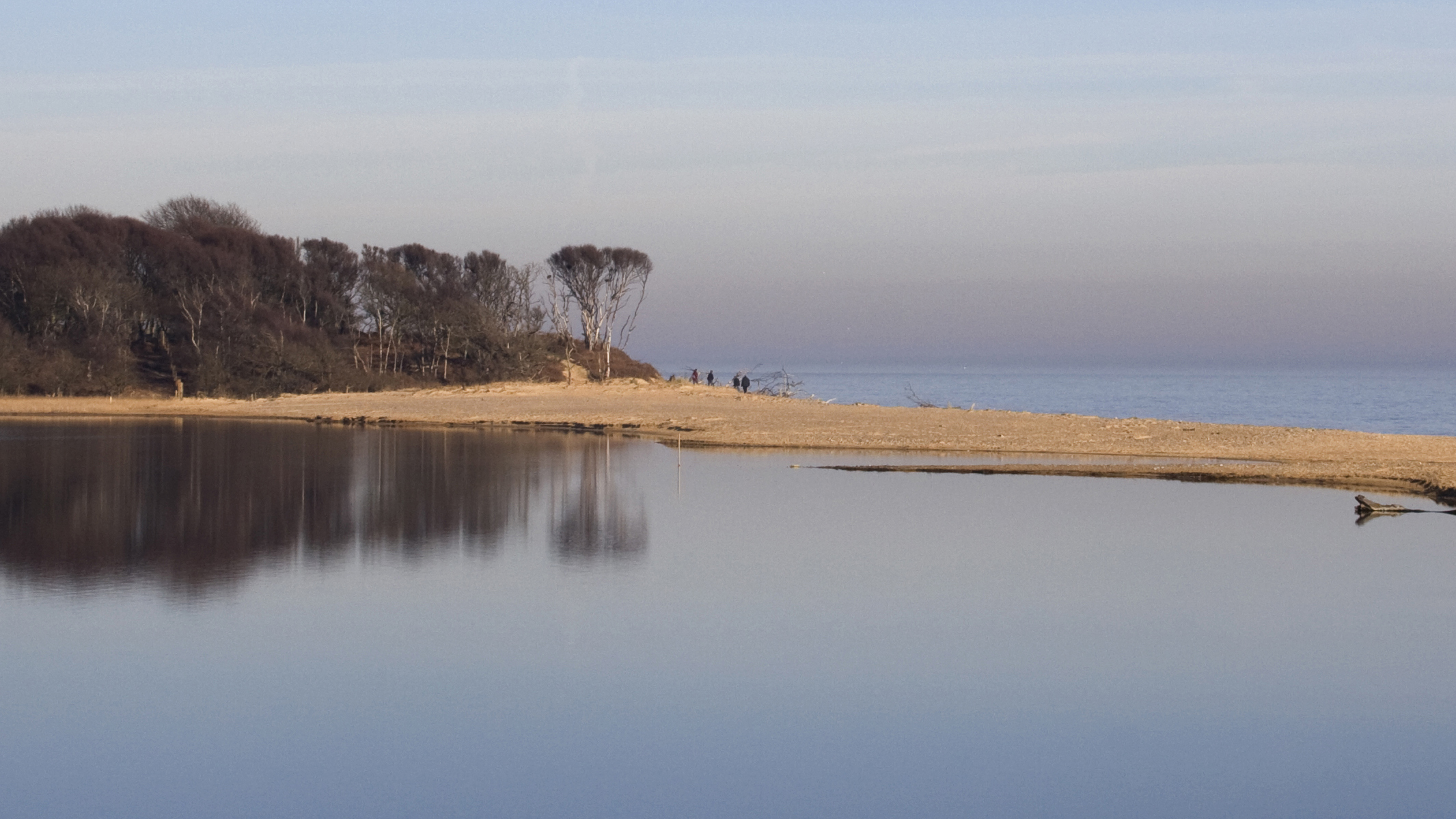
Saline Lagoons
Saline lagoons are bodies of brackish, saline or hyper-saline water partially separated from the sea, typically retaining water at low tide and supporting a range of salinity conditions. Found predominantly along the Suffolk coast, they form part of the complex mosaic of habitats that makes the county’s shoreline of international importance. Their rarity, ecological distinctiveness and the high proportion of specialist species associated with them – including invertebrates found at very few other sites in Britain – give saline lagoons a conservation significance far exceeding their often modest physical extent. Suffolk holds a nationally important concentration of this habitat, particularly along the Alde-Ore and Blyth estuaries and the vegetated shingle coast.
Defining features
- Bodies of saline, brackish or hyper-saline water are partially separated from the sea, retaining water at low tide.
- Four main lagoon types occur in Suffolk: small rivers ponded back by shingle bars and occasionally overtopped by the sea; pools enclosed within shingle beaches; shallow pools on clay trapped behind shingle ridges and fed by percolating seawater; and bodies of water behind sea walls fed by rainwater, percolating seawater, sea spray or sluices.
- Salinity varies considerably both within and between sites, creating a range of conditions that support distinct communities of specialist species.
- Typically form part of a wider coastal mosaic including vegetated shingle, saltmarsh and coastal and floodplain grazing marsh.
Importance for wildlife
Saline lagoons support a suite of specialist invertebrates found in very few other habitats in Britain. The particular combination of salinity, water chemistry and structural diversity found in lagoon environments – varying from near-freshwater to hyper-saline conditions across different sites – creates a range of niches exploited by species that cannot thrive in either fully marine or fully freshwater conditions. Key species include the Lagoon Sand Shrimp (Gammarus insensibilis), the Starlet Sea-anemone (Nematostella vectensis), the Lagoon Cockle (Cerastoderma glaucum) and the mud snails Hydrobia spp. The margins of lagoons are equally important, supporting specialist invertebrates including the Fancy-legged Fly, and the Bearded Stonewort, a rare charophyte algae associated with shallow, clear, brackish water.
Saline lagoons are also of considerable importance for birds, particularly waders and wildfowl that use them for feeding and roosting. Their position within a broader coastal mosaic – alongside saltmarsh, vegetated shingle, reedbed and grazing marsh – significantly amplifies their ecological value, as species move freely between these habitats depending on tidal state, season and food availability.
Important associated species
Species marked * are Suffolk Priority species. Species marked ** are Priority – Research Only: common and widespread, but rapidly declining.
- Birds
Black-tailed Godwit (winter feeding), Avocet, Herring Gull
- Flies
Fancy-legged Fly (bare banks)
- Freshwater Algae
- Marine Life
Factors affecting this habitat in Suffolk
- Sea level rise is occurring faster than coastal habitats can form naturally, placing low-lying lagoons at risk of inundation or fundamental change in character.
- Natural landward migration of bar-built sedimentary barriers over time, leading to lagoons becoming progressively infilled with sediment.
- Pollution and nutrient enrichment from agricultural and urban runoff can have severe effects on specialist invertebrate communities that depend on specific water chemistry conditions.
- Coastal defence works that prevent the natural movement of sediments along the shore, undermining the structural integrity of the shingle and sediment features within which many lagoons are located.
- Encroachment by Common Reed (Phragmites australis) and Sea Club-rush (Bolboschoenus maritimus), which can reduce the open water extent and alter habitat structure.
- Damage caused by the removal of shingle or sediment, or by poorly managed maintenance of coastal defence structures.
Habitat management advice
- Maintain water quality: pollution is likely to affect all elements of the specialist fauna, as many lagoonal invertebrates are highly sensitive to changes in water chemistry and nutrient levels.
- Minimise disturbance: poorly managed physical disturbance – particularly during the breeding season – can significantly affect bird populations using lagoons for nesting and feeding.
- Maintain structural diversity: convoluted margins, shallow areas and islands increase habitat diversity and help to disrupt turbulent mixing induced by wind, creating the calm, sheltered conditions many specialist species require.
- Manage vegetation encroachment carefully. Beds of Common Reed and Sea Club-rush at the lagoon edge can significantly reduce open water extent, but a limited degree of encroachment may in some cases be acceptable – for example, reeds can provide sheltered conditions for the Starlet Sea-anemone and a substratum for bryozoan colonies.
- Prioritise the management of lagoon margins: invertebrate communities associated with saline lagoons are often concentrated at the water’s edge and on bare banks, making the condition of the surrounding habitat as important as the water body itself.
Site spotlight: Havergate Island
Havergate Island, managed by the RSPB within the Alde-Ore estuary, is one of Suffolk’s most significant coastal wildlife sites and holds a complex of saline lagoons of national importance. The island is best known as the site where Avocets recolonised Britain in 1947, following their absence as a breeding species for over a century, and it continues to support an important breeding population. The lagoons are actively managed to maintain the shallow, saline conditions and open, muddy margins that Avocet, Black-tailed Godwit and other waders depend on, and the site supports several specialist invertebrate species characteristic of high-quality saline lagoon habitat.
Vision for Suffolk
The following priorities reflect the strategic goals for saline lagoons in Suffolk, drawing on both the Biodiversity Action Plan framework and the Local Nature Recovery Strategy.
- Improve knowledge of the extent and condition of saline lagoons across the county.
- Maintain the existing extent of saline lagoons to ensure no net loss.
- Re-create saline lagoons where opportunities arise, particularly in association with coastal realignment and managed retreat schemes.
- Encourage the restoration and improvement of degraded saline lagoons, particularly those affected by sedimentation, pollution or vegetation encroachment.
Further information
- Buglife – Advice on managing saline lagoons
- Buglife – Notable invertebrates associated with saline lagoons (PDF)
- JNCC – Habitat description: Saline Lagoons (PDF)
- MAGIC – Interactive mapping including designations
- Making Space for Nature – Lawton Review, Defra, 2010 (PDF, historical reference)
- The Natural Choice: Securing the Value of Nature – Natural Environment White Paper, 2011 (PDF, historical reference)
Suffolk’s Saltmarsh and Saline Lagoon Habitats
Key
A conservation priority in Suffolk’s Historic Biodiversity Action Plan.
A key habitat for recovery under Suffolk’s Local Nature Recovery Strategy.



Saline lagoons are primarily a part of the Saltmarsh and Lagoon habitat group, but also feature in these habitat groups: Coastal and Marine.
Image: Benacre Broad © Emma Aldous
 Archived BAP action plan, 2007 (PDF) Superseded – provided for historical reference only.
 Suffolk BAP action plan for Saline Lagoons (PDF, 2007)