
Maritime Cliffs and Slopes
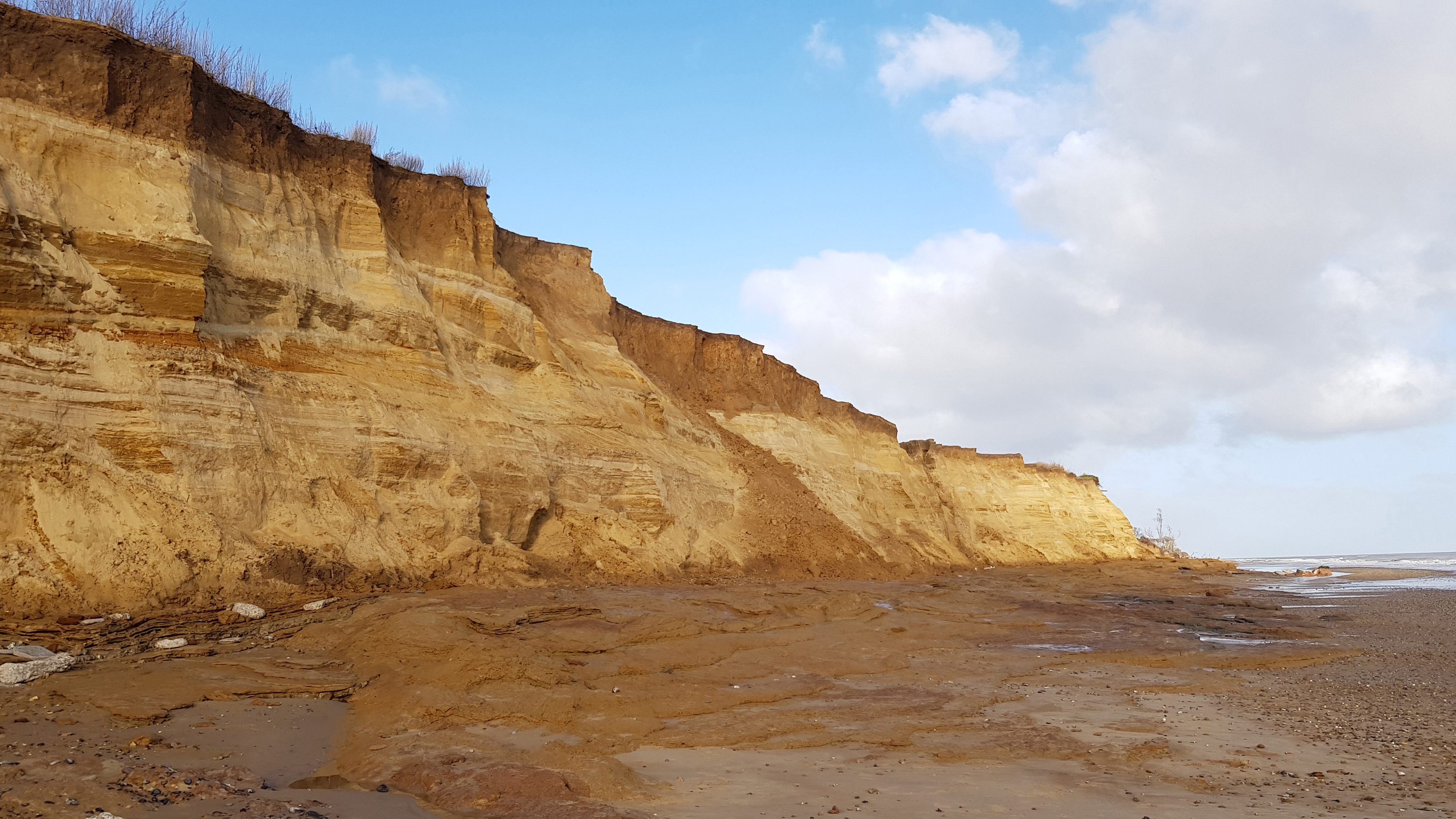
Suffolk’s maritime cliffs and slopes are all classified as soft: formed from glacial sands, gravels and clays rather than hard rock, they erode continuously and often rapidly under wave action, groundwater movement and slippage. This impermanence is not a problem to be solved – it is the source of the habitat’s ecological value. The cycle of erosion and recolonisation produces a mosaic of bare ground, pioneer vegetation, seepages and early-successional communities that support specialist invertebrates found at very few other sites in Britain. The Suffolk coast between Pakefield and Covehithe holds some of the most actively eroding soft cliffs in England, and the species dependent on them are adapted to instability in ways that make cliff stabilisation directly damaging to their habitat.
Defining features
- Sloping to near-vertical faces on the coastline formed from soft glacial deposits – sands, gravels, silts and clays – rather than hard rock. Breaks in the slope are formed by slippage and coastal erosion rather than geological bedding planes.
- Extend from immediately above the high water mark to the cliff top, including the splash zone where lichens and other salt-tolerant species colonise the lower face.
- Continuous erosion maintains bare soil and early successional vegetation; this dynamic character is the defining ecological condition of the habitat.
- Freshwater seepages emerging through the cliff face are important structural features, supporting specialist aquatic and semi-aquatic invertebrate communities.
- Cliff-top grassland and scrub form an integral part of the habitat complex, influencing which plant species colonise further down the slope through seed rain.
Importance for wildlife
Soft maritime cliffs support a remarkable range of specialist invertebrates that depend on the combination of loose, warm, sparsely vegetated substrate and the continuity of bare ground that active erosion provides. Mining bees and solitary wasps nest in vertical or steeply sloping bare sand and clay faces; tiger beetles and rove beetles exploit the open ground between sparse pioneer plants; and species including the Antlion – found at only a handful of sites in Britain, most of them on the Suffolk coast – depend on very specific conditions of fine, dry sand maintained by constant, moderate erosion. The warm, south-facing microclimate of sheltered cliff faces creates surface temperatures significantly higher than the surrounding landscape, enabling invertebrates with a continental distribution to persist at the northern or western edge of their range.
Freshwater seepages on the cliff face are disproportionately valuable: the combination of fresh water, bare mineral substrate and high humidity in a coastal setting supports scarce invertebrate communities found in very few other lowland habitats. The cliff top adds further diversity – scrubby patches attract migrant birds in spring and autumn, Sand Martin colonies nest in near-vertical sandy faces, and the flower-rich grassland that develops on undisturbed cliff tops provides pollen and nectar for the same mining bees that nest lower on the cliff.
Important associated species
Species marked * are Suffolk Priority species. Species marked ** are Priority – Research Only: common and widespread, but rapidly declining.
- Ants, Bees and Wasps
Sea-aster Colletes Bee, Brown-banded Carder Bee, Weevil Hunting Wasp, Five-banded Tailed Digger Wasp
- Beetles
- Birds
Sand Martin, Fulmar
- Butterflies
- Moths
- Other Invertebrates
- Spiders
Factors affecting this habitat in Suffolk
- Coastal protection measures – including rock armour, revetments and beach nourishment – that interrupt natural erosion processes, stabilise cliff faces and eliminate the bare ground and early successional conditions on which specialist invertebrates depend.
- Cliff-top development is increasing pressure for further coastal defence works to protect infrastructure, compounding the loss of natural erosion dynamics.
- Agricultural intensification on cliff tops, including arable cultivation and outdoor pig rearing close to the cliff edge, leads to nutrient-enriched runoff that alters plant community composition and accelerates erosion in damaging rather than ecologically productive ways.
- Loss of low-intensity grazing on cliff grasslands, or neglect, resulting in rank grass growth and scrub encroachment that shades out specialist low-growing plants and reduces the structural diversity of the cliff-top habitat.
- Invasive non-native plant species, which can smother bare ground and displace native pioneer communities, eliminating the open conditions specialist invertebrates require.
- Changes in drainage patterns that stabilise cliffs by countering natural slippage, eliminating the aquatic and semi-aquatic slope habitats associated with freshwater seepages.
- Sea level rise and increasing storm frequency associated with climate change, altering erosion patterns and threatening to accelerate cliff loss at rates that outpace ecological recovery.
- Recreational pressure, including informal coastal walking and climbing on soft cliff faces, which can cause damaging erosion in a different pattern from the natural erosion that creates valuable habitat.
Habitat management advice
Allow natural erosion to continue
- The most important management requirement for soft-rock cliffs is the continuation of natural erosion, which maintains bare ground and the early successional vegetation stages on which the specialist invertebrate and plant communities depend. These cliffs should be left to erode naturally; any activity that changes the rate of erosion – including re-profiling, cliff stabilisation or the introduction of coastal defences – should be avoided wherever possible.
Protect freshwater seepages
- Freshwater seepages emerging through the cliff face are among the most valuable features of the habitat and support scarce invertebrate communities found at very few other sites. Maintain the continued flow of cliff seepages and prevent any pollution of the groundwater sources that feed them.
- Avoid surface or sub-surface drainage works on or behind the cliff that could intercept seepage flow; drainage that stabilises the cliff eliminates the geomorphological processes that sustain the habitat.
Maintain cliff-top vegetation diversity
- Manage cliff-top grassland to maintain a mosaic of short and taller vegetation, bare and stony areas and small patches of scrub. This is best achieved through grazing or late cutting; scrub and coarse grass encroachment should be controlled to prevent the loss of open-structured grassland.
- Retain hedges and scrubby patches at the cliff top as a valued component of the cliff-edge ecology, providing shelter, nectar and nesting habitat for invertebrates and migrant birds.
- Use a flexible grazing arrangement that can respond quickly to overgrazing: maintain backup holding areas adjacent to the site. Do not dose livestock with broad-spectrum avermectin wormers, which are damaging to the dung-dependent invertebrates associated with this habitat; use alternative treatments instead. Rabbit grazing can supplement livestock management in areas where larger stock cannot access.
- Avoid erecting fences immediately alongside cliff-top paths: this creates a band of rank vegetation and scrub between the fence and the path edge, which overshadows low-growing cliff plants and can impede the movement of cliff-dependent species between the grassland and cliff face.
- Do not plough undisturbed turf, convert cliff-top ground to arable or grow crops such as oil-seed rape close to the cliff edge. Do not apply agricultural fertilisers. Where cliff-top land is currently in arable or intensive pastoral management, reversion to low-intensity grassland managed for floristic diversity should be encouraged.
Retain strandline material
- Leave accumulations of seaweed, driftwood and other natural tide-swept material undisturbed. Strandline removal for beach-cleaning purposes eliminates habitat important to both terrestrial and marine invertebrates. Driftwood collection for beach fires should be discouraged.
The Antlion on the Suffolk coast
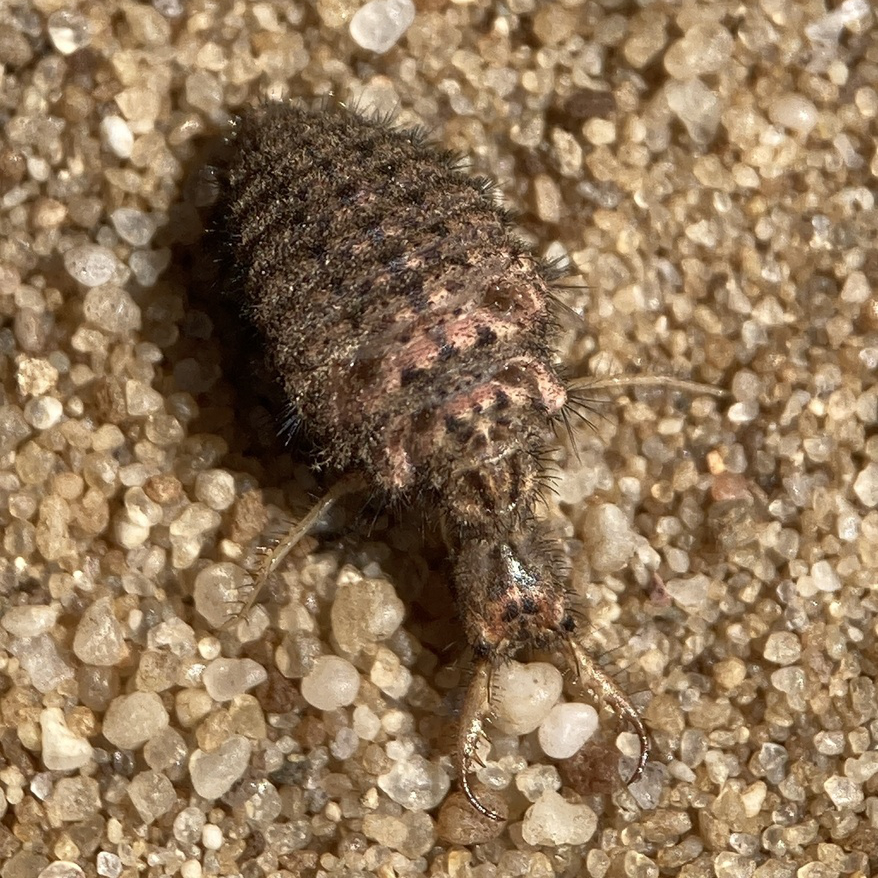 The Antlion (Euroleon nostras) is one of Britain’s rarest insects, and the Suffolk coast is its primary stronghold, with the majority of the UK’s known population concentrated on a small number of soft cliff sites between Kessingland and Southwold. The larva excavates a conical pit trap in fine, dry sand, in which it ambushes passing invertebrates; it requires specific conditions of loose, sheltered, sun-warmed sand that is maintained only by the natural erosion dynamics of actively retreating soft cliffs. Cliff stabilisation – even partial stabilisation – at or near Antlion sites is likely to directly damage this population. SBIS holds the most comprehensive dataset of Antlion records for the county; if you encounter this species, please submit your sighting.
Vision for Suffolk
The following priorities reflect the strategic goals for maritime cliffs and slopes in Suffolk, drawing on both the Biodiversity Action Plan framework and the Local Nature Recovery Strategy.
- Improve knowledge of the extent and condition of maritime cliffs and slopes across the county, including the distribution of specialist cliff invertebrate communities.
- Maintain the existing extent of maritime cliffs and slopes, recognising that managed retreat and the acceptance of natural erosion are the appropriate responses to sea level rise on this habitat.
- Resist cliff stabilisation measures that would eliminate the natural erosion processes on which the specialist communities of soft cliffs depend.
- Encourage restoration and improvement of degraded cliff-top grassland and the reinstatement of low-intensity grazing where it has been lost.
Further information
- Buglife – Advice on managing maritime cliffs and slopes
- Buglife – Notable invertebrates associated with maritime cliffs and slopes (PDF)
- JNCC – Habitat description: Maritime Cliffs and Slopes (PDF)
- MAGIC – Interactive mapping including designations
- Suffolk Wildlife Trust – Habitats Explorer: Maritime cliff
- Making Space for Nature – Lawton Review, Defra, 2010 (PDF, historical reference)
- The Natural Choice: Securing the Value of Nature – Natural Environment White Paper, 2011 (PDF, historical reference)
Suffolk’s Coastal and Marine Habitats
Key
A conservation priority in Suffolk’s Historic Biodiversity Action Plan.
A key habitat for recovery under Suffolk’s Local Nature Recovery Strategy.





Maritime cliffs and slopes are primarily a part of the Coastal and Marine habitat group, but also feature in these habitat groups: Shingle and Dune, Grass and Heath and Scrub and Mosaic.
Images: Covehithe © Emma Aldous, Antlion larvae © Mats Douma
 Archived Habitat Factsheet (PDF, 2020) Superseded – provided for reference only.
 Archived Suffolk BAP action plan (PDF, 2003) Superseded – provided for reference only.