
Wet Grassland and Rush Pasture
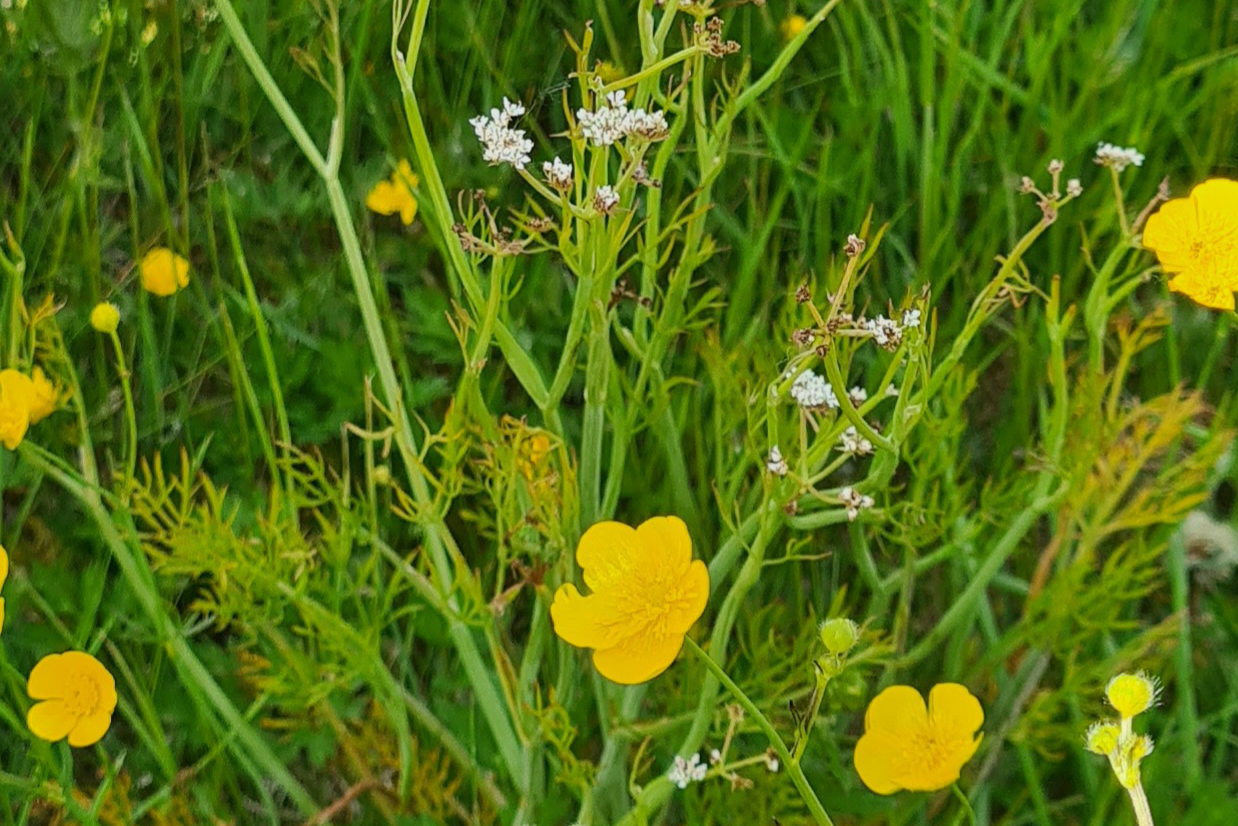
Wet grassland and rush pasture are found across Suffolk’s river valleys and flood plains, on poorly drained clay soils and at the margins of fens, ponds and watercourses. Wet grassland – periodically flooded or waterlogged pasture maintained by grazing or cutting – supports breeding waders, wintering wildfowl and a rich community of aquatic invertebrates and molluscs in its ditch and water feature network. Rush pasture, dominated by soft rush (Juncus effusus) or hard rush (Juncus inflexus) on more persistently waterlogged ground, forms a distinct but closely related habitat type, typically found at the wetter margins of grassland or as a transitional community between open water and drier pasture. Together, they make up some of the county’s most species-rich unimproved land.
Defining features
- Low-lying grassland on mineral or peaty soils with a high water table for all or part of the year, managed by grazing and in some cases cutting for hay.
- Typically includes a network of ditches, dykes, foot drains and water-filled hollows supporting a diverse aquatic community and providing key habitat for invertebrates, molluscs and amphibians.
- Rush pasture, dominated by soft rush (Juncus effusus) or hard rush (Juncus inflexus) on poorly drained, persistently waterlogged ground, often ungrazed or very lightly grazed. Typically occurs at the wetter margins of grazing grassland or as a transitional community between open water, fen and drier pasture.
- Tussocky rush pasture with deep litter accumulation provides overwintering habitat for invertebrates, nesting cover for Snipe and foraging habitat for Barn Owl and Short-eared Owl.
- Typically forms part of a wider wetland mosaic alongside fen, wet woodland, ponds and open water, with species moving freely between these habitats.
Importance for wildlife
Wet grassland provides the combination of open sward, shallow surface water and invertebrate-rich wet soil that breeding waders require for both nesting and chick-rearing. Lapwing, Redshank and Snipe all breed in Suffolk’s river valley wet grasslands. Snipe in particular favours the taller, denser sward of rush pasture over short-grazed grassland for nesting, while using adjacent wet grassland for feeding. In winter, flooded wet grassland and rush pasture support large flocks of wildfowl including Wigeon, Teal and Golden Plover, and are important hunting grounds for Barn Owl and Short-eared Owl.
The ditch systems running through wet grassland are ecologically as important as the sward itself. Suffolk’s inland wet grassland ditches support nationally scarce aquatic plants, specialist invertebrates and the full suite of amphibian species. The Little Whirlpool Ramshorn Snail – one of the rarest freshwater molluscs in Britain – depends on the clean, unpolluted ditch conditions found on the best sites. Water Vole remains associated with well-vegetated ditch networks in several Suffolk river valleys. Rush pasture adds a further dimension: the dense tussock structure provides a microclimate unavailable in open grassland, supporting overwintering invertebrates and the small mammals – including Water Shrew and Harvest Mouse – that forage and shelter within it.
Important associated species
Species marked * are Suffolk Priority species. Species marked ** are Priority – Research Only: common and widespread, but rapidly declining.
- Birds
Lapwing *, Redshank *, Snipe *, Yellow Wagtail *, Barn Owl *, Cuckoo, Reed Bunting
- Ferns and Flowering Plants
Tubular Water-Dropwort, Native Black Poplar *, River Water-dropwort, Marsh Orchid
- Freshwater Algae
- Mammals
Water Vole, Water Shrew *, Otter, Harvest Mouse, Common Pipistrelle *, Daubenton’s Bat *
- Molluscs
Desmoulin’s Whorl Snail, Narrow-mouth Whorl Snail, Little Whirlpool Ramshorn Snail
- Reptiles and Amphibians
Common Frog, Smooth Newt, Great Crested Newt, Common Toad, Grass Snake
Factors affecting this habitat in Suffolk
- Drainage and land improvement for arable or improved pasture, which eliminates the high water table, ditch network and botanical diversity that define the habitat.
- Water abstraction lowering the water table, reducing the seasonal flooding and saturated soil conditions on which breeding waders and specialist invertebrates depend.
- Inappropriate grazing management – either too intensive, causing sward damage and disturbance to nesting birds, or too light, allowing rank vegetation and invasive scrub to develop.
- Conversion of rush pasture to improved grassland through drainage, fertiliser application or heavy reseeding, eliminating the tussock structure and specialist communities the habitat supports.
- Eutrophication of ditch systems from agricultural run-off, leading to loss of aquatic plant diversity, deoxygenation and the collapse of invertebrate communities.
- Scrub encroachment on ungrazed or under-grazed sites, which fragments the open sward and progressively reduces the area suitable for breeding waders.
Habitat management advice
- Maintain high water levels throughout the year, with peak surface water and shallow flooding during the wader breeding season (March–July). Maintain ditch systems and water control structures to ensure that seasonal water-level variations reflect the needs of the key species present.
- Manage wet grassland by light cattle grazing, aiming for a relatively short, varied sward by late March to provide good visibility for nesting waders. Avoid cattle grazing in areas used for nesting between mid-March and May to prevent trampling. Sheep can be used outside these constraints on a light regime.
- Retain areas of rush pasture at the wetter margins of the site. Do not drain or heavily graze these areas; the dense tussock structure is valuable in its own right for Snipe, overwintering invertebrates and small mammals. Light cutting on a rotation – removing some tussock material but retaining structural complexity – prevents rush pasture becoming rank and monoculture without destroying its ecological value.
- Where rush pasture is becoming overly rank or scrub is establishing within it, cut in late summer and remove arisings. Avoid cutting in spring when Snipe and other ground-nesting birds may be present.
- Manage ditch systems using a rotational plan, clearing no more than a quarter of the network in any single year and timing operations to avoid the main invertebrate breeding season (May–August). Retain a varied ditch profile with both open and vegetated sections.
- Maintain water quality by preventing nutrient input from fertilisers and agricultural run-off. Create buffer strips between arable land and ditch margins.
- Control scrub encroachment through targeted cutting along field margins and ditch banks, retaining a limited amount of scrub at the site margins for shelter and nesting habitat.
Site spotlight: Waveney and Little Ouse valley fens
The river valleys of the Waveney and Little Ouse hold the largest concentration of inland wet grassland and rush pasture in Suffolk. Stretching from Diss in the north-west to Bungay and Beccles in the east, the valley floors retain extensive areas of traditionally managed wet grassland, fen, reedbed and rush pasture that together form one of the most ecologically significant wetland landscapes in East Anglia. Managed by a combination of the Suffolk Wildlife Trust, the RSPB, private landowners, and agri-environment scheme agreements, the valley supports breeding Lapwing, Snipe, Redshank, Curlew, and Marsh Harrier, nationally important populations of fen molluscs, and one of the few Suffolk locations where Water Vole populations remain relatively stable. The system demonstrates the value of coordinated water level management and sympathetic grazing across connected valley-floor landholdings.
Vision for Suffolk
The following priorities reflect the strategic goals for wet grassland and rush pasture in Suffolk, drawing on both the Biodiversity Action Plan framework and the Local Nature Recovery Strategy.
- Improve knowledge of the extent and condition of wet grassland and rush pasture across the county, including unrecorded valley-floor sites in private management.
- Maintain the existing extent of wet grassland and rush pasture to ensure no net loss, and protect the most significant river valley sites from drainage and agricultural improvement.
- Create new wet grassland where opportunities arise, particularly in association with river valley restoration, floodplain reconnection and the conversion of improved grassland on appropriate soils.
- Restore and enhance degraded wet grassland and rush pasture, prioritising sites where water level management can be reinstated and appropriate grazing regimes established.
Further information
- MAGIC – Interactive mapping including designations
- Suffolk Wildlife Trust – Habitats Explorer: Rivers and wetlands
- Making Space for Nature – Lawton Review, Defra, 2010 (PDF, historical reference)
- The Natural Choice: Securing the Value of Nature – Natural Environment White Paper, 2011 (PDF, historical reference)
Suffolk’s Reedbed and Wetland Habitats
Key
A conservation priority in Suffolk’s Historic Biodiversity Action Plan.
A key habitat for recovery under Suffolk’s Local Nature Recovery Strategy.




Wet Grassland and Rush Pasture are primarily a part of the Reedbeds habitat group, but also feature in these habitat groups: Coastal and Marine, Meadow and Pasture and River and Riverside.
Image: Buttercups and Narrow-leaved Water Dropwort (Oenanthe silaifolia) at Shalford Meadow CWS © Emma Aldous