
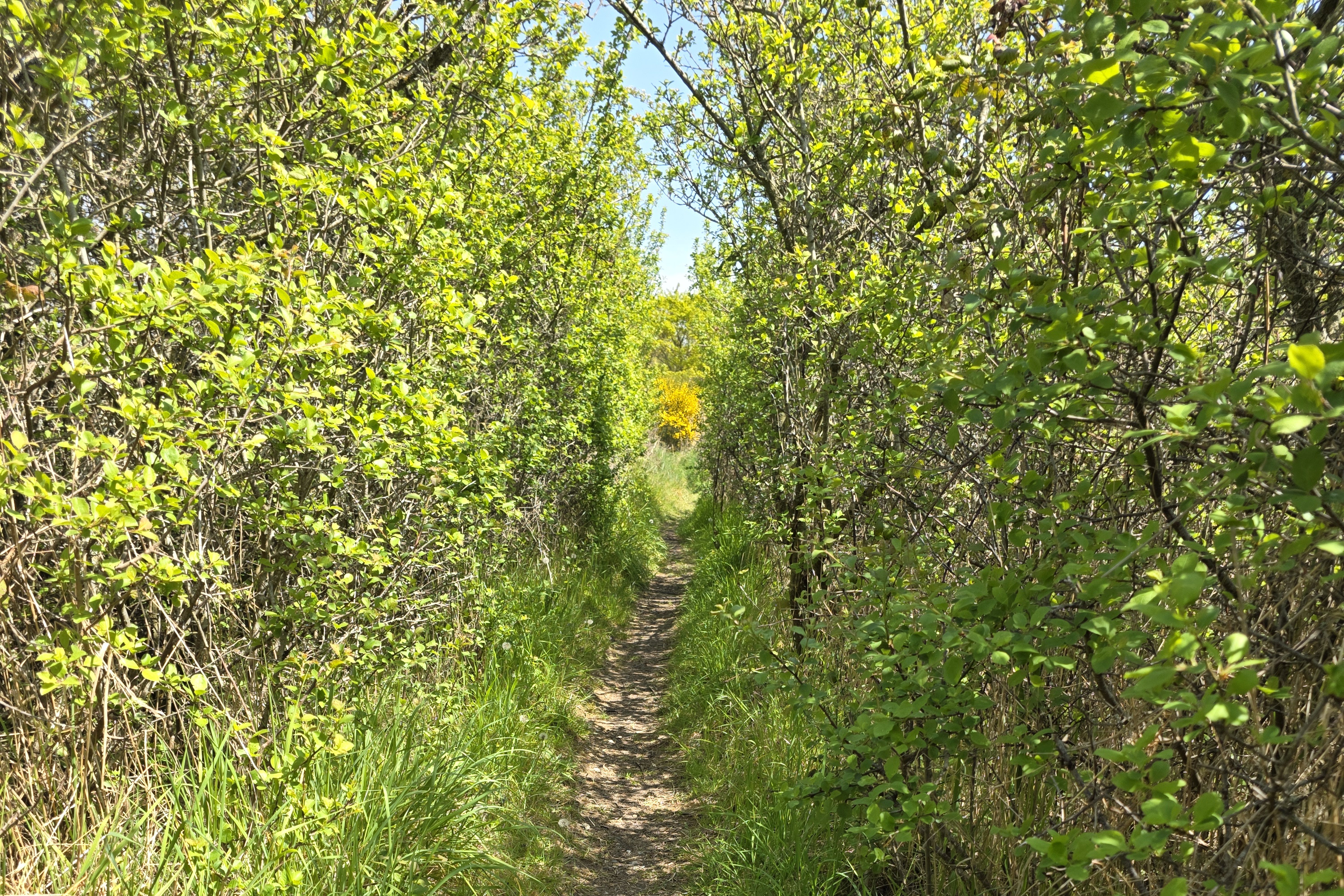
Scrub
Scrub – dense, shrubby vegetation dominated by native species such as Blackthorn, Hawthorn, Dog Rose, Elder, Bramble and Gorse, at all growth stages from scattered bushes to closed thicket – is one of the most productive wildlife habitats in the Suffolk landscape. In a county where arable cultivation dominates, and structural diversity in the countryside is scarce, scrub provides food, shelter and breeding habitat for a wide range of species that are poorly served by either open farmland or closed-canopy woodland. Its ecological value is often underestimated, but Suffolk’s best scrub – structurally diverse, well-connected and managed to maintain a range of successional stages – supports communities rivalling those of far more celebrated habitats.
Defining features
- Dense, shrubby vegetation dominated by native species, including Blackthorn, Hawthorn, Dog Rose, Elder, Bramble, Gorse, Sallow, Spindle and Privet. Scrub is typically less than five metres tall, though well-established thicket can exceed this.
- Encompasses all growth stages from scattered pioneer scrub on open ground to dense, multi-layered closed thicket. The ecological value of scrub depends significantly on structural diversity – sites with a range of ages, heights and species composition support the greatest breadth of wildlife.
- Often associated with woodland edges, hedge lines, road verges, downland margins, heath edges and coastal slopes, where it forms a transitional zone between open and closed habitats.
- Bramble understorey, thorny thicket, berry-bearing shrubs and a sheltered, humid interior microclimate are the key structural features for many specialist species.
Importance for wildlife
Scrub is the primary breeding habitat of the Nightingale in Suffolk, and the county holds one of the most significant Nightingale populations in England. Nightingales require a tall, dense thicket of at least three metres in height and four metres in width, ideally with a ground layer of leaf litter and bare or sparsely vegetated soil for foraging. The loss and deterioration of this specific structural condition – through under-management, development and agricultural clearance – are the principal reasons for the Nightingale’s steep national decline. Other scrub-nesting birds, including Lesser Whitethroat, Whitethroat, Bullfinch, Yellowhammer and Turtle Dove, depend on scrub for breeding and feeding, and scrub-dominated landscapes support some of the most productive territories for farmland bird species in the county.
Scrub also provides some of the most important reptile habitat in lowland Suffolk. Adder, Common Lizard, Slow-worm and Grass Snake all benefit from the combination of sun-warmed open patches at the scrub edge, sheltered hibernation sites within dense thicket, and the prey populations sustained by the habitat’s invertebrate richness. Hazel Dormice depend on interconnected scrub and hedgerow systems for movement across the landscape, and the berry and seed crops produced by scrub species, including Blackthorn, Hawthorn, Dog Rose and Elder, are a critical food resource for migrant and wintering birds in autumn and winter.
Important associated species
Species marked * are Suffolk Priority species. Species marked ** are Priority – Research Only: common and widespread, but rapidly declining.
- Birds
Nightingale, Turtle Dove *, Bullfinch, Yellowhammer, Lesser Whitethroat, Dunnock, Song Thrush, Linnet
- Butterflies
Brown Hairstreak, Black Hairstreak, White-letter Hairstreak
- Mammals
Hazel Dormouse, Hedgehog, Harvest Mouse, Common Pipistrelle *, Soprano Pipistrelle
- Moths
White Pinion Spotted, Lackey, Scarce Merveille du Jour
- Reptiles and Amphibians
Factors affecting this habitat in Suffolk
- Agricultural clearance and development, which removes scrub as an unproductive or untidy land use, without recognition of its ecological value.
- Inappropriate management – particularly over-cutting that removes the tall, dense thicket structure on which Nightingale and other species depend, or cutting during the breeding season (April–August) when scrub birds are nesting.
- Under-management and succession: unmanaged scrub eventually closes to woodland, losing the structural diversity – particularly the open edges, bramble understorey and thicket patches – that many specialist species require.
- Deer browsing, which can suppress scrub regeneration by preventing young shoots establishing, and erode the understorey structure of existing scrub by grazing out the ground layer.
- Fragmentation of scrub into small, isolated patches that cannot support viable populations of species such as Nightingale, which requires a substantial area of suitable thicket within a single territory.
- Loss of scrub connectivity reduces the ability of species, including Hazel Dormouse, to move between habitat patches.
Habitat management advice
- Manage scrub to maintain a diversity of age classes and structural stages simultaneously. The most valuable scrub contains a mix of pioneer scrub on open ground, mid-succession bushy growth, dense thicket at least three metres tall, and scrub edge transitioning to open grassland or heath. Avoid managing the whole site to a single structural condition.
- Prioritise the thicket stage for Nightingale management. Nightingales require dense, tall thicket – at minimum three metres tall and four metres wide – with a ground layer of bare or sparsely vegetated soil beneath. Where scrub is managed for this species, cut blocks in rotation over 15–20 year cycles rather than cutting the whole site simultaneously.
- Cut scrub in substantial blocks rather than many small, scattered patches. Dense, connected areas of thicket are more valuable than the same area fragmented across a site, both for Nightingale territories and for the interior microclimate that specialist invertebrates depend on.
- Never cut scrub between April and August. All scrub-nesting birds are either breeding or have dependent young during this period, and cutting during this window will destroy nests and kill chicks.
- Retain bramble as a component of the scrub ground layer wherever possible. Bramble provides nesting cover for Nightingale and other species, late-season nectar for invertebrates, fruit for birds and small mammals, and foraging habitat for insectivores.
- Maintain scrub connectivity through the landscape, treating hedgerows, scrubby field margins and road verges as components of a wider scrub network. For Hazel Dormouse, well-connected hedgerow systems are as important as the scrub patches they link.
- Manage deer to sustainable levels. High deer densities prevent scrub regeneration and erode the understorey structure of existing scrub, ultimately reducing its value for all scrub-associated species.
- Where scrub occurs on road verges, coppice on long rotations of 10–15 years rather than annual cutting. Long-rotation management retains the tall, dense growth that wildlife requires and is compatible with safety maintenance.
Suffolk’s Nightingale strongholds
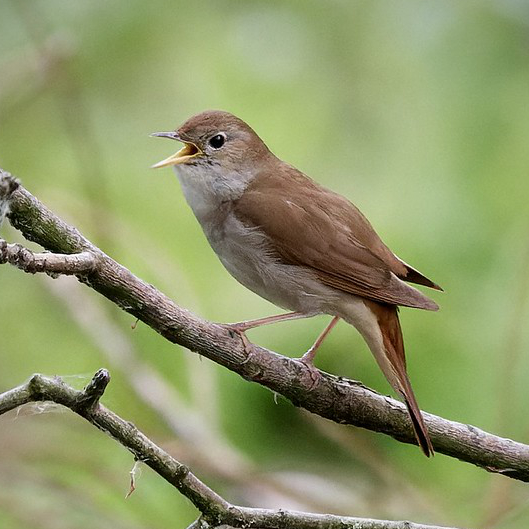
Suffolk holds one of the largest Nightingale populations in England, concentrated particularly in the Sandlings – the heathland belt along the coast and Deben and Orwell valleys – and in the clayland river valleys of mid-Suffolk. The county’s Nightingales arrive in late April from their wintering grounds in sub-Saharan Africa and are almost entirely dependent on tall, dense Blackthorn and mixed thicket for nesting. Regular surveys indicate that Suffolk’s population, while significant nationally, has declined in line with the broader national trend as scrub management and creation have not kept pace with the loss and deterioration of suitable habitat. Targeted scrub management for Nightingale, aligned with LNRS priorities, is the principal conservation intervention available to reverse this.
Vision for Suffolk
The following priorities reflect the strategic goals for scrub in Suffolk, drawing on both the Biodiversity Action Plan framework and the Local Nature Recovery Strategy.
- Improve knowledge of the extent, condition and management of scrub habitat across the county, including unrecorded scrub on road verges, field margins and coastal slopes.
- Maintain the existing extent of scrub to ensure no net loss, and resist clearance of structurally diverse or well-connected scrub without robust ecological justification.
- Create new scrub where opportunities arise, particularly on former arable margins, heath edges and within woodland management plans as part of a structured succession mosaic.
- Restore and enhance existing scrub by introducing active management where it has been neglected or managed too frequently, and by improving connectivity between fragmented scrub patches through hedgerow management and habitat creation.
Further information
- British Trust for Ornithology – Nightingale survey and population data
- Butterfly Conservation – Woodland and scrub habitat management
- JNCC – Habitat description: Scrub (PDF)
- MAGIC – Interactive mapping including designations
- People’s Trust for Endangered Species – Hazel Dormouse conservation
- Suffolk Wildlife Trust – Habitats Explorer: Scrub
- Making Space for Nature – Lawton Review, Defra, 2010 (PDF, historical reference)
- The Natural Choice: Securing the Value of Nature – Natural Environment White Paper, 2011 (PDF, historical reference)
Suffolk’s Scrub and Mosaic Habitats
Key
A conservation priority in Suffolk’s Historic Biodiversity Action Plan.
A key habitat for recovery under Suffolk’s Local Nature Recovery Strategy.


Scrub is primarily a part of the Scrub and Mosaic habitat group, but also features in these habitat groups: Urban, Built and Garden and Woodland.
Images: Scrub at Blythburgh © Emma Aldous, Nightingale © René Vlak