
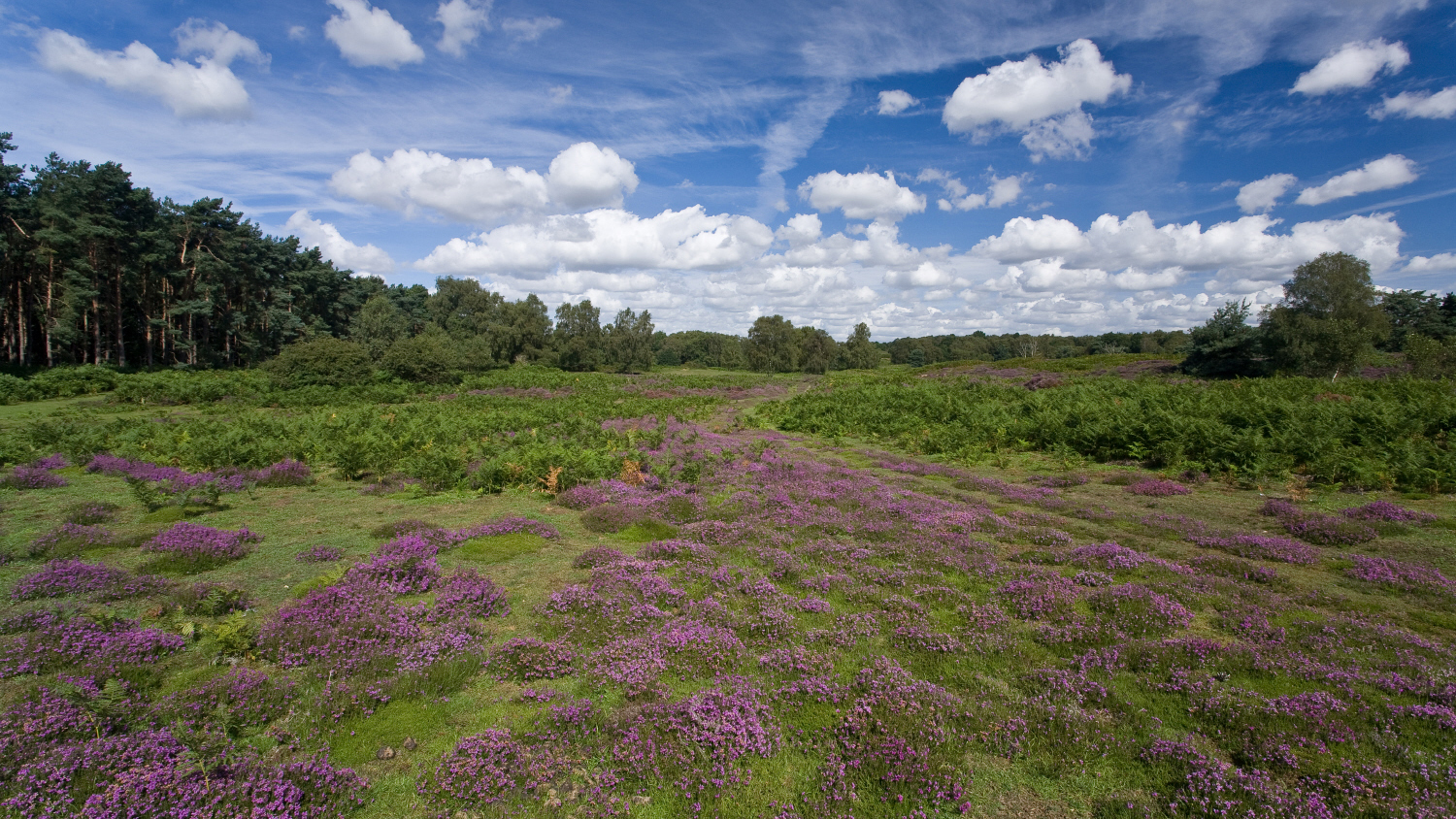
Heathland and Acid Grasslands
Suffolk’s heathlands are among the county’s most ecologically distinctive and threatened habitats. Developing on nutrient-poor, freely draining soils overlying sands and gravels, they support a mosaic of dwarf-shrub heath, acid grassland, bare ground, bracken, gorse, and scattered trees that has no equivalent in the wider farmed landscape. The Sandlings – the heathland belt running along the coast and Deben and Orwell valleys – and the Breckland grassland-heaths are the principal concentrations, both supporting nationally scarce species of birds, invertebrates, reptiles and plants found at very few other sites in Britain. Only around 8% of Suffolk’s Sandlings heathland survives; the loss of the rest, primarily to afforestation and agricultural improvement in the twentieth century, means that what remains is irreplaceable.
Defining features
- Occurs on nutrient-poor, freely draining soils with a pH of 4–5.5, overlying sandy or gravelly deposits. Low soil fertility is the defining ecological condition; enrichment rapidly and often irreversibly degrades the habitat.
- Typically comprises a matrix of dwarf shrub heath (dominated by heather, bell heather and cross-leaved Heath), dry acid grassland, bare sandy ground, patches of bracken, gorse and broom, and scattered trees or scrub.
- The Sandlings heathlands of coastal and central Suffolk and the Breckland grass-heaths of the north-west represent the two principal Suffolk forms, each with a distinct species assemblage reflecting differences in soil, climate and management history.
- A mosaic of structural stages – from bare ground to pioneer grassland, open heath, established dwarf shrub and encroaching scrub – provides the habitat heterogeneity that underpins the biodiversity of the habitat.
Importance for wildlife
Heathland and acid grassland support a suite of species dependent on the combination of low soil fertility, warm sandy substrates and open, structurally varied vegetation found in very few other lowland habitats. Nightjar and Woodlark – both birds of European conservation concern – breed predominantly on Suffolk’s heaths, requiring the open, sparsely vegetated structure maintained by grazing and management. Stone Curlew is closely associated with the open Breckland grass-heath, where it nests on bare or very sparsely vegetated ground. The Silver-studded Blue butterfly, largely confined to southern heathlands, depends on the precise combination of Bell Heather and fine-leaved grasses maintained by grazing and periodic disturbance.
The bare and sparsely vegetated sandy ground that characterises well-managed heathland supports an exceptional assemblage of solitary bees, wasps and beetles – many of them nationally scarce or rare – that burrow into warm sand to nest and depend on specific plant species for pollen. Reptiles, including all six British species on some Sandlings sites, benefit from the basking opportunities provided by open ground at the heath edge and within rides. The low-nutrient grassland supports rare plants including Clustered Clover, Suffocated Clover, Mossy Stonecrop and a suite of Breckland specialists, and acid grassland in good condition is rich in mosses, lichens and specialist fungi including Waxcaps and Nail Fungus.
Important associated species
Species marked * are Suffolk Priority species. Species marked ** are Priority – Research Only: common and widespread, but rapidly declining.
- Ants, Bees and Wasps
Brown-banded Carder Bee, Moss Carder Bee, Red-shanked Carder Bee, Weevil Hunting Wasp, Five-banded Tailed Digger Wasp
- Beetles
Wormwood Moonshiner, Brush-thighed Seed-eater, Set-aside Downy-back
- Birds
Dunnock, Grasshopper Warbler, Cuckoo, Lesser Redpoll, Tree Pipit, Nightjar *, Stone Curlew *, Woodlark *, Linnet, Skylark *, Yellowhammer
- Butterflies
Small Heath (acid grassland), Grayling, Dingy Skipper, Silver-studded Blue
- Ferns and Flowering Plants
Field Wormwood, Purple Milk-Vetch, Rare Spring-Sedge, Grape Hyacinth, Spanish Catchfly, Fingered Speedwell, Spring Speedwell, Red-tipped Cudweed, Tower Mustard, Annual Knawel, Fine-leaved Sandwort
- Lichens
Starry Breck-lichen (calcareous – Brecks), Scaly Breck-lichen (calcareous – Brecks), Thalloidima physaroides, Thalloidima sedifolia
- Liverworts and Mosses
Pitted Frillwort, Thatch Moss (acid grassland), Veilwort (acid grassland)
- Moths
Dingy Mocha, Bordered Gothic, Lunar Yellow Underwing, Pale Shining Brown, Grey Dagger **, Knot Grass **, Flounced Chestnut **, Brown-spot Pinion **, Beaded Chestnut **, Ear Moth **, Mouse Moth **, Deep-brown Dart **, Garden Tiger **, Dark Brocade **, Minor Shoulder-knot **, Mottled Rustic **, Streak **, Broom-tip **, Latticed Heath **, Small Square-spot **, Small Phoenix **, Autumnal Rustic **, White-line Dart **, Ghost Moth **, Rustic **, Rosy Rustic **, Brindled Beauty **, Lackey **, Dot Moth **, Broom Moth **, Rosy Minor **, Shoulder-striped Wainscot **, Powdered Quaker **, Mullein Wave **, White Ermine **, Buff Ermine **, Anomalous **, Hedge Rustic **, Feathered Gothic **, Blood-vein **, Pale Eggar **, Cinnabar **, Oak Hook-tip (oak trees) **, Sallow **, Dark-barred Twin-Spot Carpet **, Heath Rustic **, Neglected Rustic **
- Other Invertebrates
Antlion *
- Reptiles and Amphibians
Common Lizard, Grass Snake, Slow-worm, Common Toad, Natterjack Toad
- Spiders
Notable invertebrates
The following species have been recorded from heathland and acid grassland in Suffolk and carry national conservation designations. See the key below the species list for an explanation of designation categories.
- Grasshoppers, crickets and allies (Orthoptera)
- Stenobothrus lineatus – should be considered worthy of conservation
- True Bugs (Hemiptera)
Heteroptera
- Arenocoris waltli – RDB2
- Lygus pratensis – RDB3
- Legnotus picipes – Nb
- Odontoscelis lineola – Nb
- Spathocera dahlmanni – Nb
- Graptopeltus lynceus – Nb
- Megalonotus praetextatus – Nb
- Megalonotus sabulicola – Nb
- Chlamydatus pulicarius – Nb
- Syromastes rhombeus – Local
- Arenocoris falleni – Local
- Ceraleptes lividus – Local
- Eremocoris podagricus – Local
- Berytinus crassipes – Local
- Berytinus signoreti – Local
- Coranus subapterus – Local
- Conostethus roseus – Local
Leafhoppers and allies (Auchenorrhyncha)
- Ribautodelphax angulosus – Nb
- Flies (Diptera)
Acalyptrata (snail-killing flies, picture-wing flies and allies)
- Oscinimorpha arcuata (Chloropidae) – N
Larger Brachycera (soldier flies, bee flies, robber flies and allies)
- Eutolmus rufibarbis – RDB3
Calyptrata (blowflies, dungflies and allies)
- Freraea gagatea (Tachinidae) – RDB3
- Subclytia rotundiventris (Tachinidae) – RDB3
- Coenosia atra (Muscidae) – N
- Miltogramma germari (Sarcophagidae) – RDB3
- Sarcophila latifrons (Sarcophagidae) – N
- Eurithia intermedia (Tachinidae) – N
Several ungraded calypterates also have a strong association with acid grassland, including Dexia rustica, Linnaemyia vulpina, Medina collaris, Metopia staegerii and Prosena siberita.
- Beetles (Coleoptera)
Ground beetles (Adephaga)
- Harpalus froelichii – BAP Priority, RDB2
- Amara fusca – RDB1
- Bradycellus csikii – RDB1
- Harpalus pumilus – Na
- Amara consularis – Nb
- Amara equestris – Nb
- Amara fulva – Nb
- Amara lucida – Nb
- Calathus ambiguus – Nb
- Harpalus smaragdinus – Nb
- Licinus depressus – Nb
Leaf beetles (Chrysomelidae)
- Psylliodes sophiae – RDB2
- Cassida nebulosa – RDBK
- Mantura rustica – Nb
Weevils (Curculionoidea)
- Apion rubiginosum – RDB3
- Protapion dissimile – Nb
- Ceutorhynchus atomus – Na
- Acalles ptinoides – Nb
Dry acid grassland is less rich than calcareous grassland for weevils. Several listed species are not strictly grassland species but are included because their habitats are not appropriately assigned to any other Priority Habitat.
Rove beetles and allies (Staphylinidae)
- Heterothops dissimilis – RDBK
- Stenus aceris – Local
- Quedius aridulus – Local
- Ousipalia caesula – Local
Dung beetles and chafers (Scarabaeidae)
- Aphodius sordidus – Na
- Aphodius coenosus – Nb
- Aphodius distinctus – Nb
- Aphodius paykulli – Nb
Earth-boring dung beetles (Geotrupidae)
- Trypocopris vernalis – Local
- Ants, bees and wasps (Hymenoptera: Aculeata)
- Cerceris quadricincta – BAP Priority
- Cerceris quinquefasciata – BAP Priority
- Andrena alfkenella – RDB3
- Halictus confusus – RDB3
- Heriades truncorum – RDB3, very rare
- Hedychridium roseum – Scarce
- Hedychrum niemelai – RDB3, Scarce
- Pseudospinolia neglecta – Scarce
- Smicromyrme rufipes – Nb, Scarce
- Tiphia femorata – Scarce
- Caliadurgus fasciatellus – Scarce
- Priocnemis agilis – Nb, Scarce
- Diodontus insidiosus – RDB3, Scarce
- Nysson dimidiatus – Nb, Scarce
- Colletes marginatus – RDB3, Na, Scarce
- Andrena bimaculata – Nb, Scarce
- Andrena hattorfiana – RDB3, Scarce
- Andrena humilis – Nb, Scarce
- Andrena labiata – RDB3, Na, Scarce
Designation key
- RDB1 – Red Data Book Category 1: Endangered
Taxa in danger of extinction and whose survival is unlikely if the causal factors continue operating.
- RDB2 – Red Data Book Category 2: Vulnerable
Taxa not currently endangered but at risk. Typically occur in 15 or fewer 10km squares, or are more widespread but dependent on especially vulnerable habitat.
- RDB3 – Red Data Book Category 3: Rare
Species occurring in small populations and at risk, though not currently endangered or vulnerable. Occur in 15 or fewer 10km squares, or are more widespread but dependent on especially vulnerable habitat.
- RDBK – Red Data Book: status unknown
Species listed in the Red Data Book but with unknown status, thought to be rare.
- Na – Nationally Scarce Category A
Uncommon in Great Britain; thought to occur in 30 or fewer 10km squares (typically 16–30), or in seven or fewer vice-counties for less well-recorded groups.
- Nb – Nationally Scarce Category B
Uncommon in Great Britain; thought to occur in between 31 and 100 10km squares, or between eight and 20 vice-counties for less well-recorded groups.
- N – Nationally Scarce
Used where information is insufficient to assign Na or Nb. Thought to occur in between 16 and 100 10km squares.
- Local
Found in restricted habitats.
- BAP Priority Species
Listed under Section 41 of the Natural Environment and Rural Communities Act 2006 as priorities for conservation action.
Factors affecting this habitat in Suffolk
- Nutrient enrichment from agricultural run-off and atmospheric nitrogen deposition, which promotes rank, competitive vegetation that smothers specialist invertebrate colonies and displaces the low-growing plants on which the habitat depends. Spray drift from adjacent farmland is also a problem in the absence of buffer zones.
- Over- or under-grazing. Under-grazing – including following periodic declines in rabbit populations – allows Bracken, scrub and coarse grasses to encroach and close the open structure the habitat requires. Over-grazing removes structural complexity and can damage light, free-draining soils. Supplementary feeding of grazing animals enriches the soil locally.
- Summer wildfires, which can destroy Silver-studded Blue colonies, kill ground-nesting wildlife and damage the soil and vegetation in ways that take years to recover. Controlled burning, by contrast, can be a useful management tool when applied correctly.
- Development, change of land use and drainage of wet areas within or adjacent to heath, which destroys habitat permanently and reduces the extent of the remaining network.
- Fragmentation and isolation: only around 8% of the Sandlings heathland survives, leaving remaining sites increasingly isolated from one another and reducing the capacity for species to move between them.
- Management of golf courses, which can introduce irrigation, fertiliser and lime application that alters vegetation composition in areas of acid grassland managed as roughs.
- Disturbance to sensitive species, including ground-nesting birds such as Nightjar, Woodlark and Stone Curlew, from recreational use that is poorly managed relative to the breeding season.
Habitat management advice
- Maintain structural diversity across the site, including areas of bare sand, short acid turf, tussocky grassland, open heath, gorse, and a limited amount of scrub. Banks and south-facing slopes provide warm, sheltered conditions for basking reptiles and nesting solitary bees and wasps. Flower-rich areas provide nectar and pollen for specialist insects. All stages are valuable: management should aim to maintain the mosaic, not achieve a single end-state.
- Maintain light grazing to prevent Bracken invasion and keep succession to scrub and woodland in check. Avoid over-grazing. Where avermectin wormers are used on livestock, keep animals off the site for at least ten days after treatment to protect dung invertebrates.
- Encourage rabbit grazing on dry grass-heath, where it is often the most effective means of maintaining the very short, open turf that specialist plants and invertebrates require.
- Retain natural drainage, including any wetland, flush or seepage areas within or at the margins of the heath. These features support specialist communities of their own and are disproportionately valuable to the overall species diversity of the site.
- Where cutting is used, maintain a mosaic of cut and uncut patches and remove all cuttings to avoid enriching the soil. Cutting may not be necessary on the poorest soils, and machinery should be used with caution as it can compact light sandy substrates.
- Manage Gorse and Heather on a rotational basis, cutting or burning sections in rotation rather than the whole site, to maintain a continuous supply of young growth for specialist invertebrates and nesting habitat for Dartford Warbler and Nightjar.
- Where traditional management has included mechanical disturbance of the soil – including ploughing in Breckland – continue this on an appropriate rotation. Check for archaeological features before any ground disturbance on unrecorded sites.
- Control Bracken using herbicides where necessary; Natural England Technical Information Note TIN048 provides guidance on appropriate methods. Do not use the same mechanical approach across the whole site simultaneously.
- Do not change the management of a designated Site of Special Scientific Interest without prior consultation with Natural England.
The Sandlings: Suffolk’s coastal heaths
The Sandlings is the name given to the belt of sandy, heathy landscape running along the Suffolk coast from Lowestoft south to Ipswich, and extending inland along the Deben and Orwell valleys. Once one of the most extensive lowland heath landscapes in England, the Sandlings lost the vast majority of its open habitat during the twentieth century to conifer afforestation and agricultural improvement. What remains is fragmented but ecologically rich: the surviving heaths – at Minsmere, Dunwich, Sutton, Rendlesham and elsewhere – support breeding Nightjar, Woodlark, Dartford Warbler and Tree Pipit, nationally important Silver-studded Blue colonies, the Antlion on a handful of coastal sites, and one of the strongest concentrations of heathland reptile communities in the region. Reconnecting and buffering the surviving heath blocks is a strategic priority for the Suffolk Local Nature Recovery Strategy.
Vision for Suffolk
The following priorities reflect the strategic goals for heathland and acid grasslands in Suffolk, drawing on both the Biodiversity Action Plan framework and the Local Nature Recovery Strategy.
- Improve knowledge of the extent and condition of lowland dry acid grasslands and heathlands across the county.
- Maintain the existing extent of lowland dry acid grasslands and heathlands to ensure no further net loss.
- Re-create heathland and acid grassland where opportunities arise, prioritising locations that buffer or connect existing heath blocks and using locally appropriate seed sources.
- Encourage the restoration and improvement of degraded sites, including former heathland under conifer plantation, prioritising those with the best potential for reconnection to surviving heath.
Further information
- Buglife – Advice on managing BAP habitats: dry acid grassland, heathland
- Buglife – Notable invertebrates (PDF): dry acid grassland, heathland
- Forest Research – Best Practice Guidelines for heathland management (PDF)
- JNCC – Habitat descriptions (PDF): dry acid grassland, heathland
- MAGIC – Interactive mapping including designations
- Natural England – Lowland Dry Acid Grassland (Publication 19) (PDF)
- Natural England – National Character Area 85: Breckland (PDF)
- Natural England – Technical Information Note TIN048: Bracken management and control (PDF)
- Plantlife – Important Plant Areas: Breckland
- Suffolk Wildlife Trust – Habitats Explorer: dry acid grassland, heathland
- Making Space for Nature – Lawton Review, Defra, 2010 (PDF, historical reference)
- The Natural Choice: Securing the Value of Nature – Natural Environment White Paper, 2011 (PDF, historical reference)
Suffolk’s Grass and Heath Habitats
Key
A conservation priority in Suffolk’s Historic Biodiversity Action Plan.
A key habitat for recovery under Suffolk’s Local Nature Recovery Strategy.
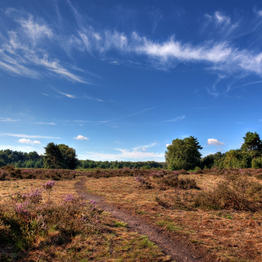


Heathland and Acid Grassland is primarily a part of the Grass and Heath habitat group, but also features in these habitat groups: Coastal and Marine, Shingle and Dune and Scrub and Mosaic.
Image: Blaxhall Common © Steve Aylward

 Archived Suffolk BAP action plan (PDF, 2007) Superseded – provided for reference only.
 Suffolk State of Nature: Heathland, SBRC 2005