
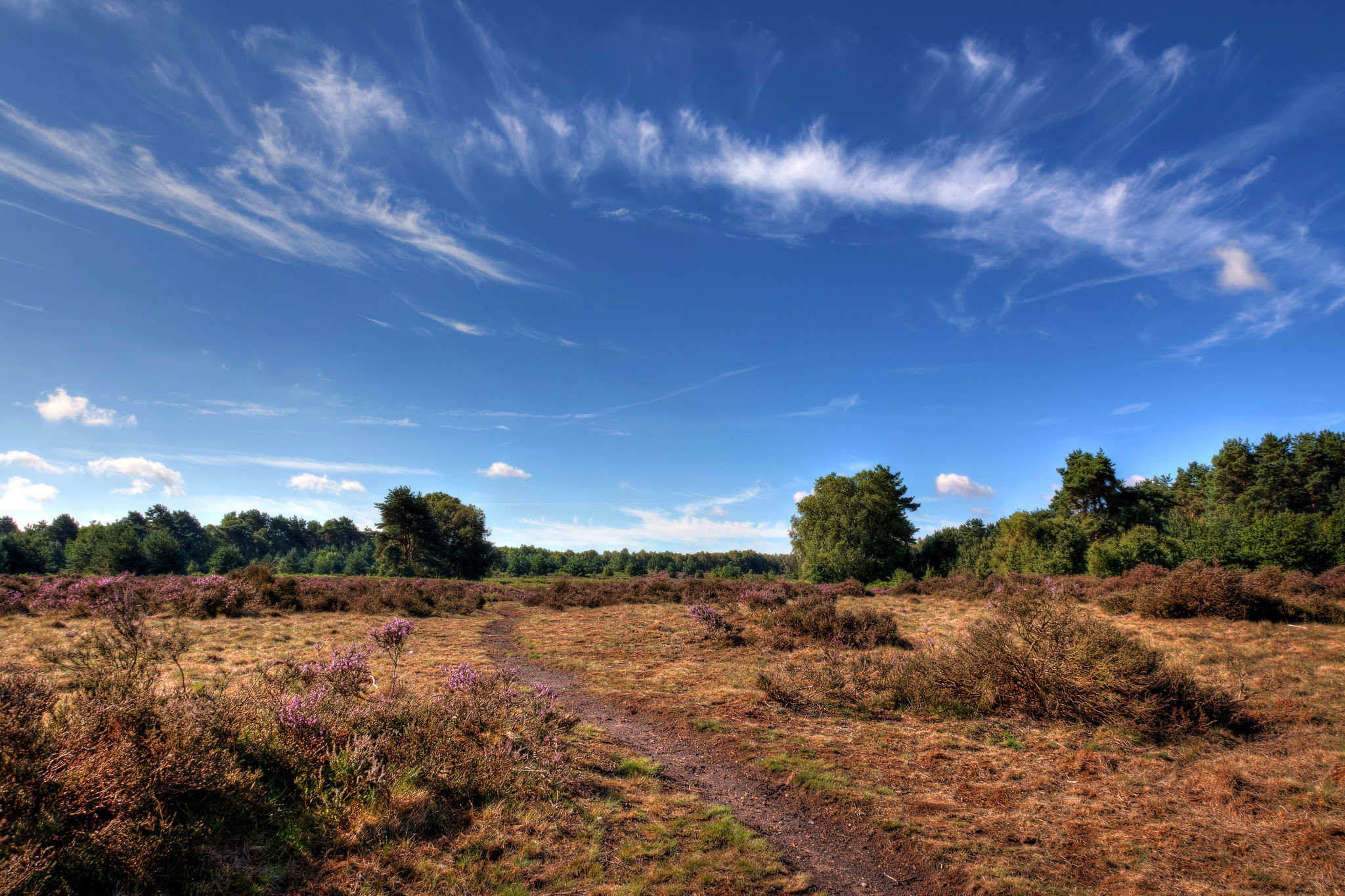
Brecks Grass-Heath
Brecks Grass-Heath occupies a unique position in British natural history. Developing on the chalk-influenced sands of the Brecks – a landscape straddling the Suffolk-Norfolk border that takes its name from the ancient practice of temporarily breaking up sandy ground for cultivation – they support plant and invertebrate assemblages more reminiscent of central European steppe than English downland. The combination of a semi-continental climate, nutrient-poor substrates, extreme temperature variation and centuries of rabbit and sheep grazing has produced conditions in which species at the westernmost limit of their European range can persist. These communities cannot be replicated anywhere else in Britain, and the fragments that survive are of international conservation significance.
Defining features
- Develop on chalk-influenced sandy soils in the Breckland, a landscape straddling the Suffolk-Norfolk border characterised by freely draining, low-nutrient substrates overlying chalk.
- Influenced by a distinctively semi-continental climate: warm, dry summers, cold winters and high diurnal temperature variation that regularly exceeds the range experienced by other lowland grassland types in Britain.
- The name “Brecks” derives from the historic practice of breaking up sandy ground for temporary cultivation, then abandoning it – a cycle that created and maintained the disturbed, open conditions on which many specialist species depend.
- Maintained by rabbit and sheep grazing, which produces the characteristically short, open turf, bare sand and gravel patches that are essential to the habitat’s specialist communities.
- Typically forms a mosaic with Breckland heathland, bare sand, patches of sparse vegetation and open disturbed ground, often in close proximity across a single site.
Importance for wildlife
Breckland grasslands are ecologically unlike any other grassland type in lowland Britain. The semi-continental climate, combined with highly porous soils that dry out rapidly and create surface temperatures far exceeding those of surrounding habitats, produces conditions that a suite of specialist plants and invertebrates has evolved to exploit. Several of the plants associated with Breckland grassland – including Spanish Catchfly, Field Wormwood and Fingered Speedwell – are found at very few other British sites, their populations here representing outliers from their main continental distributions. The terricolous lichen communities, including the nationally threatened Starry Breck-lichen, develop on the bare, stable sandy ground between the turf and are among the most sensitive indicators of undisturbed Breckland conditions.
The grassland’s open, sparsely vegetated character makes it essential for Stone Curlew, one of Britain’s most threatened breeding birds, which requires extensive areas of open ground with very short or absent vegetation for nesting and foraging. Woodlark and Skylark also breed in the open Breckland landscape. The Brown Hare is strongly associated with this habitat, and the warm, bare sandy ground supports assemblages of specialist beetles – including several species found at few other sites in England – that depend on the combination of open substrate and high soil temperatures found in the Brecks. The Grayling butterfly, which favours bare or sparsely vegetated, sun-warmed sandy ground, retains important populations in the Brecks.
Important associated species
Species marked * are Suffolk Priority species. Species marked ** are Priority – Research Only: common and widespread, but rapidly declining.
- Beetles
Wormwood Moonshiner, Pashford Pot Beetle, Brush-thighed Seed-eater
- Birds
- Butterflies
- Ferns and Flowering Plants
Spanish Catchfly, Basil Thyme, Field Wormwood, Fingered Speedwell, Spring Speedwell, Grape Hyacinth, Annual Knawel, Fine-leaved Sandwort, Tower Mustard, Rare Spring-Sedge, Purple Milk-Vetch, Frog Orchid
- Lichens
- Mammals
- Moths
Factors affecting this habitat in Suffolk
- Large-scale afforestation during the twentieth century, primarily for timber production, eliminated the majority of open Breckland habitat across both Suffolk and Norfolk. Thetford Forest now covers much of the former open landscape, and the ecological legacy of this loss continues to limit recovery.
- Agricultural intensification, including the conversion of remaining grassland to arable, the application of fertilisers and herbicides, and the loss of traditional mixed farming practices that sustained open ground conditions.
- Decline of rabbit populations, historically the primary grazers of Breckland turf. Although rabbits remain present, repeated outbreaks of myxomatosis and rabbit haemorrhagic disease have caused periodic population crashes, allowing scrub and rank vegetation to establish rapidly on formerly open ground.
- Scrub and bracken encroachment, which shades out the specialist low-growing plants and bare ground communities, and closes the open structure on which Stone Curlew, Woodlark and specialist invertebrates depend.
- Fragmentation of the remaining habitat into small, isolated patches reduces connectivity among populations and increases the extinction risk for the most sedentary species.
- Recreational pressure, particularly off-road vehicles and dog walking, can damage the sparse vegetation and disturb nesting Stone Curlew and Woodlark during the breeding season.
Habitat management advice
- Maintain open, short-turf conditions through a combination of rabbit and sheep grazing. Rabbit grazing is often the primary driver of the most valuable bare-ground and ultra-short-turf conditions, but sheep grazing can supplement this on sites with active management. Avoid over-grazing, which degrades the turf structure, and monitor for under-grazing, particularly in years following rabbit population crashes.
- Retain and protect areas of bare sand and gravel, which are used by specialist beetles, solitary bees and wasps, and are essential for the establishment of terricolous lichens and annual Breckland plants.
- Control scrub and bracken encroachment through targeted clearance, prioritising areas adjacent to open turf and bare ground. Remove scrub by cutting or pulling and treat stumps to prevent regrowth; do not burn scrub adjacent to lichen communities, which are highly vulnerable to fire damage.
- Maintain rabbit warrens and avoid disturbing them during management operations. Rabbit grazing is often the most cost-effective way to maintain short-turf conditions across large areas of Breckland that would be impractical to manage intensively by other means.
- Manage Stone Curlew nesting areas carefully, avoiding disturbance between March and August. Where arable land adjacent to grassland is managed for Stone Curlew, maintain areas of very sparse or absent vegetation and consider leaving fields uncropped in appropriate locations.
- Create and maintain disturbed ground features through harrowing, light cultivation, or tracked-vehicle use on sandy substrates to renew open conditions and provide bare ground for specialist annual plants and invertebrates.
- Avoid any application of fertilisers or soil amelioration. The low nutrient status of Breckland soils is fundamental to the habitat’s ecological value; enrichment rapidly shifts the vegetation towards competitive grasses and eliminates specialist flora within a few growing seasons.
Site spotlight: Stone Curlew recovery in the Brecks
The Breckland is the British stronghold of the Stone Curlew, a cryptic wading bird whose open-ground nesting requirements make it entirely dependent on the short, sparsely vegetated turf of Breckland grasslands and adjacent arable land. The species declined severely during the twentieth century as open habitats were lost to afforestation and agricultural intensification, but a long-term partnership between the RSPB, Natural England and Breckland farmers – involving nest protection, habitat management and targeted agri-environment agreements – has contributed to a substantial recovery. The Brecks now hold the large majority of England’s breeding Stone Curlew population, and the species has become both the flagship for Breckland conservation and a measure of the grassland ecosystem’s overall condition.
Vision for Suffolk
The following priorities reflect the strategic goals for Breckland grasslands in Suffolk, drawing on both the Biodiversity Action Plan framework and the Local Nature Recovery Strategy.
- Improve knowledge of the extent and condition of Breckland grasslands across the county, including the distribution of key indicator species.
- Maintain the existing extent of Breckland grasslands and associated open habitats to ensure no further net loss.
- Expand the area of open Breckland grassland where opportunities arise, including through the restoration of scrub-invaded sites and the conversion of low-quality arable adjacent to existing grassland.
- Strengthen habitat connectivity across the Breckland landscape to support the movement of specialist species between fragmented grassland sites.
Further information
- Brecks Landscape Partnership – Brecks wildlife
- Brecks Nature – Landscape Recovery
- RSPB – Stone Curlew conservation in the Brecks
- Natural England – Breckland Special Area of Conservation
- JNCC – Habitat description: Calcareous Grassland (PDF)
- MAGIC – Interactive mapping including designations
- Suffolk Wildlife Trust – Habitats Explorer: Grassland
- Dolman, P.M. and Sutherland, W.J. (1992) The ecological changes of Breckland grass heaths and the consequences of management. Journal of Applied Ecology 29, 402–413
- Making Space for Nature – Lawton Review, Defra, 2010 (PDF, historical reference)
- The Natural Choice: Securing the Value of Nature – Natural Environment White Paper, 2011 (PDF, historical reference)
Suffolk’s Grass and Heath Habitats
Key
A conservation priority in Suffolk’s Historic Biodiversity Action Plan.
A key habitat for recovery under Suffolk’s Local Nature Recovery Strategy.


Image: Knettishall Heath © Nick Ford