
Calcareous Grasslands
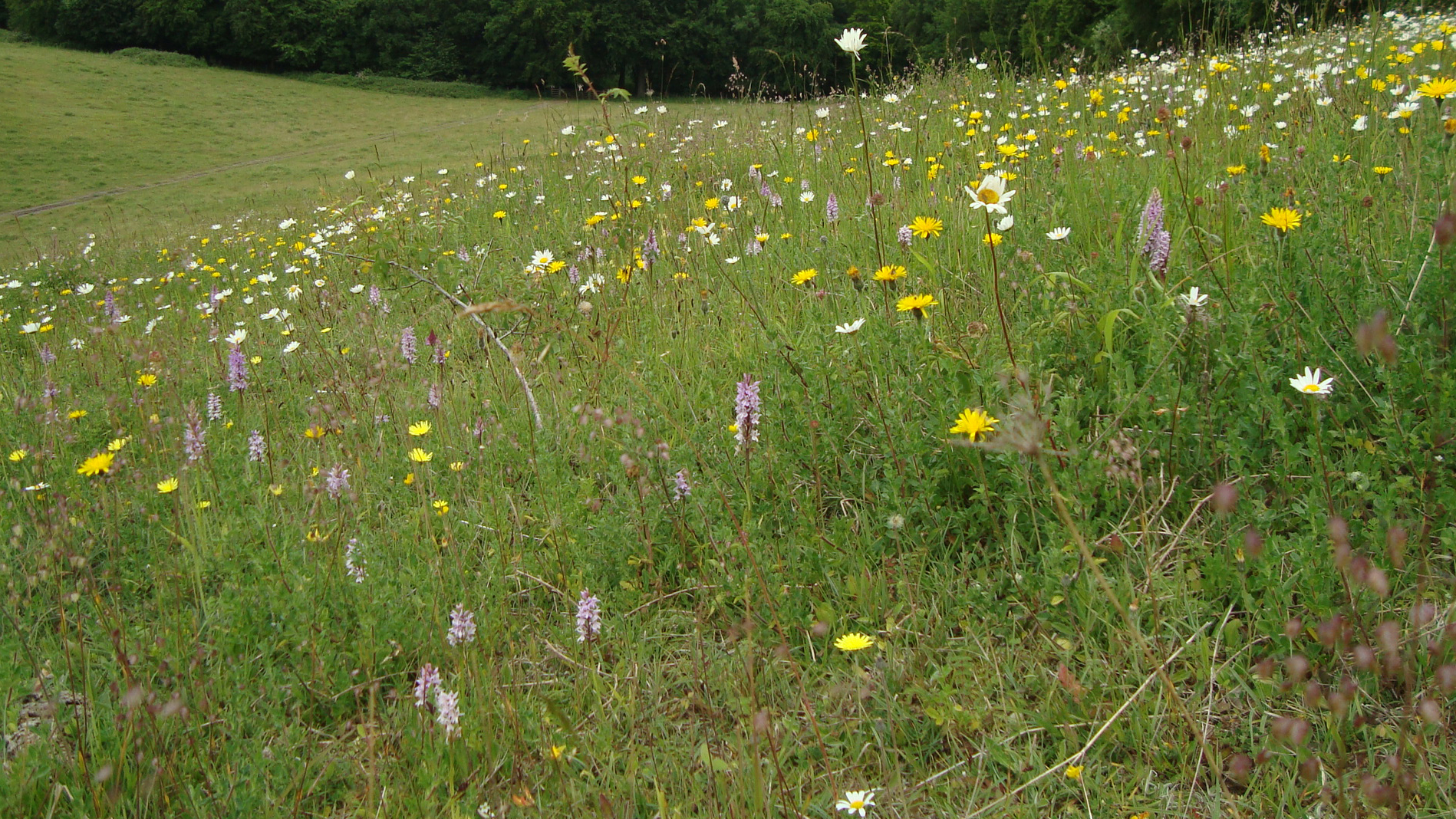
Calcareous grasslands develop on shallow, lime-rich soils and are among Britain’s most floristically rich habitats. Their plant communities are shaped by centuries of low-intensity grazing on thin, drought-prone soils with minimal organic accumulation, which prevents competitive grass species from dominating and allows a diverse assemblage of flowering plants, orchids and invertebrates to establish. In Suffolk, calcareous grassland occurs primarily on the chalk ridge of the county’s west and northwest, typically on ancient earthworks, trackway margins and valley slopes. The Breckland form of calcareous grassland – which develops on flatter, sandier ground and has a distinctive semi-continental character – is covered on the Breckland Grasslands page.
Defining features
- Develop on shallow, lime-rich soils derived from chalk or limestone, typically on south- or west-facing slopes, ancient earthworks, dry valley sides and long-established trackway margins.
- Characterised by a short, open sward with high plant species diversity, including flowering plants unable to persist in more fertile or rank grassland.
- Managed as part of pastoral or mixed farming, with some areas cut for hay. Rabbit grazing helps maintain short turf on some sites.
- A mosaic of short turf, bare ground, longer grass and limited scrub represents the most ecologically valuable structural condition.
- For neutral grassland habitats on soils of intermediate pH, see the Meadow and Pasture page.
Importance for wildlife
Calcareous grassland can be the most species-rich of all UK grassland types, particularly where grazing maintains a varied, open sward that prevents competitive grasses from dominating. The floral diversity is exceptional: typical species include Marjoram, Salad Burnet, Fairy Flax, Greater Knapweed and a range of orchid species, including the Bee Orchid. This plant diversity underpins a rich invertebrate community – burnet moths, grasshoppers and a wide range of butterflies are characteristic of well-managed calcareous grassland in spring and summer, and the habitat supports some of the most demanding invertebrate specialists in the British fauna.
The antiquity of a site is often as important as its current management: ancient earthworks, long-undisturbed trackway margins and unimproved pastures that have never been ploughed retain seed banks, mycorrhizal networks and populations of slow-dispersing invertebrates that cannot be recreated in restored or newly created grassland within any useful timescale. Suffolk’s most significant non-Breckland calcareous grassland is concentrated along the chalk ridge of west Suffolk, where ancient boundary features, barrows and trackway margins provide refugia for species that have been lost from the wider farmed landscape.
Important associated species
Species marked * are Suffolk Priority species. Species marked ** are Priority – Research Only: common and widespread, but rapidly declining.
Species primarily associated with the Breckland form of calcareous grassland are listed on the Brecks Grass-Heath page.
- Ants, Bees and Wasps
- Ferns and Flowering Plants
Man Orchid, Frog Orchid, Purple Milk-Vetch, Fine-leaved Sandwort, Annual Knawel
- Moths
Forester, Narrow-bordered Bee Hawk-moth, Large Nutmeg **, Deep-brown Dart **, Dark Brocade **, Broom-tip **, Latticed Heath **, White-line Dart **, Small Emerald **, Rosy Rustic **, Dot Moth **, Broom Moth **, Rosy Minor **, Shoulder-striped Wainscot **, Dark Spinach **, Mullein Wave **, Shaded Broad-bar **, Buff Ermine **, Hedge Rustic **, Feathered Gothic **, Blood-vein **, Cinnabar **, Oak Hook-tip (oak trees) **, Dark-barred Twin-Spot Carpet **
Factors affecting this habitat in Suffolk
- Fragmentation of remaining grassland into small, isolated patches increases the risk of local species extinction and reduces the capacity for recolonisation following adverse events.
- Agricultural intensification, including the application of fertilisers, herbicides and other pesticides, re-seeding with improved grass varieties or conversion to arable cultivation.
- Under-grazing, leading to dominance by coarse grasses and progressive invasion by scrub and woodland, ultimately results in the loss of open grassland character entirely.
- Over-grazing, causing localised sward damage from trampling, soil compaction and long-term nutrient enrichment from livestock dung and urine.
- Recreational pressure, particularly trampling and soil compaction on sites with public access, can damage specialist turf communities.
- Spread of invasive non-native plants, which can smother specialist calcareous grassland communities if not controlled.
Habitat management advice
- Maintain a mosaic of sub-habitats across the site, including areas of very short turf, bare ground, longer grass and a limited amount of scrub. Tussocky vegetation is essential for overwintering invertebrates and should be retained in patches even where the dominant management aim is short turf. Sward height is a critical variable for many chalkland butterflies and other specialists; management should be tailored to the needs of the species present.
- Allow plants to flower before cutting or grazing removes the sward. Many species – insects in particular – depend on pollen and nectar from flowering grassland plants and will not thrive in grassland that is cropped too closely throughout the growing season.
- Achieve an open, varied sward through a combination of livestock and rabbit grazing. Use a managed rotation over at least three years so that plants can flower, set seed and establish seedlings. Where cutting is used, delay it until after July to allow seed set, and remove cuttings from the site to avoid enriching the soil.
- Never apply artificial fertilisers. Even modest nutrient inputs will shift the plant community towards competitive grass species, shade out specialist low-growing flora and rapidly and often irreversibly reduce plant diversity.
- Maintain or create bare ground patches within the grassland. These are used by specialist solitary bees and wasps, ground beetles and a range of other invertebrates, and are essential for the germination of annual and short-lived calcareous grassland plants. Small-scale disturbance, such as harrowing or light scarification, can be effective on appropriate sites.
- Control scrub encroachment through targeted cutting or pulling, retaining a limited amount of scrub at the margins for shelter, nesting habitat and nectar sources. Monitor annually and remove regrowth promptly, as scrub establishes quickly on ungrazed calcareous grassland.
Ancient earthworks as grassland refugia
Some of Suffolk’s most significant fragments of calcareous grassland survive on ancient earthworks – field boundaries, barrows, drove roads and defensive banks – where the combination of raised ground, thin chalk soils and centuries of freedom from cultivation has allowed specialist communities to persist long after the surrounding farmland was improved or ploughed. These linear and isolated features can support remarkable plant diversity, including orchids, rare sedges and specialist invertebrate assemblages, in sites of less than a hectare. Their management is often complex, as they may be under multiple owners or lack a history of formal conservation management, yet their ecological importance is disproportionate to their size.
Vision for Suffolk
The following priorities reflect the strategic goals for calcareous grasslands in Suffolk, drawing on both the Biodiversity Action Plan framework and the Local Nature Recovery Strategy.
- Improve knowledge of the extent and condition of calcareous grasslands across the county, including unrecorded fragments on ancient earthworks, roadside verges and field margins.
- Maintain the existing extent of calcareous grasslands to ensure no net loss.
- Re-create calcareous grassland where opportunities arise, particularly on former arable land on chalk soils adjacent to existing sites.
- Encourage the restoration and improvement of degraded calcareous grasslands, prioritising sites where traditional grazing can be reintroduced and scrub encroachment reversed.
Further information
- Buglife – Advice on managing BAP habitats
- Grazing Animals Project – Conservation grazing resources
- JNCC – Habitat description: Calcareous Grassland (PDF)
- MAGIC – Interactive mapping including designations
- Natural England – Lowland Grassland Management Handbook, Chapter 5: Grazing (PDF, historical reference)
- Suffolk Wildlife Trust – Habitats Explorer: Grassland
- Making Space for Nature – Lawton Review, Defra, 2010 (PDF, historical reference)
- The Natural Choice: Securing the Value of Nature – Natural Environment White Paper, 2011 (PDF, historical reference)
Suffolk’s Grass and Heath Habitats
Key
A conservation priority in Suffolk’s Historic Biodiversity Action Plan.
A key habitat for recovery under Suffolk’s Local Nature Recovery Strategy.


Calcareous grasslands are primarily a part of the Grass and Heath habitat group, but also feature in these habitat groups: Meadow and Pasture and Scrub and Mosaic.
Image: Chalk grassland © Natural England/Des Sussex
 Archived Habitat Factsheet (PDF, 2020) Superseded – provided for reference only.
 Archived Suffolk BAP action plan (PDF, 2007) Superseded – provided for reference only.