
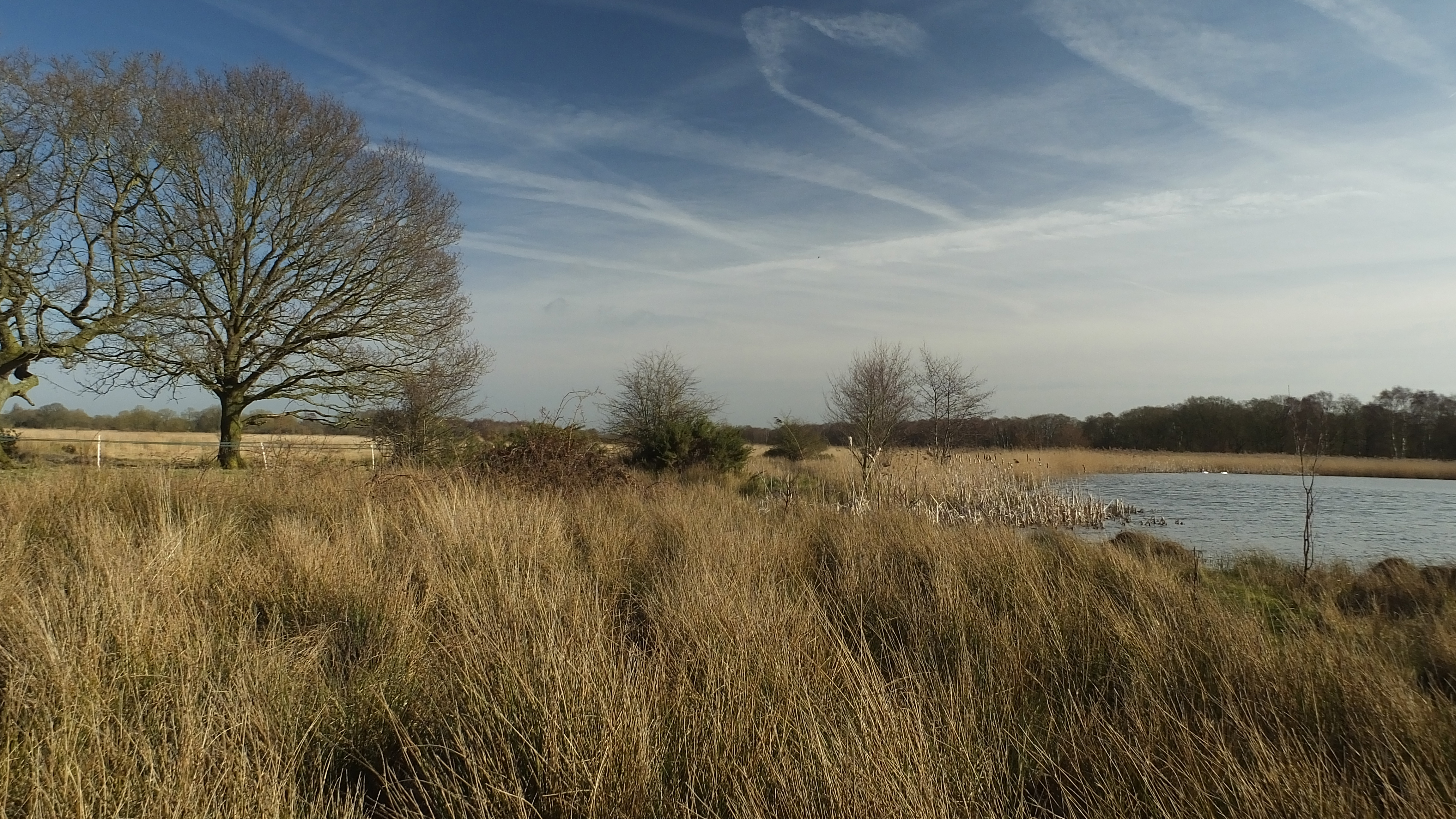
Fen
Fens are permanently or seasonally waterlogged habitats fed by nutrient-rich groundwater or surface water, dominated by reeds, rushes, sedges and a diverse community of wetland plants. Among the richest of all lowland habitats, they contain roughly one third of all native British plant species, thousands of invertebrate species and more than half of the UK’s dragonfly species. Suffolk’s fens are concentrated in the river valleys of the Waveney, Little Ouse and Blyth and along the coast, where they grade into reedbed, wet woodland and open water to form wetland complexes of national importance. The Fen Raft Spider – one of Britain’s rarest invertebrates – depends on high-quality fen habitat and is known from only a handful of sites in the UK, most of them in Suffolk and Sussex.
Defining features
- Waterlogged areas fed by mineral-rich groundwater or surface run-off, typically with a pH above 5.5 – distinguishing them from the more acidic bog habitats of upland or more isolated lowland areas.
- Dominated by reeds, rushes and sedges, with a complex mosaic of plant communities influenced by water depth, water chemistry, management history and successional stage.
- Typically include a range of structural elements: open pools, wet hollows, mown fen, tussocky areas with deep litter accumulation and transitions to swamp, reedbed and wet woodland – all of which contribute to overall biodiversity.
- Open water features, including pools, ditches and dykes, support specialist aquatic communities, including stoneworts, bladderworts and a rich invertebrate fauna.
Importance for wildlife
Fens support ecological communities of exceptional richness. The combination of standing and flowing water, fluctuating water levels, wet peat and mineral substrates, dense emergent vegetation and open water creates structural complexity matched by very few other habitats. Open pools within fens can support stonewort communities – charophyte algae requiring clean, mineral-rich water – and insectivorous bladderworts (Utricularia spp.) whose branching roots carry bladder-like traps for small invertebrates. The diversity of microhabitats within a well-managed fen – from deep litter and tussock bases to bare peat margins, choked ditches and open shallow water – is what sustains the remarkable invertebrate richness of this habitat type, including many aquatic beetles, specialist flies and nationally rare molluscs.
The Fen Raft Spider (Dolomedes plantarius), one of Britain’s largest and rarest spiders, is a flagship species for high-quality fen. It hunts at the water surface, detecting prey through vibrations, and requires the specific combination of open water, emergent aquatic vegetation and humid marginal conditions that only well-structured, unpolluted fen provides. Drier fen margins support Water Vole, Water Shrew and Harvest Mouse, while bats – including Daubenton’s Bat foraging low over open water – make extensive use of fen habitats for foraging throughout the season.
Important associated species
Species marked * are Suffolk Priority species. Species marked ** are Priority – Research Only: common and widespread, but rapidly declining.
- Ants, Bees and Wasps
- Beetles
Scarce Four-dot Pin-palp, Pashford Pot Beetle, Zircon Reed Beetle
- Birds
- Dragonflies and Damselflies
- Ferns and Flowering Plants
Flat Sedge, Early Marsh Orchid (cream), Tubular Water-Dropwort, Greater Water-Parsnip, Marsh Stitchwort
- Flies
Broads Long-legged Fly, Clubbed Big-headed Fly, Black Fungus Gnat
- Fungi and Slime Moulds
Frogbit Smut
- Mammals
Noctule, Daubenton’s Bat *, Nathusius’ Pipistrelle *, Soprano Pipistrelle, Harvest Mouse, Water Vole, Water Shrew *
- Molluscs
Little Whirlpool Ramshorn Snail, Shining Ram’s-horn Snail, Large-mouthed Valve Snail, Desmoulin’s Whorl Snail, Narrow-mouth Whorl Snail
- Moths
Water-dock Case-bearer, Concolorous, Double Dart, Grey Dagger **, Knot Grass **, Brown-spot Pinion **, Ear Moth **, Mouse Moth **, Large Nutmeg **, Dusky Brocade **, Garden Tiger **, Minor Shoulder-knot **, Mottled Rustic **, Haworth's Minor **, Crescent **, Small Square-spot **, Small Phoenix **, Rustic **, Rosy Rustic **, Dot Moth **, Rosy Minor **, Shoulder-striped Wainscot **, Oblique Carpet **, Powdered Quaker **, Shaded Broad-bar **, White Ermine **, Buff Ermine **, Hedge Rustic **, Blood-vein **, Oak Hook-tip (oak trees) **, Sallow **, Dark-barred Twin-Spot Carpet **
- Spiders
Factors affecting this habitat in Suffolk
- Drainage for conversion to intensive agriculture, and the historical lowering of surrounding water tables by drainage works, which has dried out remnant fen habitats and altered their ecological character.
- Excessive water abstraction from aquifers, reducing or eliminating the spring-line flows that feed many fen systems and lowering water tables to the point where peat desiccates and the fen vegetation is replaced by drier grassland species.
- Nutrient enrichment from agricultural run-off, atmospheric nitrogen deposition and other sources, which promotes rank, competitive vegetation and eliminates the diverse low-nutrient plant communities that characterise high-quality fen.
- Afforestation within fen catchments, which can reduce water yield and increase evapotranspiration, effectively drying out the fen.
- Lack of appropriate management, leading to scrub encroachment, loss of structural diversity and succession towards wet woodland – a natural process that, if unchecked, eliminates the open and semi-open conditions on which most fen species depend.
Habitat management advice
- Maintain structural diversity across the site through rotational management that ensures a range of vegetation heights and ages are present simultaneously – from short mown fen and open water to tall reedbed, tussocky sedge and scrub patches. Transition zones between fen and adjacent habitats such as wet woodland, reedbed, bog, saltmarsh and open water should be conserved, as many species depend on these interfaces.
- Maintain water levels at a sufficiently high level to prevent peat desiccation and preserve the waterlogged conditions that define the habitat. Allow seasonal fluctuation where this is part of the site’s natural hydrological regime; artificially stabilised water levels can be less beneficial than managed variation.
- Retain and maintain a network of ditches at different stages of management. Clear ditches on a rotation, never clearing more than a quarter of the network in a single year; some ditches should be allowed to become choked with vegetation, as this provides critical habitat for specialist molluscs and aquatic invertebrates.
- Maintain shallow-profiled water margins and gently sloping ditch sides where possible. Avoid excessive clearance of marginal vegetation, which provides important transitional habitat between open water and drier fen.
- Control scrub encroachment to prevent succession to woodland, but retain scattered bushes and trees – particularly sallows – which provide nectar, pollen and nesting sites for invertebrates. Small stands of scrub within a fen matrix increase overall structural diversity.
- Manage grazing to create a diverse sward where grasses and herbs can flower and set seed. Where a traditional mowing pattern has been in place for many years, maintain it: invertebrate communities will be adapted to this regime, and abrupt changes can be damaging.
- Retain deep litter accumulations in patches, particularly in both sunny and shaded situations, away from areas likely to flood. Deep litter is an important overwintering site for many invertebrates and should not be removed wholesale.
- Where ground beetle populations are a management priority, consider small-scale turf stripping or shallow peat cutting to create bare ground and early successional fen conditions. This targeted disturbance can maintain habitat features that would otherwise be lost to vegetation encroachment.
- Encourage adjacent landowners to create buffer strips and restrict fertiliser application within the water catchment. Nutrient-enriched run-off can degrade water quality and shift fen plant communities rapidly towards nutrient-demanding species.
Site spotlight: Redgrave and Lopham Fen
Redgrave and Lopham Fen, managed by the Suffolk Wildlife Trust in the Waveney valley near the Suffolk-Norfolk border, is the largest valley fen in England and one of the most ecologically significant wetland sites in the country. The fen occupies the watershed between the Waveney and Little Ouse river systems and is fed by spring-line flows from the surrounding chalk. It is one of only four sites in the UK where the Fen Raft Spider survives, and holds exceptional populations of fen invertebrates, plants and dragonflies. A major restoration programme beginning in the 1990s, including the removal of surrounding conifers that were drying out the fen and the reinstatement of water control structures, has reversed much of the mid-twentieth century decline and significantly improved the quality and extent of open fen habitat.
Vision for Suffolk
The following priorities reflect the strategic goals for lowland fen in Suffolk, drawing on both the Biodiversity Action Plan framework and the Local Nature Recovery Strategy.
- Improve knowledge of the extent and condition of lowland fens across the county.
- Maintain the existing extent of lowland fens to ensure no net loss.
- Re-create lowland fen where opportunities arise, particularly in association with river valley restoration and the removal of agricultural drainage from former fen areas.
- Encourage the restoration and improvement of degraded lowland fens, prioritising sites where hydrological restoration is feasible and where scrub encroachment or nutrient enrichment can be reversed.
Further information
- Buglife – Advice on managing fens
- Buglife – Notable invertebrates associated with fens (PDF)
- Fen Management Handbook (PDF)
- JNCC – Habitat description: Lowland Fens (PDF)
- MAGIC – Interactive mapping including designations
- Suffolk Wildlife Trust – Habitats Explorer: Lowland fen
- Making Space for Nature – Lawton Review, Defra, 2010 (PDF, historical reference)
- The Natural Choice: Securing the Value of Nature – Natural Environment White Paper, 2011 (PDF, historical reference)
Suffolk’s Fen Habitats
Key
A conservation priority in Suffolk’s Historic Biodiversity Action Plan.
A key habitat for recovery under Suffolk’s Local Nature Recovery Strategy.

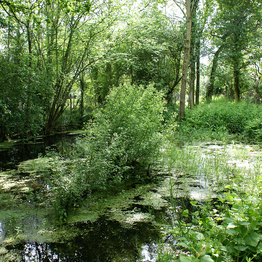
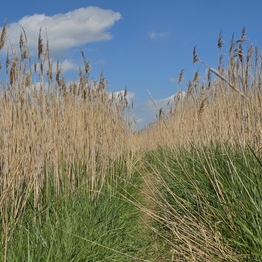


Fens are primarily a part of the Fen habitat group, but also feature in these habitat groups: Meadow and Pasture, Woodland, Reedbed and Wetland and River and Riverside.
Image: Redgrave and Lopham Fens © Paul Holmen
 Archived Habitat Factsheet (PDF, 2020) Superseded – provided for reference only.
 Archived Suffolk BAP action plan (PDF, 2003) Superseded – provided for reference only.