
Vegetated Shingle
Vegetated shingle is one of the rarest and most ecologically distinctive coastal habitats in the world. Approximately one-third of Europe’s vegetated shingle is found in the UK, and Suffolk holds some of the finest examples in England. The Orfordness – Shingle Street system is the largest vegetated shingle structure in Europe, and its beaches, ridges, coastal lagoons and shingle heath support communities of plants, invertebrates and breeding birds of international importance. Shingle communities establish slowly and are easily damaged: the best management for this habitat is usually minimal intervention, allowing the natural forces of wind and wave to maintain the dynamic character on which the specialist flora and fauna depend.
Defining features
- Vegetated shingle occurs at or above spring tide mean high water, on beaches, spits, bars and barrier ridges formed from coarse sediments – pebbles, gravel and coarse sand – shaped by wave action and longshore drift.
- Vegetation zones change with increasing distance from the sea, influenced by shingle stability, distance inland, pebble size, the amount of fine material between the stones, water availability and management history.
- Vegetation ranges from sparse pioneer communities on the most mobile shingle, through lichen-rich turf and patches of low herbs, to Gorse and Bramble scrub or, where grazed, a species-rich calcareous turf.
- Ridges and lows within the shingle structure create local variation in drainage and shelter, producing distinct zones of vegetated and bare shingle in close proximity.
Importance for wildlife
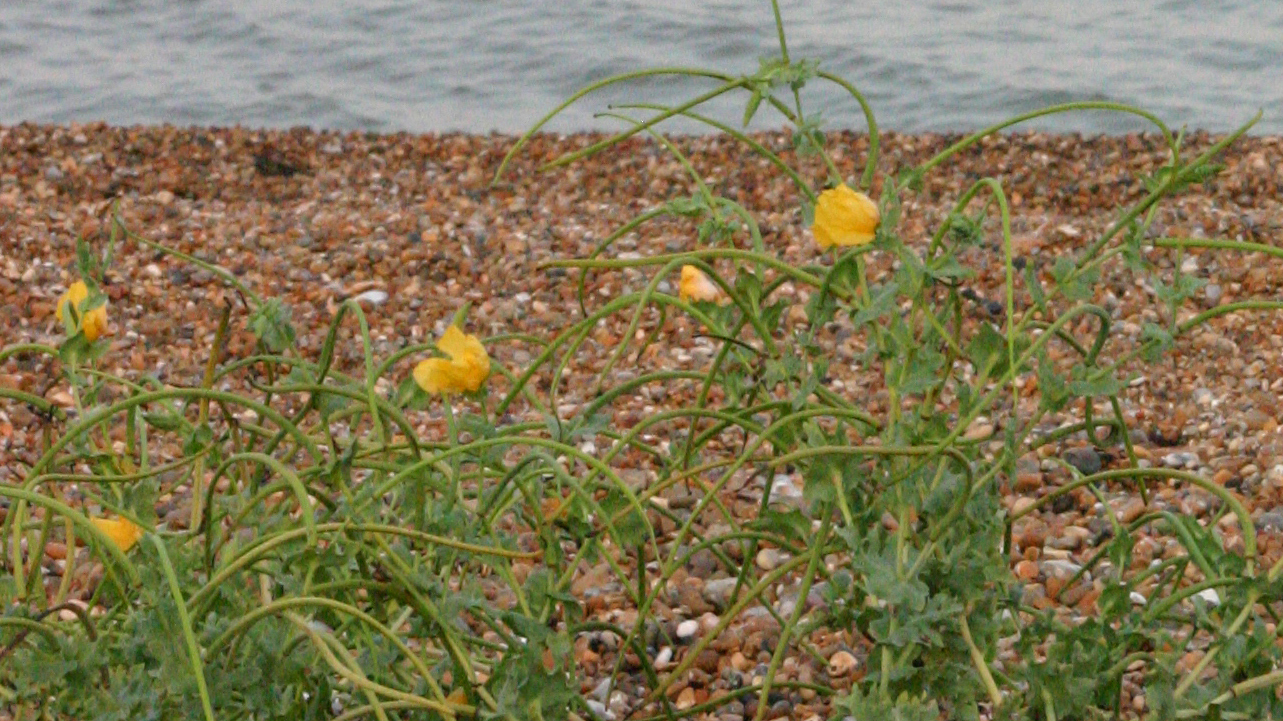
Vegetated shingle beaches support a highly specialised flora of deep-rooted and stress-tolerant plants adapted to the unstable, droughty and nutrient-poor conditions of coastal pebble. Pioneer species, including Sea Pea, Sea Kale, Yellow Horned Poppy and Sea Rocket, colonise bare shingle near the tide line, binding the surface and gradually creating conditions for a wider community. Further from the sea, a thin turf of acidic heath can develop on older, more stable shingle, supporting a range of lichens, mosses, rare clovers and succulents. Rarer species including Rock Samphire, Ray’s Knotgrass and Slender Hare’s-Ear are associated with specific zones of this succession.
The invertebrate communities of vegetated shingle are exceptional. A suite of nationally scarce spiders, beetles, true bugs, centipedes and woodlice exploit the stable, sun-warmed microhabitats between pebbles that have no equivalent elsewhere in the lowland landscape. The Whelk-shell Jumper spider inhabits empty whelk shells cast up by storms; Grey Bush-cricket feeds on herbs, grasses and small invertebrates in the shingle turf; sand hoppers inhabit the strandline beneath tidal debris. Little Tern, one of Britain’s most threatened breeding seabirds, nests in shallow scrapes on shingle beaches, where its camouflaged eggs and chicks are almost invisible against the pebble background.
Important associated species
Species marked * are Suffolk Priority species. Species marked ** are Priority – Research Only: common and widespread, but rapidly declining.
- Ants, Bees and Wasps
- Birds
Herring Gull, Little Tern *, Ringed Plover
- Bugs
- Butterflies
- Ferns and Flowering Plants
Stinking Goosefoot, Red Hemp-Nettle, Prickly Saltwort, Slender Hare's-Ear, English Stonecrop, Wall Pepper (Biting Stonecrop), Sea Pea, Yellow Horned Poppy, Sand Catchfly, Sea Kale, Sea Rocket, Sea Sandwort, Sea Holly, Sea Spurge, Henbane, Sea Campion
- Moths
Rest Harrow, Dusky Brocade **, Mullein Wave **
- Spiders
Notable invertebrates
The following species have been recorded from coastal vegetated shingle in Suffolk and carry national conservation designations. See the designation key below for definitions.
- Spiders and allies (Arachnida)
- Arctosa fulvolineata – RDB3
- Pseudeudeuophrys obsoleta – RDB3
- Haplodrassus minor – RDB3
- Trichoncus affinis – RDB2
- Trichoncus hackmani – RDB2
- Agraecina striata – Nb
- Argiope bruennichi – Na
- Sitticus inexpectus – Na
- Zelotes petrensis – Na
- Centipedes (Chilopoda)
- Lithobius lapidicola – RDBK
- Pachymerium ferrugineum – Nb
- Millipedes (Diplopoda)
- Thalassisobates littoralis – Nb
- Woodlice (Isopoda)
- Miktoniscus patiencei – Nb
- Trichoniscoides saeroeensis – Nb
- Stenophiloscia zosterae – Nb
- Grasshoppers and crickets (Orthoptera)
- Platycleis albopunctata – Nb
- Ectobius panzeri – Nb
- True Bugs (Hemiptera)
Heteroptera
- Corizus hyoscyami – Local
Leafhoppers and allies (Auchenorrhyncha)
- Trigonocranus emmeae – Nb
- Beetles (Coleoptera)
Ground beetles (Adephaga)
- Cymindis axillaris – Na
Leaf beetles (Chrysomelidae)
- Longitarsus ganglbaueri – Notable A
Weevils (Curculionoidea)
- Ethelcus verrucatus – RDB3
- Lixus scabricollis – RDBK
Rove beetles (Staphylinidae)
- Medon brunneus – Local
- Ants, bees and wasps (Hymenoptera: Aculeata)
- Bombus humilis – BAP Priority
- Hylaeus spilotus – RDB3
Designation key
- RDB2 – Red Data Book Category 2: Vulnerable
Not currently endangered but facing a high risk of extinction in the medium term. Typically occur in 15 or fewer 10km squares, or are more widespread but dependent on especially vulnerable habitat.
- RDB3 – Red Data Book Category 3: Rare
Occur in small populations and are at risk, though not currently endangered or vulnerable. Typically occur in 15 or fewer 10km squares, or are more widespread but dependent on especially vulnerable habitat.
- RDBK – Red Data Book: status unknown
Listed in the Red Data Book but with unknown status; thought to be rare.
- Na – Nationally Scarce Category A
Uncommon in Great Britain; thought to occur in 30 or fewer 10km squares (typically 16–30), or in seven or fewer vice-counties for less well-recorded groups.
- Nb – Nationally Scarce Category B
Uncommon in Great Britain; thought to occur in between 31 and 100 10km squares, or between eight and 20 vice-counties for less well-recorded groups.
- Local
Found in restricted habitats.
- Notable A
Uncommon in Great Britain; thought to occur in 30 or fewer 10km squares. Equivalent to Nationally Scarce Category A.
- BAP Priority Species
Listed under Section 41 of the Natural Environment and Rural Communities Act 2006 as priorities for conservation action.
Factors affecting this habitat in Suffolk
- Reduced sediment supply, where coastal defence structures intercept the longshore drift of shingle, preventing natural replenishment of beaches and bars. Offshore aggregate extraction and artificial redistribution of beach material can also disrupt the sediment budget that sustains shingle structures.
- The dynamic and inherently unstable nature of shingle, which is continuously transported and sorted by wave action. This natural mobility is ecologically important, but means that shingle features are rarely stable in the long term and can change substantially following storm events.
- Development adjacent to shingle habitats, which can alter tidal patterns and sediment dynamics, increase pressure for coastal protection works and lead to direct habitat loss.
- Water quality and pollution, particularly oil pollution, which is especially damaging on shingle beaches where it penetrates between pebbles and is extremely difficult to remove without destroying the associated communities.
- Recreational pressure: shingle beaches are fragile and easily damaged by trampling, which destroys slowly establishing plant communities and collapses the invertebrate microhabitats between pebbles. Vehicle access to beaches and dog fouling in nesting areas compound these impacts. Disturbance to ground-nesting birds including Little Tern and Ringed Plover during the breeding season is a significant threat.
- Over-grazing at the few sites where livestock management occurs, which can damage the slow-establishing vegetation and compact the surface between pebbles.
Habitat management advice
- The primary management principle for coastal vegetated shingle is minimal intervention. Shingle communities form over decades and are easily disturbed; when natural processes of wind and wave are allowed to operate freely, they will maintain the range of successional stages that the habitat’s specialist communities require.
- Maintain habitat diversity by ensuring that all successional stages – from bare mobile shingle through pioneer vegetation and stable turf to scrub – are present and that any seepage areas or hollows are retained undisturbed.
- Protect the site from human disturbance through boardwalks, fencing and access management where necessary, concentrating footfall on defined routes away from the most sensitive areas. Manage dog access in Little Tern and Ringed Plover nesting areas throughout the breeding season (April–August).
- Manage adjacent flower-rich grassland through cutting and light grazing to benefit bees and other invertebrates. Ensure that some plants can flower and set seed each year; tussocky vegetation at the grassland margin provides shelter for invertebrates moving between habitats.
- Retain some scrub of Broom, Blackthorn, Bramble and Willow at the landward margin; these support invertebrate populations and provide shelter and nectar, but prevent scrub from encroaching onto open shingle.
- Retain tidal debris – seaweed, driftwood and other organic strandline material – on the beach; this provides important habitat for invertebrates and should not be removed for beach cleaning purposes.
- Ensure that coastal management and planning decisions maintain natural tidal patterns. Any construction that alters tidal behaviour can degrade shingle structures and disrupt the hydrological conditions on which the vegetation communities depend.
Site spotlight: Orford Ness
Orford Ness is the largest vegetated shingle spit in Europe, extending approximately 15km south from Aldeburgh along the Suffolk coast. Managed by the National Trust as a National Nature Reserve, it supports an outstanding assemblage of shingle habitats: open mobile shingle, pioneer shingle vegetation, lichen-rich fixed shingle heath, coastal lagoons and brackish grassland. The site is a Special Area of Conservation designated for its shingle and lagoon communities, and an SSSI of outstanding geological and ecological importance. Its remoteness and restricted access have allowed shingle vegetation to develop undisturbed over a long period, producing some of the finest examples of late successional shingle heath in Britain – including extensive stands of lichen communities rarely seen elsewhere on the east coast.
Vision for Suffolk
The following priorities reflect the strategic goals for coastal vegetated shingle in Suffolk, drawing on both the Biodiversity Action Plan framework and the Local Nature Recovery Strategy.
- Improve knowledge of the extent and condition of coastal vegetated shingle across the county.
- Maintain the existing extent of coastal vegetated shingle to ensure no net loss, accepting that natural processes of erosion and accretion are part of the habitat’s character.
- Encourage the restoration and improvement of degraded coastal vegetated shingle, particularly through reduced recreational pressure and the removal of invasive vegetation.
- Re-create coastal vegetated shingle where opportunities arise, recognising that recovery of the specialist communities is a very long-term process requiring realistic expectations.
Further information
- Buglife – Advice on managing coastal vegetated shingle
- Buglife – Notable invertebrates associated with coastal vegetated shingle (PDF)
- JNCC – Common Standards Monitoring Guidance for Vegetated Coastal Shingle (PDF)
- JNCC – Habitat description: Coastal Vegetated Shingle (PDF)
- MAGIC – Interactive mapping including designations
- National Trust – Orford Ness National Nature Reserve
- Sanford, M. and Fisk, R. (2010) A Flora of Suffolk. D.K. and M.N. Sanford
- Making Space for Nature – Lawton Review, Defra, 2010 (PDF, historical reference)
- The Natural Choice: Securing the Value of Nature – Natural Environment White Paper, 2011 (PDF, historical reference)
Suffolk’s Shingle and Dune Habitats
Key
A conservation priority in Suffolk’s Historic Biodiversity Action Plan.
A key habitat for recovery under Suffolk’s Local Nature Recovery Strategy.


Vegetated shingle is primarily a part of the Shingle and Dune habitat group, but also features in these habitat groups: Coastal and Marine.
Image: Yellow Horned Poppy, Shingle Street © Emma Aldous
 Archived Habitat Factsheet (PDF, 2020) Superseded – provided for reference only.
 Archived Suffolk BAP action plan (PDF, 2003) Superseded – provided for reference only.