
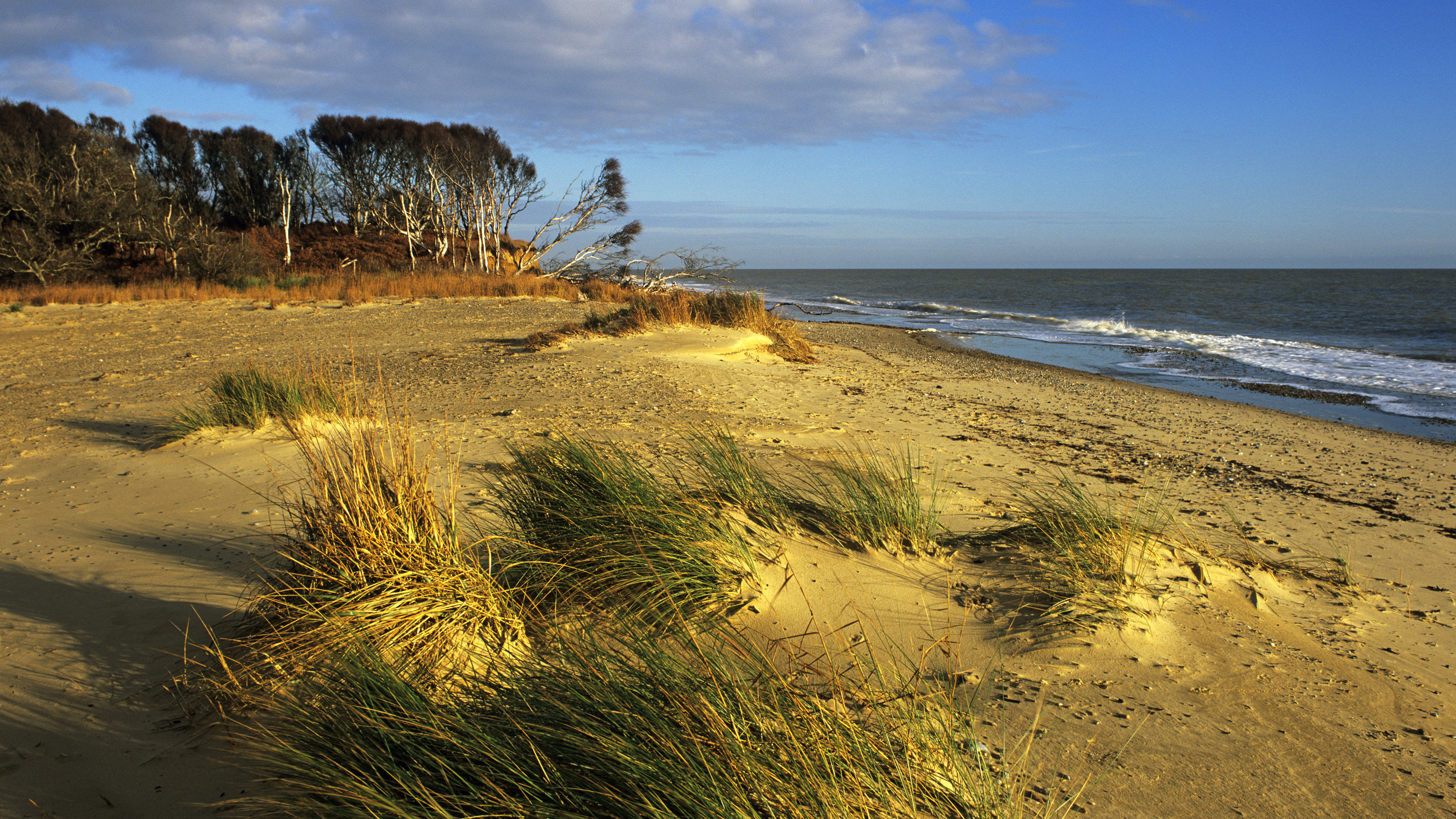
Sand Dunes
Sand dunes are dynamic landforms built from sand blown inland and deposited above the high water mark, forming ridges and hills parallel to the beach that become taller, more stable and more complex in vegetation the further they extend from the sea. Suffolk’s sand dune systems are small in extent compared with those on the north and west coasts of Britain, but the county’s examples at Bawdsey, Dunwich and Minsmere nonetheless support specialist invertebrate, plant and reptile communities of real conservation interest. Their ecological value depends on the continuation of the natural processes of erosion and deposition that create and renew the range of dune habitats; stabilisation – whether by artificial means or by the cessation of the natural processes that keep dunes mobile – progressively reduces this diversity.
Defining features
- Hills or ridges of wind-blown sand deposited above the high water mark, forming dynamic coastal landforms that evolve continuously in response to wind, wave and sediment supply.
- Vegetation zones change with distance from the sea, influenced by dune age, stability and local hydrological conditions: from embryo dunes and mobile fore-dunes with sparse pioneer vegetation, through fixed dunes with varied grassland, to dune heath, dune slack and scrub further inland.
- Calcareous fixed dunes – where shell-derived calcium carbonate buffers the naturally acidic sand – support a diverse range of flowering plants, including legumes. Acidic dune systems, where calcium has been leached, are dominated by Heather and allied species. Dune slacks – wet depressions between dune ridges – support Creeping Willow, mosses and specialist wetland communities.
- Dune systems can shrink or change character due to storms, rising sea levels, reduced sediment supply or over-stabilisation.
Importance for wildlife
The ecological value of sand dunes rests on the diversity of habitats they contain within a small area: mobile sand, pioneer grassland, stable fixed dune, flower-rich calcareous turf, acidic dune heath and seasonally flooded slacks can all occur within a single dune system, each supporting distinct communities of specialist species. The warm, freely draining bare sand of mobile dunes and fore-dune slopes provides nesting sites for solitary bees and wasps that burrow into stable sandy ground; the sparse vegetation between Marram Grass and Sand Couch supports leafhoppers, planthoppers and ground beetles found in few other coastal habitats. Tussocky Marram provides shelter for invertebrates and small mammals, and the flower-rich calcareous dune turf is an important foraging habitat for pollinators.
Dune slacks are the most ecologically distinctive element of many dune systems, their seasonal water levels and specialised plant communities – including Creeping Willow, mosses and rare sedges – supporting invertebrates found almost nowhere else in the lowland landscape. The Natterjack Toad, Britain’s rarest amphibian, breeds in shallow, warm, sparsely vegetated pools, including dune slack habitats. The Antlion, whose larvae excavate pit traps in fine, dry sand, is present on a small number of Suffolk coastal sites where the combination of loose substrate and shelter from wind creates the specific microhabitat the species requires.
Important associated species
Species marked * are Suffolk Priority species.
- Ants, Bees and Wasps
Brown-banded Carder Bee, Large Garden Bumblebee, Sea-aster Colletes Bee, Weevil Hunting Wasp, Five-banded Tailed Digger Wasp
- Ferns and Flowering Plants
Prickly Saltwort, Field Scabious, Viper’s Bugloss, Campylium polyganum
- Moths
- Other Invertebrates
Antlion *
- Reptiles and Amphibians
- Spiders
Silky Gallows-spider, Heath Grasper, Sand Running Spider
Factors affecting this habitat in Suffolk
- Sea level rise, compounded by the ongoing isostatic tilt of south-east England. As the land mass that was depressed by ice sheet weight during the last glaciation continues to adjust, this region is gradually sinking relative to sea level – a process that accelerates the effective rate of coastal inundation and reduces the opportunity for dune systems to maintain or rebuild their extent.
- Reduced sediment supply, where coastal management structures up-drift intercept the longshore drift of sand that would otherwise feed dune systems, leading to dune erosion that cannot be naturally replenished.
- Excessive trampling and recreational pressure. Sand dunes are usually accessible to the public, and their loose substrates are vulnerable to erosion along informal paths; trampling also destroys the ground-nesting burrows of solitary bees and wasps and disturbs nesting birds.
- Over-stabilisation, whether through artificial measures such as fencing and planting, or simply through the cessation of natural erosion. Stabilisation removes the mobile dune habitats that the most specialist species require and drives succession towards uniform fixed grassland or scrub.
- Sea defence structures that change sediment deposition patterns, alter the dynamic behaviour of the dune system and may prevent the natural landward migration of dunes in response to sea level rise.
Habitat management advice
- Maintain the full range of successional stages across the site: mobile fore-dunes, more established dunes with varied pioneer vegetation, stable dune grassland or heath, and wet dune slacks. The ecological value of a dune system is proportional to the diversity of stages present simultaneously.
- Avoid over-stabilisation. Some degree of mobility is essential to the habitat’s ecological function; management should aim to maintain rather than suppress the natural processes of sand movement and dune formation.
- Retain areas of undisturbed, sparsely vegetated sand for ground-nesting insects. These warm, open microhabitats are critical for solitary bees, wasps and the Antlion, and are rapidly lost if vegetation is allowed to close over them.
- Maintain flower-rich areas, particularly on calcareous fixed dunes where legumes and other flowering plants provide high-quality foraging for bees, butterflies and hoverflies. Legumes are especially important as nectar and pollen sources for specialist dune bees.
- Maintain transition zones between the dune system and adjacent habitats – saltmarsh, fen and scrub – as the mosaic supports a wider range of species than any single habitat type. Retain scrub and woodland at the landward margin for shelter and nectar, but prevent it encroaching onto open dune.
- Maintain dune slacks and their natural water level fluctuation. Do not drain or stabilise slack vegetation; the seasonal inundation cycle is essential to the ecology of these habitats.
- Retain natural water features – streams, seepages and pools – within and adjacent to the dune system.
- Retain biodegradable tidal debris, including seaweed and driftwood, on the strandline; this provides important foraging and sheltering habitat for invertebrates.
- Manage visitor access through boardwalks, fencing and waymarking to concentrate pedestrian traffic on defined routes, protecting the most sensitive areas of bare sand and fore-dune from trampling. Manage dog access in areas sensitive to disturbance and fouling.
Dune slacks and the Natterjack Toad
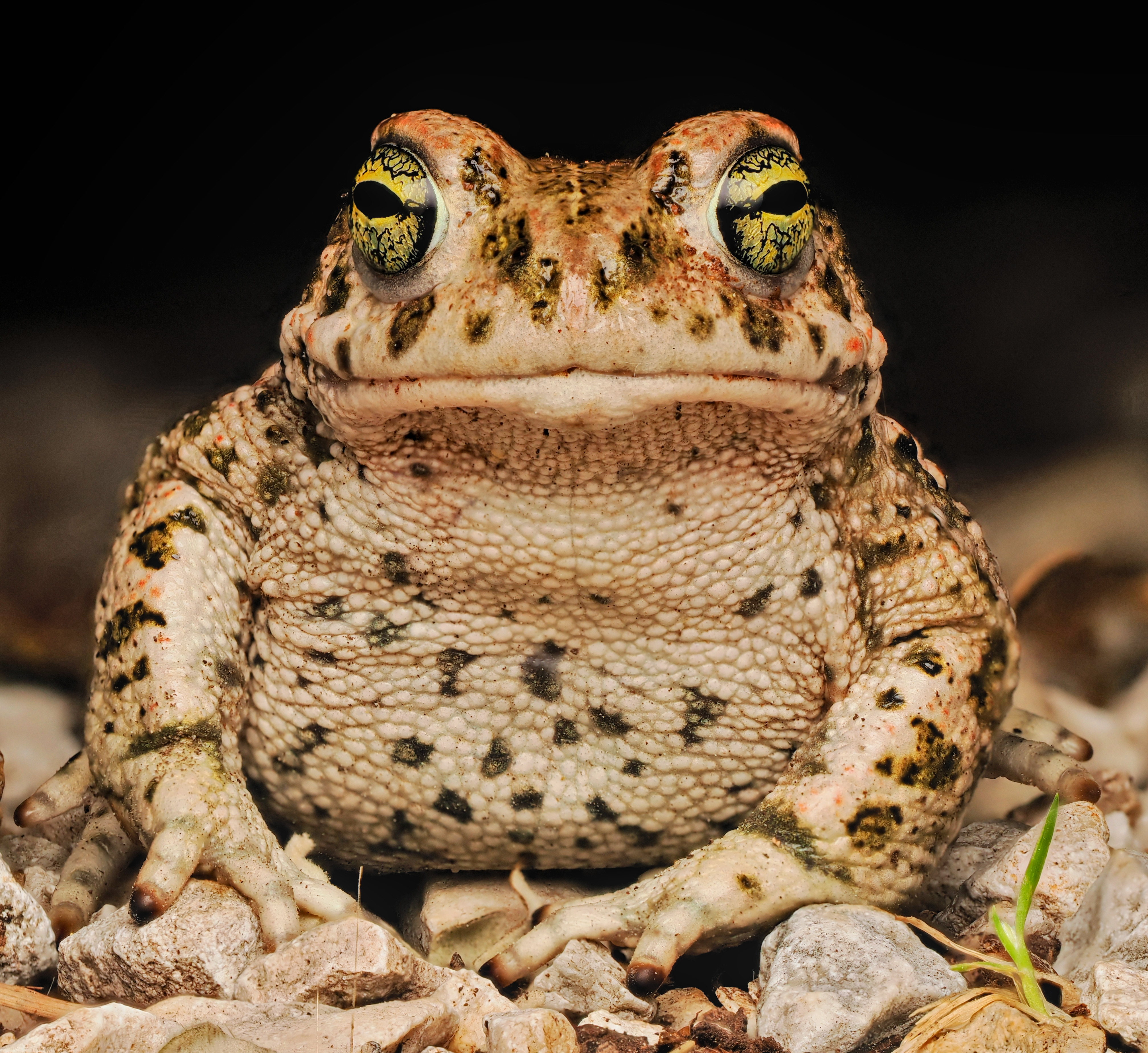 The Natterjack Toad is Britain’s rarest amphibian and depends on a very specific set of conditions for breeding: shallow, warm, sparsely vegetated pools that warm up quickly in spring and are largely free of the aquatic vegetation and predatory invertebrates that would be present in older, more established water bodies. Dune slack pools – seasonally flooded depressions between dune ridges with minimal shade and sparse marginal vegetation – provide exactly these conditions. Suffolk holds a small number of Natterjack Toad sites, concentrated on coastal dune and heath systems. Management of these sites to maintain open pool conditions, prevent shading by scrub and sustain the warm, sparsely vegetated surroundings that adults use for foraging is among the most important practical conservation work undertaken on Suffolk’s coastal habitats.
Vision for Suffolk
The following priorities reflect the strategic goals for coastal sand dunes in Suffolk, drawing on both the Biodiversity Action Plan framework and the Local Nature Recovery Strategy.
- Improve knowledge of the extent and condition of coastal sand dunes across the county.
- Maintain the existing extent of coastal sand dunes to ensure no net loss, recognising that managed coastal processes – rather than rigid stabilisation – are the appropriate response to sea level rise.
- Create or restore sand dune habitat where opportunities arise, particularly in association with coastal realignment and the removal of over-stabilising structures.
- Encourage the restoration and improvement of degraded sand dune systems, prioritising the reinstatement of mobile dune habitats and the management of dune slacks.
Further information
- Buglife – Advice on managing coastal sand dunes
- Buglife – Notable invertebrates associated with coastal sand dunes (PDF)
- JNCC – Habitat description: Coastal Sand Dunes (PDF)
- MAGIC – Interactive mapping including designations
- Radley, G.P. (1994) Sand Dunes – Part 1: England. ISBN 1 873701 19 5
- Suffolk Wildlife Trust – Habitats Explorer: Sand dunes
- Making Space for Nature – Lawton Review, Defra, 2010 (PDF, historical reference)
- The Natural Choice: Securing the Value of Nature – Natural Environment White Paper, 2011 (PDF, historical reference)
Suffolk’s Shingle and Dune Habitats
Key
A conservation priority in Suffolk’s Historic Biodiversity Action Plan.
A key habitat for recovery under Suffolk’s Local Nature Recovery Strategy.


Sand dunes are primarily a part of the Shingle and Dune habitat group, but also feature in these habitat groups: Coastal and Marine, Grass and Heath and Scrub and Mosaic.
Images: Sand Dunes at Benacre © Paul Mitchell, Natterjack Toad © Gilles San Martin

 Archived Suffolk BAP action plan (PDF, 2003) Superseded – provided for reference only.