
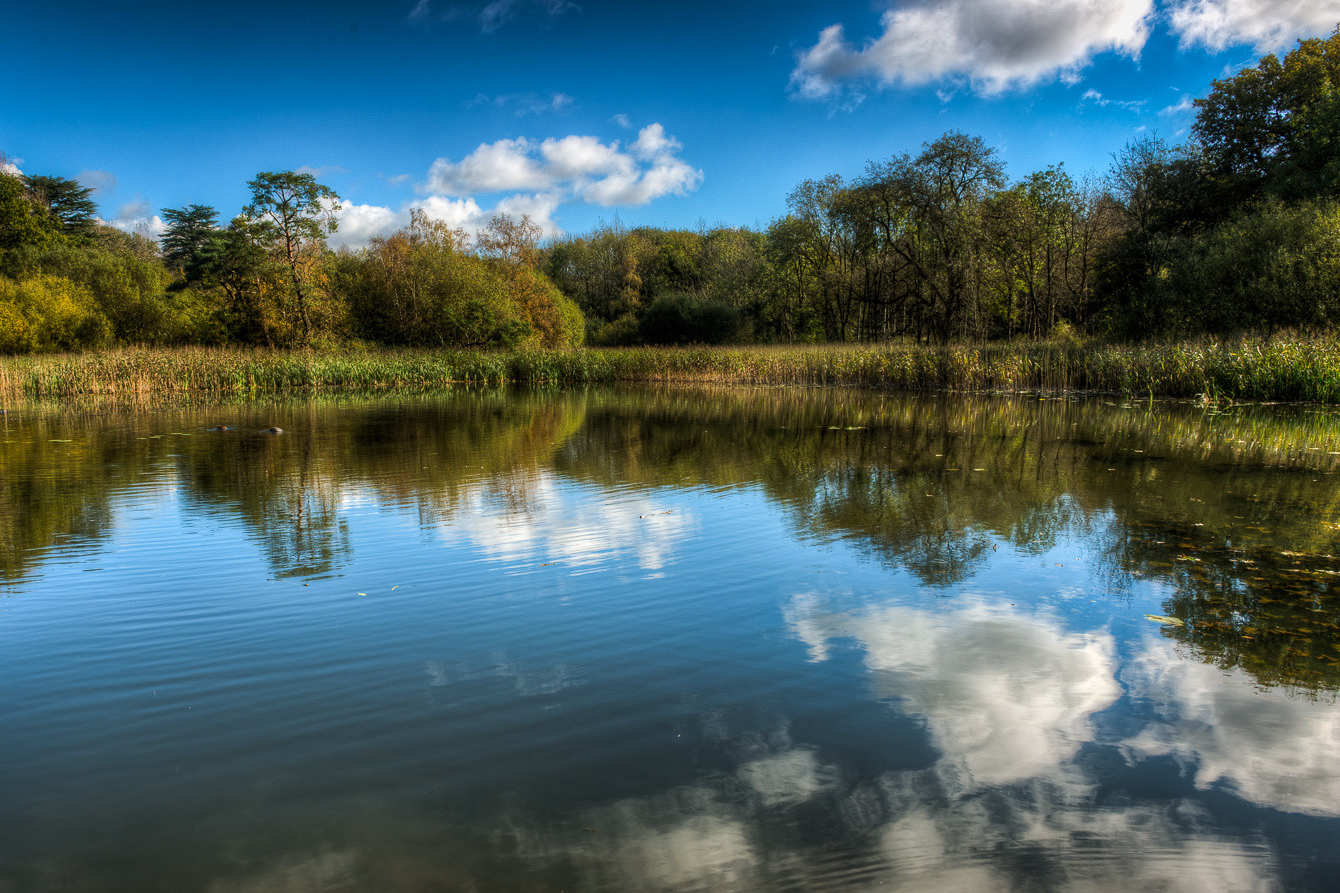
Still Water
Standing freshwater habitats – from the smallest farm pond to gravel pit lakes of many hectares – are among the most species-rich features in the Suffolk landscape, and among the most rapidly lost. The UK is estimated to have lost around 70% of its ponds since 1900, with those that remain often degraded by nutrient enrichment, shading and the spread of invasive non-native species. In Suffolk, however, significant opportunities exist alongside the losses: the extraction of sand and gravel along river valleys has created a legacy of large water bodies that, with appropriate management, can develop into high-quality freshwater habitat.
The character of still water habitats varies enormously with depth, water chemistry, substrate and catchment land use. The pingos – periglacial melt-water ponds – of the Breckland are a nationally rare feature of great ecological significance, their isolation and antiquity having allowed the development of specialist aquatic communities including several plant and invertebrate species of restricted range. Farm ponds, when kept clean, support great crested newt, water vole, dragonflies, and a diversity of aquatic invertebrates that reflect the productivity of standing water in calcium-rich agricultural landscapes. Gravel pit complexes in the river valleys of the Lark and Stour have developed into important sites for wintering wildfowl, breeding tern species and aquatic invertebrates.
The great crested newt (Triturus cristatus) is the assemblage flagship, its population in Suffolk representing one of the more significant concentrations in England. It requires ponds with relatively clear, neutral-to-slightly alkaline water, fish-free or low-fish conditions, and sufficient nearby terrestrial habitat for foraging and hibernation. Its sensitivity to water quality and pond condition makes it a reliable indicator of broader still water habitat health. Suffolk’s great crested newt populations are largely dependent on the pond network within the farmed landscape – a network whose continuity and quality are under pressure from agricultural drainage, infilling and neglect.
Suffolk’s Still Water Habitats
Key
A conservation priority in Suffolk’s Historic Biodiversity Action Plan.
A key habitat for recovery under Suffolk’s Local Nature Recovery Strategy.

Associated habitats
Gravel pits and flooded mineral workings: Flooded mineral extraction sites are among the most important wildlife habitats created by human activity in the lowland landscape, and Suffolk has several notable examples. Their typically clear, nutrient-poor water – combined with varied bankside topography and minimal early management – can rapidly attract colonising plants, invertebrates and waterbirds. Older gravel pit complexes, in particular, can support nationally important populations of great crested newts, wintering diving ducks, and nesting common terns.
Lakes and natural meres: Natural lakes and meres – formed through glacial, solution or other natural processes – represent a small but ecologically significant component of Suffolk’s freshwater resource. Where water quality is good and marginal vegetation well developed, these water bodies can support diverse communities of aquatic plants, invertebrates, amphibians and breeding waterbirds. Their natural origins and the long-term ecological continuity they can represent give them particular conservation importance relative to constructed water bodies.
Reservoirs and other artificial still waters: Constructed water bodies, including reservoirs, ornamental lakes and farm ponds, vary widely in their ecological value depending on age, design, management and water quality. Older, well-vegetated examples can support populations of great crested newts, dragonflies, water voles and a range of aquatic plants, and may function as important stepping stones between natural wetlands. Even relatively species-poor water bodies contribute to the connectivity of the freshwater network and can be enhanced through targeted management.
Image: Pond at Ickworth © Mark Seton