
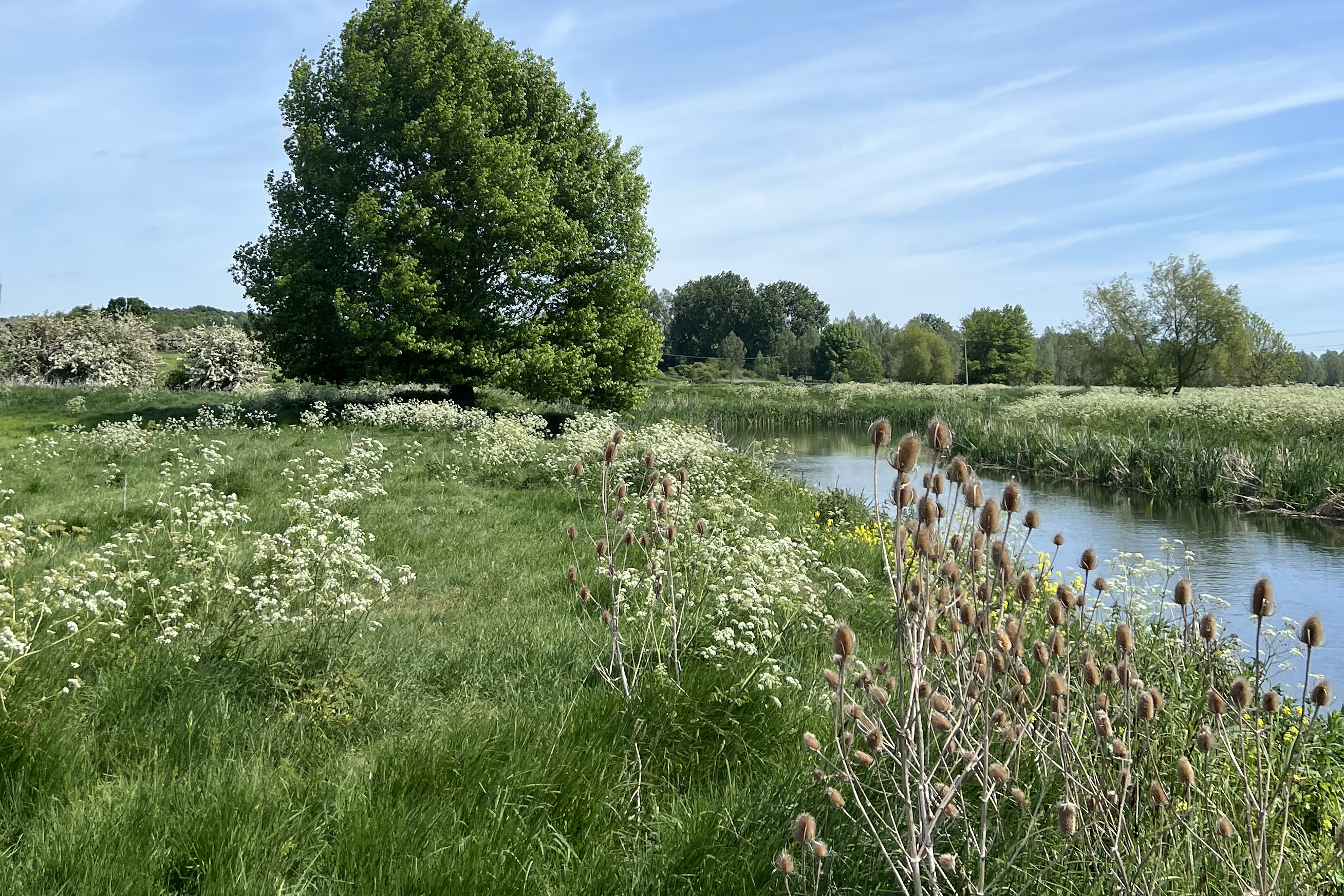
Rivers and Riverside Habitats
Suffolk is drained by a network of rivers whose ecological character reflects the underlying geology of their catchments. The rivers of west and central Suffolk – the Lark, the Linnet and the upper Brett among them – rise on the chalk and oolitic limestone that gives them the clear, cool, calcium-rich and seasonally stable flows that define the chalk stream. Chalk streams are a globally rare habitat type, concentrated almost entirely in southern and eastern England, and those of west Suffolk represent some of the most southerly and easterly examples in the country. Their distinctive ecology — beds of aquatic ranunculus, rapid water exchange through permeable chalk, populations of brown trout and the specialist invertebrate communities associated with clean, stable flows – makes them conservation priorities of national significance.
The rivers of the Suffolk coast – the Blyth, Alde, Ore, Deben, Orwell and Stour – are lower-gradient, estuarine in their lower reaches, and support different but equally important communities. Their floodplains, where not drained for agriculture, hold alluvial meadows, carr woodland, reedbed and grazing marsh that function as an interconnected riverine system. The kingfisher (Alcedo atthis) is the assemblage flagship, its presence indicates rivers with clean water, adequate fish populations, and the earthen banks in which it excavates nest burrows. Other LNRS key species associated with this assemblage include the spined loach, river lamprey, European eel and white-clawed crayfish – all indicators of good water quality and structural habitat diversity.
Suffolk’s rivers face severe and chronic pressures. Abstraction from the chalk aquifer depresses water levels and reduces flow in chalk streams. Diffuse agricultural pollution – nitrates, phosphates and suspended sediment – degrades water quality and simplifies aquatic communities. Invasive non-native species, particularly Himalayan balsam, Japanese knotweed, signal crayfish and mink, alter the structure and food web of river habitats. Very few of Suffolk’s rivers currently meet good ecological status under the Water Framework Directive.
Image: Shalford Meadow © Emma Aldous